
“Are you a wildcatter?” asked the president.
“Yes, I’m a wildcatter, Mr. President,” replied Alex Cranberg.
No doubt many explorers tuned into this conversation on January 9 at the White House. Energy industry executives met with President Donald Trump to discuss opportunities in Venezuela. This included executives from some of the largest operators and service companies in the world. Some of the most deliberate investors with huge impenetrable corporate hierarchies were represented, such as ExxonMobil CEO Darren Woods, who offered this pithy and now infamous quote: “Venezuela today is uninvestable.”
There was also another segment of upstream present with the president: those known for kickstarting exploration and production (“kickstarting” was a term reiterated by Cranberg that day). These wildcatters have track records spanning decades that demonstrate a deft embodiment of risk. The companies they’ve built from the ground up, well-by-successful-well in many cases, and their entire careers, have been examples of once-in-a-generation skillful navigation of risk. Among the greatest explorers of our generation, these wildcatters include Cranberg and William Armstrong, and relative newbies to the global scene like Stanford grad Luis Rodriguez of Raisa.
All of the people in the room with President Trump that day play a key role in capital allocation for exploration and production. The supers’ CEOs are carefully advised by large boards and personally have less skin in the game compared to the private, independent wildcatters. It’s just the supers’ model, and it has worked for more than 100 years. They have been around for a long time because they’re very good at finding and producing molecules – the best of the best. The others – the wildcatters – have honed and developed a very high tolerance to risk because they had to put a lot of their own capital up, and as a result, have reaped asymmetric rewards on successful wells and have become billionaires or, at least, very close to that iconic number. These are the nimble and true wildcatters of our generation. They perceive risk in a personal, nuanced way.
If you want to survive this game as a wildcatter as long as they have, like Cranberg, you can’t afford to get 100-percent-itis.
Why?
The reason is simple.
Cranberg’s quote at the beginning of the article continues: “Nature has an infinite number of reasons and ways to humble you, particularly in the exploration business.”
We won’t cover infinity, but we will discuss the fundamental approach to risk. Avoiding 100-percent-itis involves a sound understanding of risk.
What is ‘Risk’ in Our Business?
As F. J. Peel – one of the smartest people I’ve ever met – explained: geologic risk cannot be changed from how nature designed it.
In his 2015 AAPG Geologic Note, “What to expect when you are expecting: How new information changes our estimate of the chance of success on a prospect,” co-authored with J. R. V. Brooks, he expounded on that principle by noting that a specific outcome, such as “Is there source rock present?”, is known only to nature.
Further, integrating established rules of probability and seminal texts on the process of risking (like that of Rose, 1987; 1992; 2001), gaining new information can worsen percentage of geologic success (abbreviated “Pg”) and you should expect that in a portfolio of prospects, the majority of them will worsen in terms of Pg as new information becomes available. Subsurface risk is different from financial risk, which relates to the range of future investment returns. This is an important distinction that often needs to be better communicated to those who fund the drilling of a well, a subject we cover in introductory finance courses at university.
Risk and uncertainty are often viewed as one and the same to the uninitiated, but are different and largely independent. As cited by Rose (1987, 2001) and Binns and Corbett (2012) included in Peel and Brooks (2015), uncertainty is the “tightness of the range within which an estimated parameter may lie.”
While new information can provide value – and speaking for all of us explorers, I don’t think there’s a single study out there I’ve seen which doesn’t advertise itself as providing value – it doesn’t guarantee a reduction in risk. But new information can decrease uncertainty. So be wary when you see that “risk can be reduced” by many operators and service companies alike. It cannot.
Bright and Shiny Objects
Many of you would agree one of geology’s greatest pastimes is prospect browsing, and the grand slam each year is the AAPG-sponsored North American Petroleum Expo. This February, as always, hungry wildcatters and high-energy prospectors gathered at George R. Brown Convention Center in downtown Houston for NAPE. I hope you attended this year to see old friends, make new ones, observe a lot of deals, and examine prospect maps.
Oh, and by the way, it’s a perfect opportunity to practice what you learned in identifying errors in structural contour maps in “Applied Subsurface Geological Mapping,” by D. J. Tearpock. Some of us ask for 1 or 5-percent to 10-percent working interest stakes in prospects we like in order to deploy capital for another year of drilling. I have yet to see one of my peers ask for 100 percent, since they are my friends and of course well versed in 100 percent-itis.
Every NAPE, we hear how the latest seismic attributes or imaging technology are reducing risk (beware of narrative bias; prospectors tell captivating stories). No, they’re just helping to better quantify that risk and reduce uncertainty – or “tighten the range” according to Peel and Brooks.
K. W. Rudolph explains in the aforementioned “The Explorer’s Mindset”: “Don’t get overly enamored by high-end tools. They have their place, and they’re really important. But you have to tie it back to basic science.”
“As people, we’re always looking for the bright, new shiny object … from azimuthal seismic to sequence stratigraphy … you can’t think to yourself, ‘Ok, I’ve got this covered … this is going to solve world hunger.’”
This is one slick slope that can lead to 100 percent-itis.
Plotting and Calculating Risk
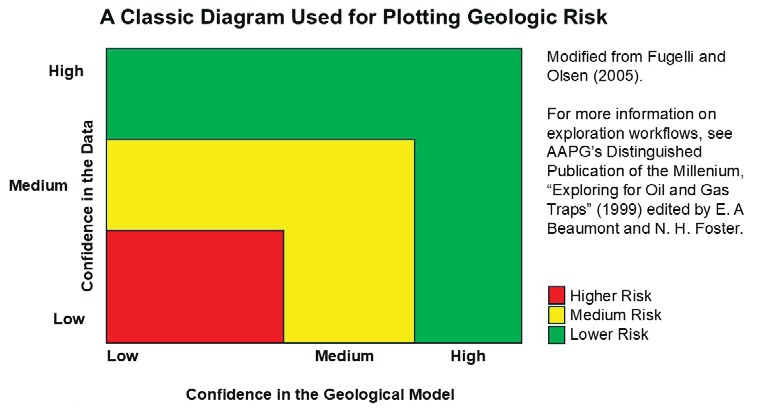
How is geologic risk quantified and represented in graphical form? It is shown on a classic data (“bottom-up”) and geological model (“top-down”) diagram (see figure 1). This organization and workflow is taught at many great exploration companies. This diagram can be used across the scale of exploration, from the smallest order for each of the primary geologic risks, also known as “risk elements”: source rock, charge, trap, seal, reservoir, deliverability – to a cumulative plot for a prospect, then for plays, and even up to basins for ranking in a company portfolio.
It depends on the question being asked, either at the company level (higher order), or for an individual prospect (lower order), and thus, this diagram has utility across multiple scales of exploration.
How is the Pg eventually calculated and plotted on the above diagram? By multiplying the risk elements. At the Case Study Seminar II, “Missed Opportunities and Surprise Successes” held on January 15, one of the panelists said, “There is a small community of highly successful explorers who are not fans of multiplying the individual risk elements to arrive at Pg … for example, applying 0.9 risk for all six elements is 53 percent.”
The solution, as recommended by another speaker at the forum, was, “You’ve got to pick the top one or two risks and really work those.”
You heard it there first. Take it from the best in the business, and go find more oil.
Just for free: when starting from square one, it can be helpful to use the crowd’s approach to understanding risk and uncertainty. I use this with large groups routinely. If you have a couple dozen professionals in the room working on a project, ask them, “What will the permeability be for this reservoir?” or “How long did it take to deposit this turbidite?” or some other technical question that you care about.
Don’t have them blurt out answers. Rather, ask them to write them down, otherwise you might run into anchoring bias. The average of their responses will probably come close to the right answer. Of course you might have some weird outliers. These answers could point you to black swan-type outcomes. Value these, too.
Try this crowd approach with your teams. I think you’ll be surprised by the results – in a good way.
There’s More to Risk? ‘Yes way, Garth!’
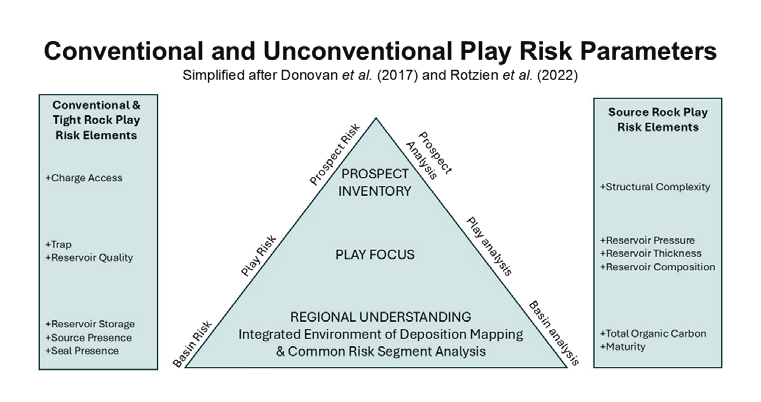
Most prospecting geoscientists are familiar with subsurface or geologic risk associated with oil and gas exploration, including common risk segments, critical risk segments and composite risk segment maps (all “CRS” acronyms, by the way). Fewer geoscientists might be specialized in articulating how risk elements differ from conventional to unconventional exploration. Donovan et al. (2017) demonstrates how to assess geologic risk for the two, with standard conventional and tight rock plays on the left and unconventional source rock plays on the right (figure 2). The reason this was published when it was is for a simple reason: if you have a global business looking at all three types of opportunities, you need to be able to compare them as much as possible, as if they were all apples. But in many cases in real life, as at the market, people do choose between apples and oranges. All day long.
Risk extends to much more in the business than just the subsurface.
“The Offshore Imperative,” by Tyler Priest, is a brilliant look at how deepwater grew in to a global business opportunity. In it, Priest explains that Shell’s method of assessing risk is by use of “TECOP,” which stands for the five independent risk themes: technical, economic, commercial, organizational, and political:
- T: Have we assessed the subsurface and technical risks including the infrastructure and logistics?
- E: Have we done a proper valuation of operating the oil and gas field?
- C: What licenses and contracts, plus financing and insurance, do we need to make this happen?
- O: Do we have organizational structures in place with the right competencies to deliver?
- P: Which governments will we work with, and in which communities will we operate, and who are the stakeholders in this project?
Before anything progresses to final investment decision, it must have undergone a rigorous risk analysis using TECOP.
Further, risk isn’t just for application by corporations. It’s a topic that should be discussed at the nexus of industry, government, and academic institutions. One recent example that should catch the attention of anyone working offshore is “Advancing Understanding of Offshore Oil and Gas Systemic Risk in the U.S. Gulf of Mexico” published by the National Academies. More conversations with the explorer responsible for this contribution, R. A. Sears, will follow in a later installment of this column.
Put it into Practice
Cranberg brings up the concept of perfection in his quote, in that we might see our prospects as perfect and might hesitate to show them to others for a variety of reasons. Thus, avoiding 100 percent-itis in practice can be challenging. You need to talk to people. Hang with me here: this can be daunting.
I have observed so many discussion-ending arguments based purely on differences in word choice and definition. For example, prospect meeting walkouts have happened when one company rep says, “This is a channel,” but to that partner, it is a channel complex.
So, the communication aspect can be big in bringing in partners at the asset or equity level. Senior explorationists who habitually choose to argue about terminology are affectionately known as “the word police.” One solution to this, when we published the deepwater book, was that we chose to include a glossary of terms at the end, with citations.
One other key in the system of the checks and balances of understanding exploration risk and uncertainty is benchmarking, which is a way of metacognition for explorers. “Are we really as smart as we think we are?” If your actual post-drill numbers are in line with your pre-drill estimates consistently, you’re good at your job as an explorer.
Over 30 years, one of K. W. Rudolph’s roles at Exxon and ExxonMobil was to establish benchmarking across the global company, and in the end, it was like, “Yeah, our estimates are statistically in line with what we find … and the corporation was satisfied.”
Wildcattin’ Ain’t Dead Yet
If you’ve tuned in to the consultancy reports on recent and upcoming high-impact wildcats, you might recognize that many are in deepwater areas of interest and several of the wells operated by national and international oil companies are set to spud at or close to 100 percent ownership based on current and available data. Chafalote. Civette. Conifer. Gemsbok. Jambu. Jampuk. Julaiah. Morpho. Nanamarope. Nokhetha. OKK. Riquah. Some of these might have TD’d by the time this article publishes, and there are many of you who follow these more closely than I do.
How can the large NOC and IOC drill wells at or close to 100 percent? Simply because they can, as R. A. Sears explained in his presentation on portfolio risk at the regional AAPG GeoGulf “Wildcattin’ Ain’t Dead Yet” Symposium in San Antonio in 2024. This symposium was a nod to the late great Matt Furin of Armstrong Oil and Gas (see Pikka discovery, North Slope, Alaska). Finance theory tells us that companies should be able to take on risk better than the individual, and that if the project should make the company richer based on net present value, they should do the project, unless project failure would cause the entire company to go under.
So, go big, or go home. BP certainly went big with Bumerangue last year. Kudos to them for not letting any working interest go on that well, which was drilled at 100 percent. Turns out it’s their largest discovery in 25 years. Exceptional. Why not one more? Let’s go Tupinamba! Other high-impact wildcats not listed above are chopped up with working interest divided among two or more partners. These teams are particularly cognizant of 100 percent-itis.