
For quite some time, Mexico’s largest oilfields have been steeply declining in production. Once considered one of the largest producers in the world, Mexico has been struggling to explore and exploit its resources.
For Alfredo E. Guzmán, a former vice president of exploration at Pemex and charter commissioner of Mexico’s National Hydrocarbons Commission, the solution lies in the nation’s great wealth of unconventional resources.
“Mexico has at least 99 billion barrels of oil equivalent in unconventional resources, and less than 1 percent have been extracted,” he said.
In his eyes, the obstacles to such resources are mostly political, as leaders of Mexico remain hesitant toward hydraulic fracturing and reopening the country’s borders to private companies, Guzmán said.
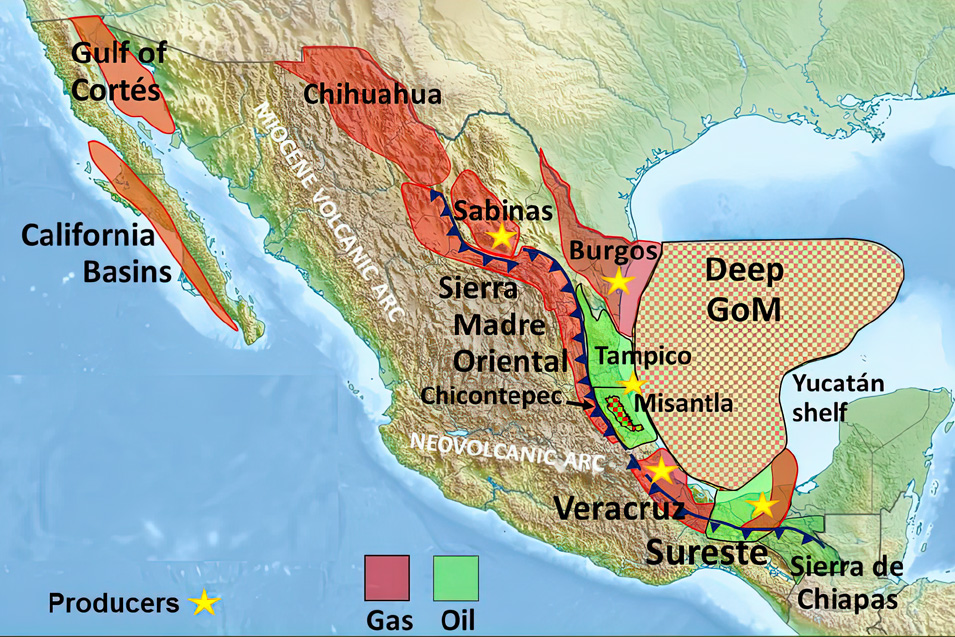
Focusing on the Tampico-Misantla Basin, Guzmán is slated to discuss the resources of two world-class unconventional plays at the International Meeting for Applied Geoscience and Energy in Houston this month. He believes the Chicontepec tight oil formation and the Upper Jurassic shale oil formations have all the necessary characteristics for rejuvenation – just like the Permian.
“These resources could be extracted easier, cheaper, faster and with less geologic risk than any other resources in Mexico,” he said. “In the Tampico-Misantla Basin, there is no risk. We already know the oil is there. It has been certified. We have data on it.”
Furthermore, the cost to drill a well in these formations is “much less” than drilling and producing in the offshore and in the very deep formations of southeastern Mexico, Guzmán said, adding that “in a matter of weeks you can be producing oil and gas.”
Unconventional Opportunities
Mexico’s oil and gas glory days began more than a century ago when the country led the world in oil exports and trailed only the United States in production. At that time, the Northern Golden Lane fields in the Tampico-Misantla Basin were pumping up to 300,000 barrels of oil a day.
In the 1980s, the Cantarell field in the Sureste Basin became the world’s largest offshore oilfield and peaked at 2.2 million barrels a day in the early 2000s.
Searching for additional resources as a Pemex field geologist in the early days of his career, Guzmán explored the Tampico-Misantla Basin, where substantial oil accumulations were found in carbonates, and the Chicontepec sub-basin, known for its tight oil. Yet, the basin never saw significant development due to additional discoveries in the Sureste Basin and in more attractive provinces.
“Mexico has lost almost 2 million barrels of oil per day since production peaked at 3.4 million barrels per day in 2004, and it has lost 3 (billion cubic feet) of gas since production peaked at 7.7 BCF per day in 2010,” Guzmán said. “The country has not been able to make up for the lost production through its conventional resources. Although plentiful, they are difficult to explore and develop because they are either in deep waters, at great depths, in hard-to-find traps, in pressure-depleted reservoirs or in subtle stratigraphic traps.”
The obvious solution for Mexico is to reopen its doors to third-party operators and to allow current technology and completions processes to turn the Tampico-Misantla Basin into the Mexican equivalent of the Permian Basin, Guzmán said.
“More than half of Mexico’s total oil and gas prospective unconventional resources are located here,” said Juan Rogelio Ramón Ramos, a former exploration asset manager at Pemex and co-presenter at IMAGE. “This oil-rich province has a history of conventional hydrocarbon production for more than a century, with road infrastructure close to Gulf of Mexico ports and wastewater disposal sites.”
Such infrastructure could reduce operating costs and socioeconomic and environmental impacts.
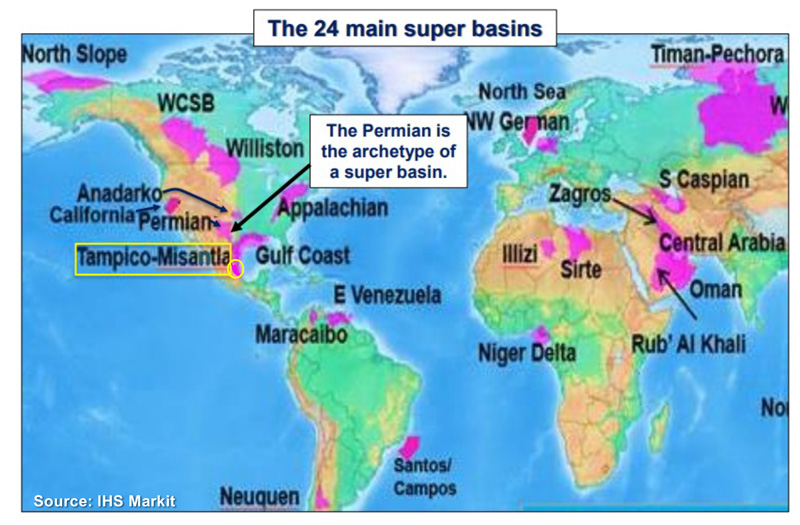
Echoing the findings of IHS Markit, Guzmán said of the approximately 400 super basins identified in the world, the Tampico-Misantla is considered one of the best. It contains more than 90 billion barrels of tight and shale oil and 50 trillion cubic feet of gas – “more than what is estimated for the deep waters of the Gulf of Mexico and for the Sureste Basin,” he said.
Tight Oil Resources
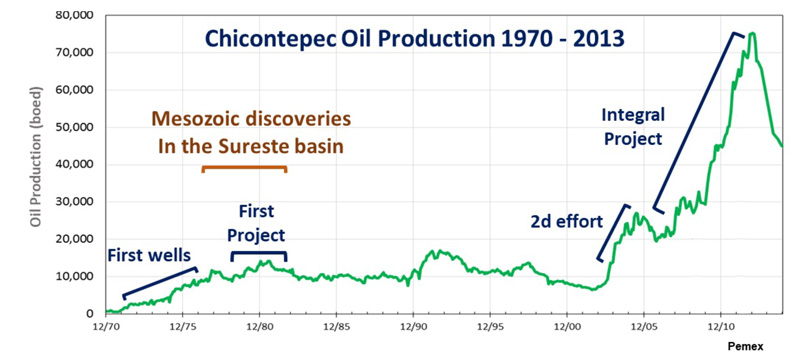
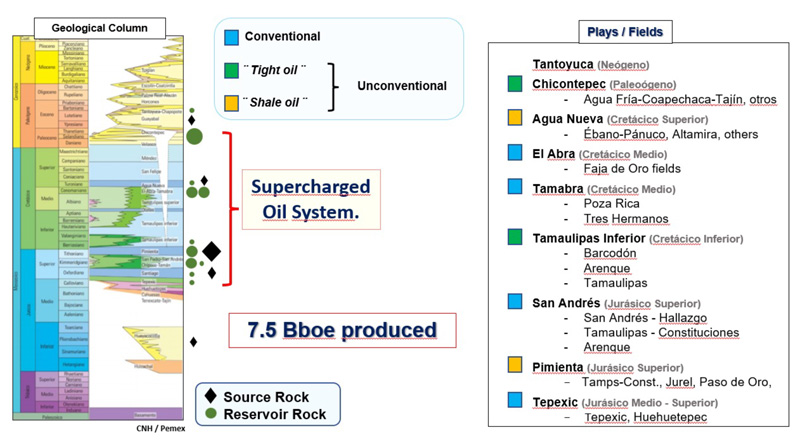
The Chincontepec formation is a thick sequence rich in oil and gas, deposited in a deeply incised paleochannel recently quantified to have at least 60 billion barrels of original oil in place and 31.5 TCF of original gas in place. Its 3P reserves are on the order of 4.64 billion barrels of oil equivalent.
In the late 1970s, DeGolyer & MacNaughton certified 106 billion barrels of oil equivalent in a continuous accumulation of more than 3,000 square kilometers between the Sierra Madre Oriental and the Tuxpan Platform. Pemex began developing it, but halted development after the voluminous fields in southeastern Mexico were found.
Roughly 20 years later, Pemex learned that when it applied the same technology and techniques that were used in the Spraberry Formation in the Permian Basin – such as comingling, larger fractures, better drill bits and 3-D seismic imaging – it achieved nearly 30,000 barrels per day in the Chicontepec, Guzmán said.
Around that time, production in the Cantarell field had begun to decline, so Pemex authorized the development of the Chicontepec and the Ku-Maloob-Zaap fields, preparing to produce 600,000 barrels of oil per day in the Chicontepec. By 2009, production had reached 73,000 barrels per day when the price of oil collapsed and the project was cancelled.
When the price of oil recovered in 2012, the project was expected to continue under Mexico’s 2013 Energy Reform act, which after 75 years of nationalization allowed private companies to participate in upstream projects. But this never happened.
To date, Guzmán said less than 300 million barrels of oil and 0.5 BCF of gas in the Chicontepec have been produced.
Shale Solutions
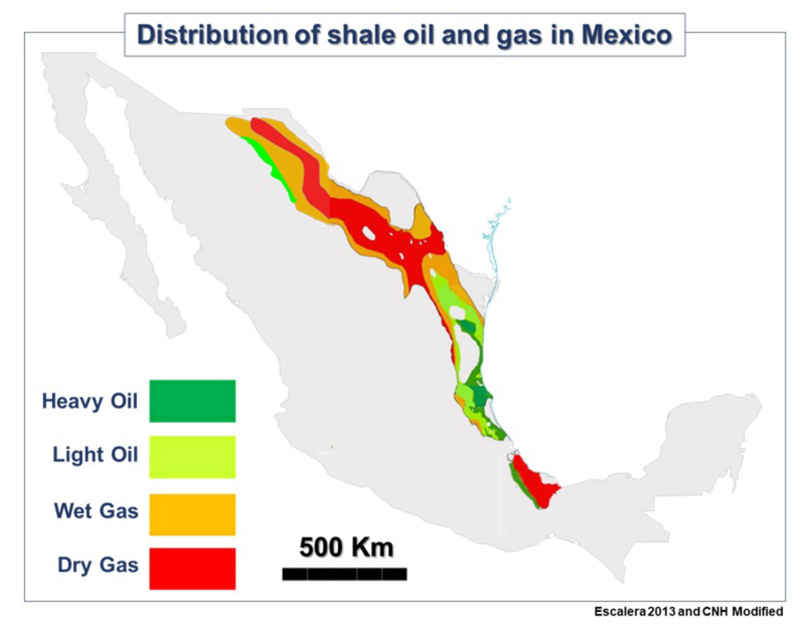
In addition to the Chicontepec, the oil and gas in the Upper Jurassic shales distributed throughout the Tampico-Misantla also hold the potential for a world-class play, Guzmán said. These shales are the source for the oil and gas found and produced in the basin since the early 1900s. While a small fraction of hydrocarbons migrated to conventional reservoirs, the majority remains in the compact shales, which require hydraulic fracturing to produce.
The few wells that have been drilled and completed have shown flows up to 1,500 barrels per day through natural fractures, Guzmán noted.
In north and northeast Mexico, particularly in the Cretaceous Agua Nueva and Upper Jurassic Pimienta and Santiago formations, Pemex has shown that 34.8 billion barrels of oil and 20.7 TCF of gas can be produced. “Yet not a single barrel has been extracted from these resources,” Guzmán said.
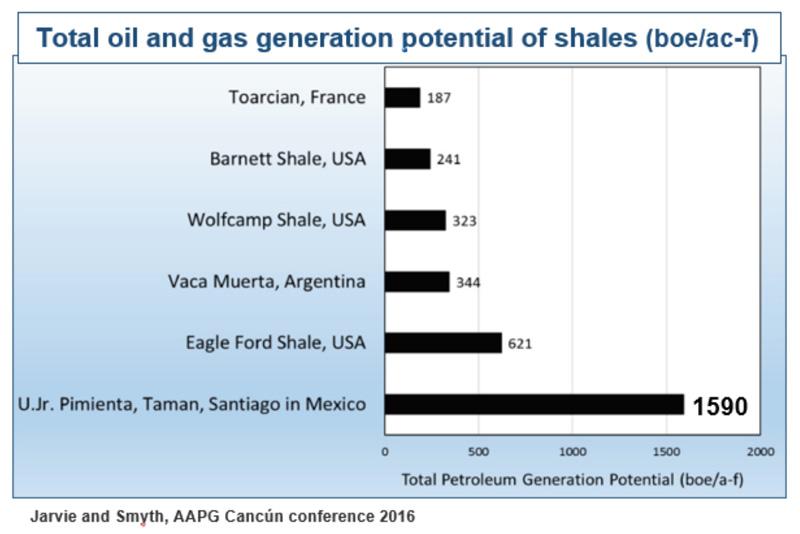
In its Upper Jurassic shales, Mexico’s potential for total oil and gas generation is 1,590 barrels of oil equivalent per acre-foot – compared to 621 in the Eagle Ford shale, according to oil shales geochemical experts.
In fact, reexploring the Tampico-Misantla should only add to its production and reserves since the basin was relegated in the 1980s when the Sureste Basin was discovered.
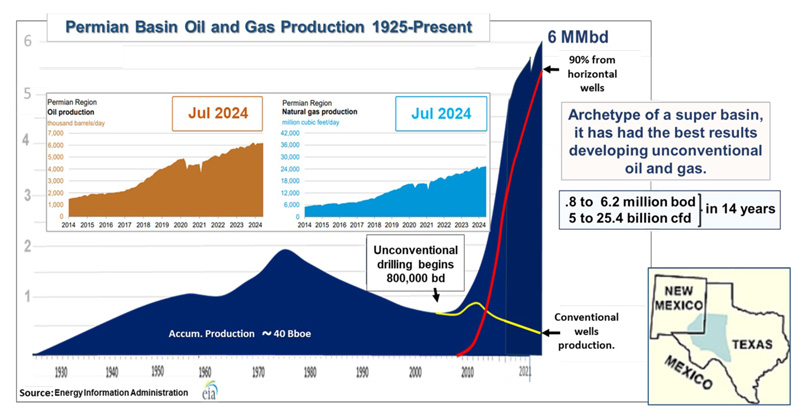
Guzmán reminded that the United States currently produces 13 million barrels of oil per day, up from the 5 million barrels it produced during the former peak of 1970. Of that amount, 9.5 million barrels come from unconventional reservoirs.
Permian 2.0
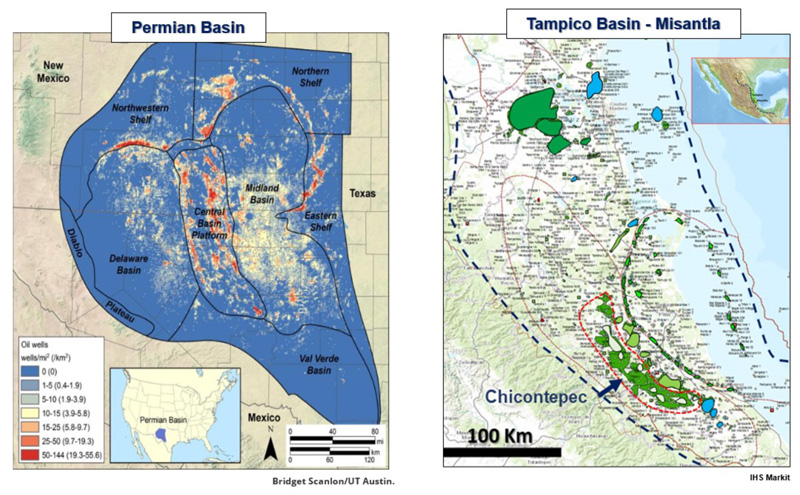
The Permian Basin is, in fact, an analog to the Tampico-Misantla.
The Permian has more than 150 billion barrels of oil equivalent compared to the Tampico-Misantla’s 140 billion barrels of oil equivalent – at the very least.
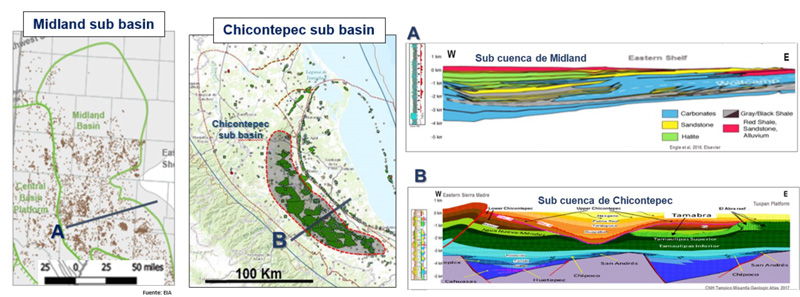
In terms of the tight oil in the Chicontepec, Guzmán and a former colleague, Chris Cheatwood from Pioneer Natural Resources, compared the Spraberry Formation of the Midland Basin to the Chicontepec and found them to be similar in lithology, petrophysics, depth, thickness, internal structure, reservoir characteristics and origin. And to top it off, Guzmán added, “Chicontepec’s potential is 10 times greater!”
(Results of this study can be found in SPE 74407 “Comparison of Reservoir Properties and Development History: Spraberry Trend Field, West Texas and Chicontepec Field, Mexico,” by Cheatwood and Guzmán.)
The Permian first peaked in the 1970s at nearly 2 million barrels per day using conventional drilling. Production then declined until the combination of hydraulic fracturing and horizontal drilling was implemented in the 2010s. Today, the basin produces an estimated 6.3 million barrels per day, according to the U.S. Energy Information Administration.
Down to Politics
Mexico’s unconventional resources could satisfy all of the country’s oil and gas requirements and produce a surplus to export, generating an enormous wealth, Guzmán said.
“Population and consumption have grown in Mexico. There is now a gasoline shortage,” he added. “We are importing half a million barrels of gasoline a day.”
Ramos added that the oil and gas industry represents one of Mexico’s main sources of tax revenue and economic growth and is needed to support its citizens. Furthermore, an increase in natural gas production and reserves would help Mexico achieve cleaner energy.
In part, Guzmán blames the country’s leaders for not having the foresight to invest in exploration and production. When the country historically opened its doors to third parties a decade ago, more than 100 contracts were signed for business, Guzmán reminded. But that process was shut down a few years later when protestors believed that open doors would “strip Mexico of its wealth,” as was reported by BBC News.
Environmental activists have been successful in convincing the government to maintain a moratorium on hydraulic fracturing, consequently holding unconventional resources at bay. So, the government allocated Pemex’s capex toward a refinery. And, by implementing many new welfare-type programs, the government has, in effect, won the public’s allegiance.
“I have been trying to lobby (for unconventional resources) for the past five to six years. I have talked with people at the secretary of energy, the government, but I am told the (current) president will not change his mind,” Guzmán said.
However, the president-elect, Claudia Sheinbaum, seems to be a “practical person,” Guzmán said, adding that she may be more open. Only time will tell.
Guzmán holds out hope for Pemex, which today is one of the most indebted oil companies in the world.
In 2018, Mexico began building a $16 billion refinery that is still not up and running. Meanwhile, from 2018-24, production in the Permian basin grew from 2.5 million to more than 6 million barrels per day.
“That would have made a difference in Mexico,” Guzmán said. “It’s urgent to develop these resources. If we continue delaying it, they will remain underground forever and no one will ever benefit from their value.”