
Carbon is an essential element for life on Earth. Add two oxygen atoms and then you get carbon dioxide. Joesph Black was the first to identify and isolate carbon dioxide in the 1750s. Carbon dioxide is needed for photosynthesis of plants and the respiration of fauna and micro-organisms.
We also know that the amount of CO2 in the atmosphere varies throughout geologic time. Today, it is widely thought of solely as a greenhouse gas that contributes to the warming of Earth’s climate, thus lowering the amount of CO2 in the atmosphere is a priority. This has created a whole industry of carbon geosequestration alongside the decades of use of CO2 for enhanced oil recovery.
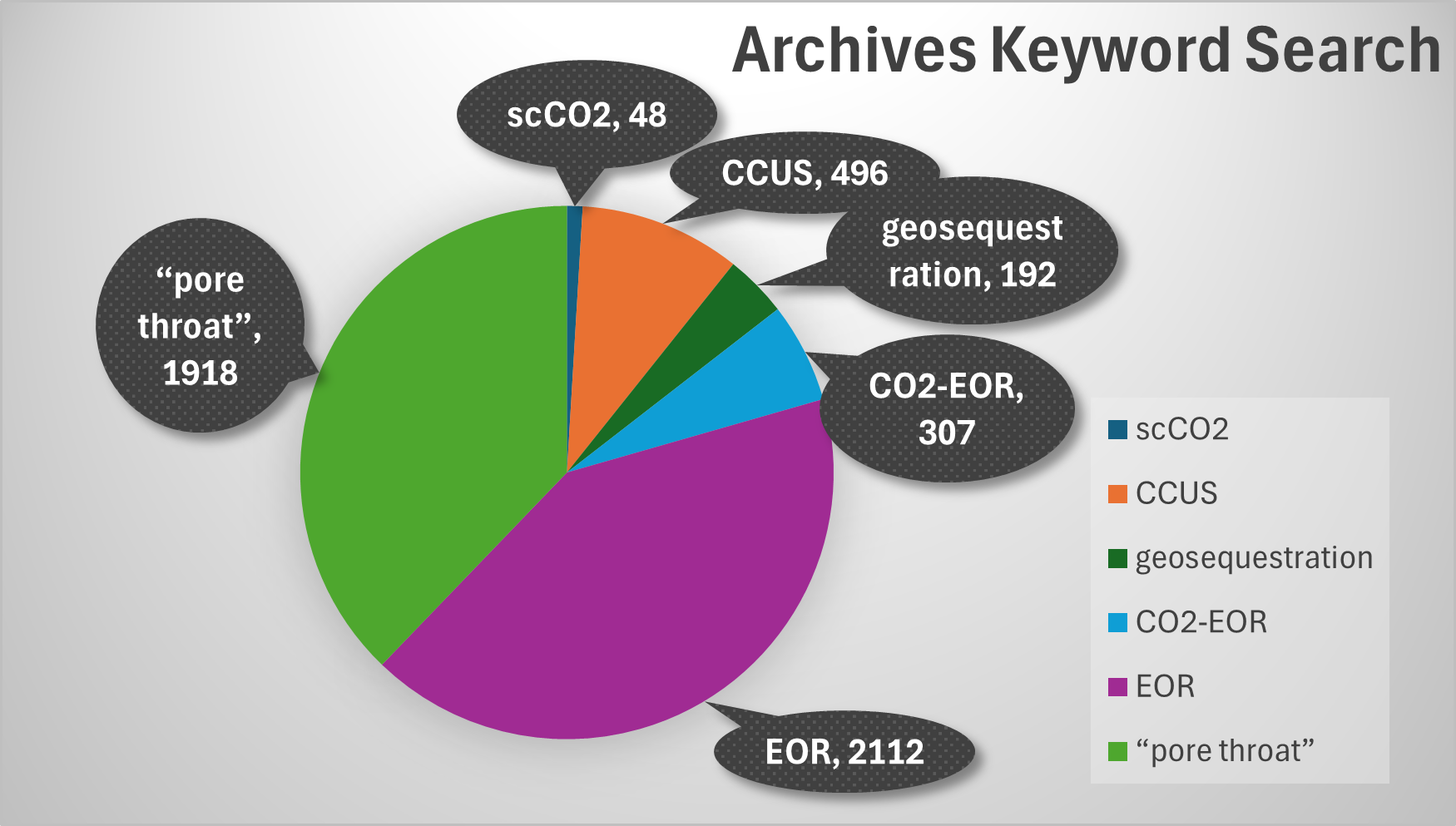
The Datapages Archives houses years of articles about carbon capture, utilization and storage, as AAPG members were at the forefront of the research. The graph below shows the keyword search terms used and the number of results. The following summary highlights just the proverbial “tip of the iceberg” of the information in the Archives.
A Brief History of CCUS
In the 1920s, CO2 capture was used for separating CO2 from methane gas found in natural gas reservoirs. The first enhanced oil recovery project to utilize CO2 took place in 1972 at the Scurry Area Canyon Reef Operators Committee unit of Scurry County in western Texas, eastern side of the Pennsylvanian Horseshoe Atoll. By the 1980s, major oil companies had built three long CO2 pipelines into the Permian Basin area. In 1996, the Sleipner Project, in Norway’s North Sea, became the largest and longest running commercial CCS facility with dedicated storage. The nearly 72-year-old Weyburn field in Saskatchewan began a CO2 sequestration study in 2000. Completed four years later, the study demonstrated the feasibility of geological storage in mature oil fields.
Carbon capture, utilization and storage was still a new science in 2001. In September of that year, a special issue of the Division of Environmental Geosciences’ Environmental Geosciences journal was published by AAPG, which focused on carbon sequestration.
The U.S. Department of Energy Carbon Sequestration Program also formed that year to build government/industry research and development partnerships. The program resulted in the International Energy Agency Greenhouse Gas R&D Programme, and the Climate Technology Initiative of the Framework Convention on Climate Change. The Sleipner Project in Norway and the Weyburn CO2 EOR Project in Canada are coordinated through the IEA/GHG.
The Geology of Carbon Capture
To determine what reservoirs are suitable for CCS, the caprock composition, porosity and permeability must be evaluated. Leakage of CO2 from the reservoir through the caprock is the main risk, while unexpected natural migration paths, and seismicity are also significant risk factors. Additionally, human-caused factors such as legacy wellbores must also be taken into consideration. Subsurface storage in a natural system brings about uncertainties, for example, how the reservoir and caprock are affected by super critical CO2 (scCO2) storage over long time scales. Wet scCO2 can create carbonic acid, causing dissolution of carbonate minerals, such as calcite and dolomite, swelling of coal bodies and clay minerals, and mineral alteration. Depending on the composition of the rock minerals, scCO2 can cause porosity/permeability changes in the reservoir rock or seal fractures in the caprock. In reservoir sandstones, dawsonite, siderite, and kaolinite can precipitate after injection of scCO2 due to the dissolution of the silicate minerals such as olivine and feldspar.
Monitoring the carbon storage site is important to ensure the long-term integrity of subsurface storage. Techniques for monitoring include time-lapse seismic monitoring, electrical resistivity tomography, 4-D gravity measurements, vertical seismic profiling, and geochemical sampling.
Carbon capture and storage allow energy companies to reduce their own emissions and the emissions from other industry sectors. Carbon sequestration lets energy companies lead the charge in the reduction of GHG’s.
To read the latest research regarding CCUS, visit the 2025 CCUS Collection in the Datapages Archives. There are thousands of articles on related topics, such as mineral trapping, mineral alteration, brine chemistry, reservoir connectivity, and hydraulic gradient, just to name a few.