

AAPG and its student and early- career members have long benefited from the generosity of corporate partners. Beginning in 2006, Chevron provided a substantial grant that supported nearly all student memberships through June 2025. We are sincerely grateful for their nearly two decades of commitment to the next generation of geoscientists. With that funding now fully exhausted, students are responsible for the annual student rate, and we are seeing a sharp impact on student membership totals. Because students represent the primary feeder group into our early- career and young professional segments, this shift has meaningful implications for our long-term membership pipeline. Prior to Chevron’s support, Halliburton funded student memberships through a three-year grant from 2003 to 2006.
A marketing colleague once told me “free” is a four-letter word. Similarly, others have asserted that if something is free, you do not appreciate it and its value is minimized. These same individuals have advocated for students to pay a nominal fee to ensure they are committed to the AAPG. Our current student membership is about the price of a single venti (large) fancy Starbuck’s beverage. Is an AAPG student membership worth a cup of coffee?
It seems appropriate to look back and assess how well the AAPG has done at connecting with recent graduate members as a result of these corporate gifts and if we have translated these corporate membership investments into a long- tenured AAPG member. To do so fairly, we will also need to benchmark our performance with external comparative data.
State of Professional Associations
In 2016, Millennials (born 1980-1996) became the largest population in the workforce. According to the U.S. Department of Labor’s 2024 statistics, Gen Z (born 1997-2012) and Millennials together occupy 54 percent of the working population, with Millennials accounting for 36 percent. Generation X (born 1965 to 1979) represents 31 percent of the workforce and Baby Boomers (born 1946 to 1964) or older represent the remaining 15 percent. If we compare this data to other member professional organizations, U.S. Census data for petroleum geoscientists, and AAPG generational data, discordances appear (see table 1).
Generation Z and Baby Boomer or older demographics show larger representation in the AAPG’s member data. The AAPG’s data is bimodally distributed and relative to the other datasets, our Generation Z population is overweight. Student members fall in this generational category and have been subsidized. Is this causative or just a correlation or something else?
Framed Against Other Petroleum Associations
To investigate this further, we can compare AAPG age demographic 2024 data with the Society of Petroleum Engineers and Society of Exploration Geophysicists. The SPE’s member data largely parallels the U.S. Census data for petroleum workers, while the AAPG’s does not (table 2). The SEG’s data has higher populations in the Millennial and Baby Boomer age groups.
Per conversations with the SPE and SEG, both have also offered free or reduced student membership until recently, due to a similar Chevron grant. Does this mean we are better at attracting younger members than the other petroleum professional societies?
Member Retention
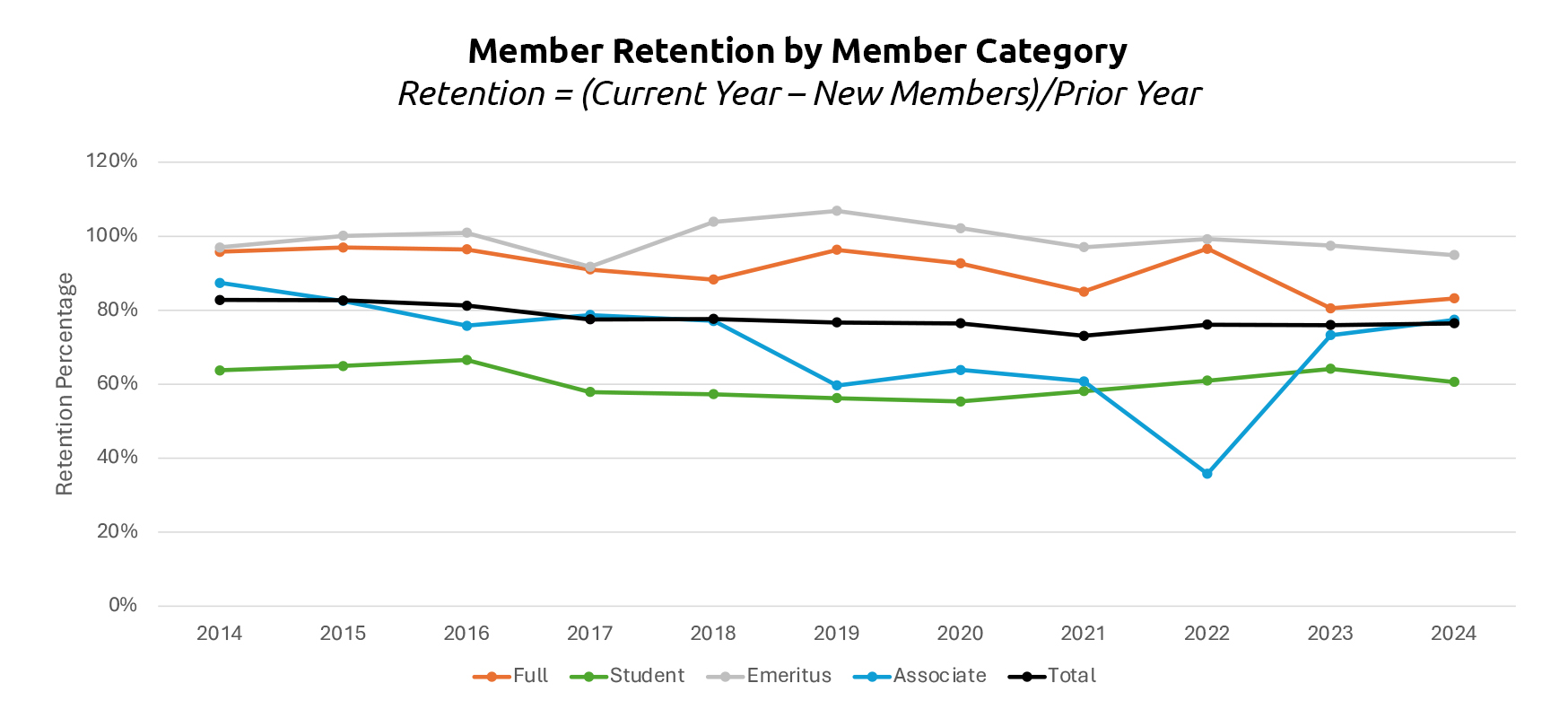
And if we have been better at capturing the younger generation, how well have we been doing at converting them to long-tenure members? Regretfully, the answer is “poorly,” and I am not sure we can say truthfully that we attract more students than the other associations. Our retention of student members with corporate funding has been around 60 percent (figure 1).
Additionally, if we track the recent graduate and professionals with less experience age demographic over a nine-to- ten-year period in our dataset, it shows we have lost a massive percent (90 percent) of our future generation members (figure 2).
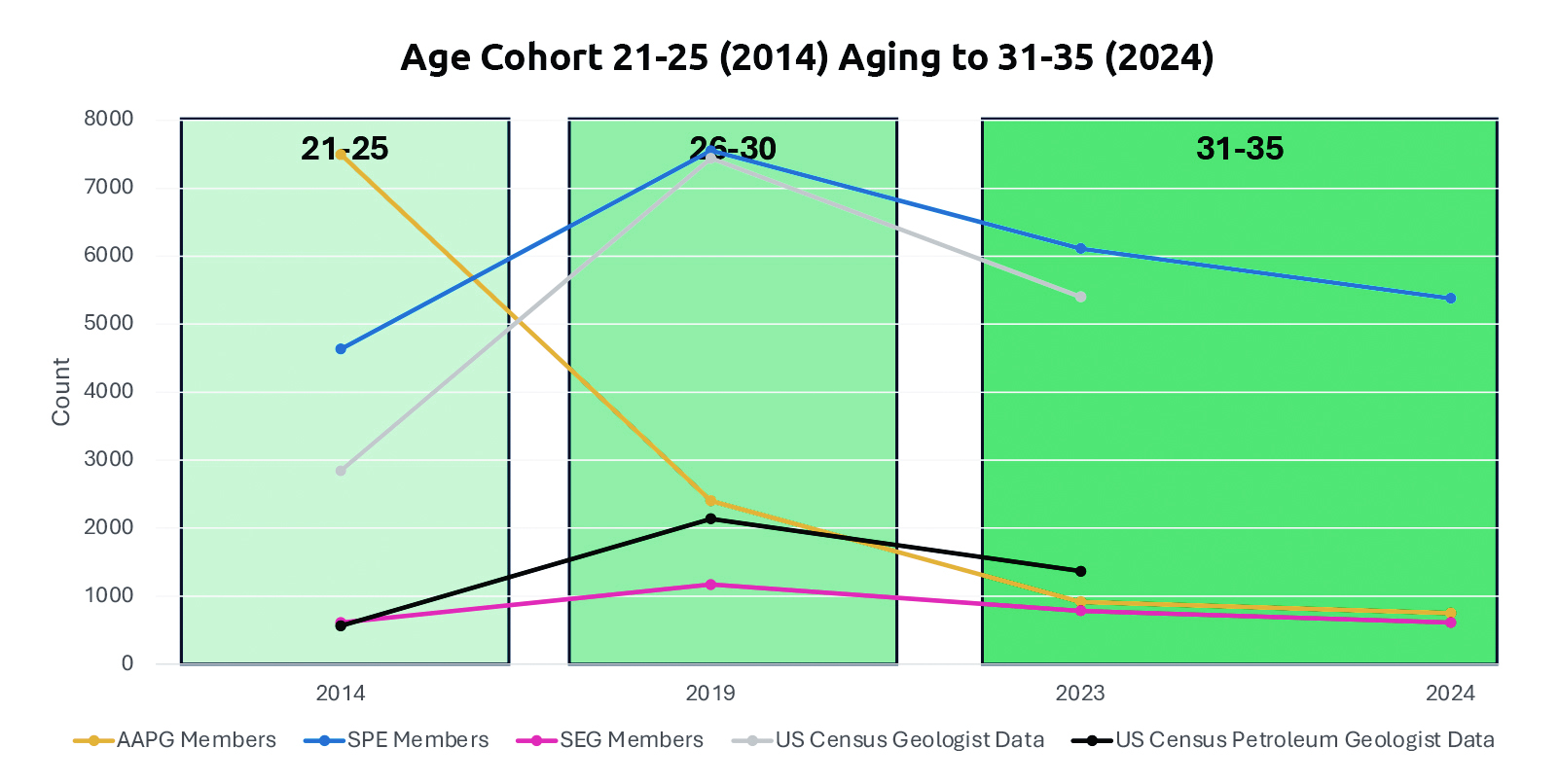
What is more concerning is that when benchmarked to other petroleum member societies or U.S. Census geologist data, we are not following industry trends and are disproportionately losing members.
In response, we have recently launched a “Gift a Membership” campaign, enabling members and partners to sponsor student memberships. While early interest is encouraging, this approach has not yet fully replaced the scale and stability previously provided through corporate grant funding. We continue to also look for a replacement for the Chevron grant.
Potential Causes
There are other professional societies that have experience and member trajectories similar to ours, especially following the COVID pandemic. The published rationale for declining professional society membership among the younger generations has been attributed to a variety of reasons. Social media and the internet have created opportunities for the technologically savvy to access publications and to find different forms of professional networking online. This is putting pressure on professional associations to examine and modernize their member value propositions.
More clinically, according to “5 Reasons Younger Generations Aren’t Joining Associations” at hum.works, professional society member studies have shown that associations:
1. Are not meeting prospective Generation Z members where they are (online or digital platform),
2. Are not supporting their (new) nuanced career trajectories (think data- science influence on geology careers),
3. Are not creating the experiences they want (social networking or experiential conferences/events/webinars), and
4. Haven’t proven their value proposition or their value doesn’t match their price point.
These are not trivial observations that can be easily addressed. The infrastructure and both the delivery methods and points of connection for professional associations would have to be transformed to confront these challenges.
If these challenges are those of the AAPG, are we prepared to make evolutionary changes to connect more effectively with Generation Z? Complicating this is the multi-generational aspect of the AAPG. Do Baby Boomers want the same style of engagement or member benefits as Generation X, Y (Millennial), or Z? Can we be all things, to all generations? Should corporate giving be directed more toward technology enabling better connections with members, rather than underwriting student memberships?
Conclusion

These are robust questions and how we choose to answer them will impact our future. Our corporate benefactors have given us opportunities to attract students, and I believe delivering a compelling value proposition at the right price point will attract and retain members. Our member data shows it is time for us to redouble our efforts to ensure that AAPG will have an enduring and bright future. I look forward to working with you to deliver member value.