
<a href=”/news-and-media/details/explorer/articleid/69465/why-world-watching-venezuelas-oil” target=”_blank” class=”btn btn-primary btn-sm”>READ PART 1</a>
<br><br>
The start of 2026 brought sweeping changes to Venezuela, the South American nation housing the world’s largest oil reserves. Since President Maduro’s removal from power on Jan. 3, the U.S. and Venezuelan governments have announced a series of actions designed to reactivate and open the country’s energy industry.
As operators, service companies, and analysts shuffle 2026 priorities and shift their focus to Venezuela, key questions arise:
What exploration and production opportunities are available?
And what will it take to start operating in-country?
The Explorer took these questions to AAPG members and subject-matter experts who contributed to a two-part series featuring Venezuela’s geology, petroleum systems exploration opportunities, and investment potential.
The previous installment focused on geology and petroleum systems and reserves estimates, helping to explain why investors show so much interest in the country.
There is great upstream potential, both offshore and onshore, and advice to be considered by companies entering the country for the first time or after a long absence.
Exploration Opportunities
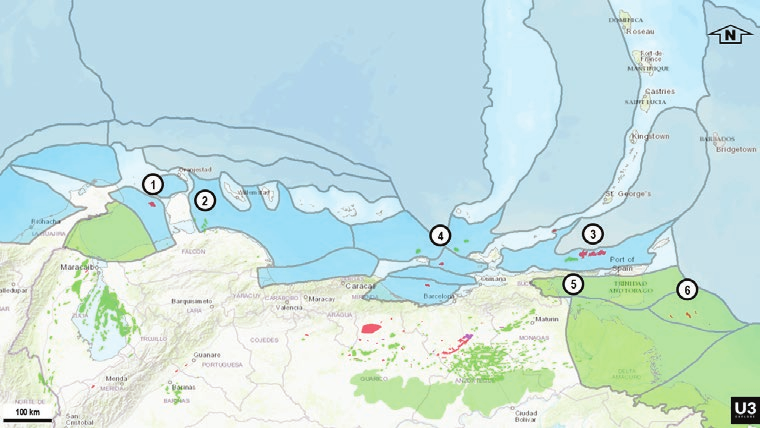
discoveries in red. Blue: Basins with Tertiary petroleum systems. Associated accumulations: Perla super-giant (1), La Vela (2), Patao, Dragón
and Río Caribe (3) and various discoveries in Northern Venezuela (4); Green: Basins with Late Cretaceous source rocks sourcing Corocoro and
Pedernales (5) and Lorán, Cocuina, Dorado and Tajalí (6); Grey: oceanic and B-subduction related basins. Modified from Arminio et al. (2025)
and U3 EXPLORE (2026) and World Topo Map, October 2024.
Given the offshore discoveries in neighboring Guyana, Trinidad and Tobago, and Colombia over the past decade, questions naturally arise about offshore potential in Venezuela.
Jairo Lugo, exploration director at Caribbean Oil and Gas, and author of the 2021 AAPG Memoir 123 South America–Caribbean–Central Atlantic Plate Boundary: Tectonic Evolution, Basin Architecture, and Petroleum Systems, said Venezuela’s offshore basins hold extraordinary exploratory potential.
He said the country’s continental shelf covers more than 160,000 square kilometers, 53 percent of which are in shallow waters of less than 200 meters. Within that area lie seven major basins: Golfo de Venezuela, Falcón NE–Bonaire, Blanquilla, Tuy–Cariaco, Margarita, Golfo de Paria, and Plataforma Deltana.
“Having studied and evaluated each of them, my estimates indicate yet-to-find resources exceeding 45 billion barrels of light oil and 111 trillion cubic feet of gas (risk weighted 15 billion barrels and 45 trillion cubic feet of gas),” Lugo said. “Yet, since 1958 only 72 exploratory wells were drilled across this entire offshore domain – a scarce level of activity that leaves Venezuela’s offshore basins in an authentically immature exploration stage.”
Lugo said the exploration potential is undeniable.
He explained how supergiant gas field Perla, discovered in the Gulf of Venezuela in 2009 and calculated at 17 trillion cubic feet of gas, combined with gas discoveries in the Margarita Basin (Dragón, Patao, Mejillones, and Río Caribe fields) and the Plataforma Deltana area (Lorán, Cocuina, Tajalí, and Manatee fields), represent a combined total of 30 tcf of proven offshore gas.
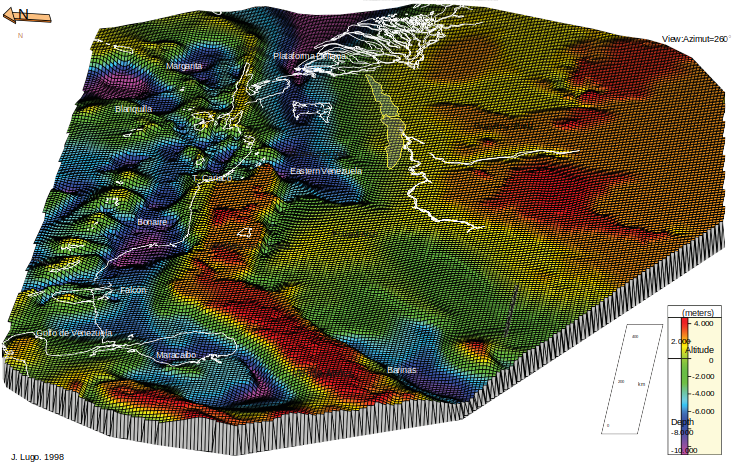
reveals 17 depocenters. Basin sediments range from the Neoproterozoic to present and
result from diverse origins including rifting, passive margins, foreland and backarc basins,
transtensional basins, pull-aparts, and aulacogens. Image produced by Jairo Lugo, 1998
The large resources attracted large companies (Shell to Dragón and Lorán-Manatee and BP to Cocuina).
“Across these regions, historical exploration success rates average above 45 percent, underscoring just how underexplored – and how promising –Venezuela’s offshore truly is,” he said.
“Notably, in western Golfo de Venezuela, Golfo de Paria south Tuy-Cariaco, and Plataforma Deltana Basins, the La Luna and Querecual source rocks are present, and within the oil and gas window beneath thick reservoir-seal pairs waiting to be discovered in their hiding place,” he added.
Juan Francisco Arminio, AAPG Latin America and Caribbean Region delegate and senior consultant at U3 Explore, described how the geology points to offshore gas potential.
“Besides the prolific Cretaceous La Luna – Querecual petroleum system, there are the Tertiary petroleum systems associated with Cuenca de Margarita, Gulf of Venezuela, and Plataforma Deltana, the three of them with significant exploration upside for gas,” he said.
“And then there is significant potential in the northern offshore region, including the Blanquilla and Tuy-Cariaco basins, where oil, gas, and condensate discoveries sourced by Paleogene and Neogene rocks have been reported.”
Onshore Mature Basins
Lugo noted that exploration potential extends onshore as well.
“Venezuela’s mature onshore basins still offer significant exploratory opportunities. Despite more than a century of drilling, the Maracaibo, Barinas-Apure, and Eastern Venezuela basins collectively contain more than 41 billion barrels of oil and 154 tcf of gas (16 billion barrels medium to light oil and over 58 tcf of free gas for risked prospective resources), concentrated in over four hundred mapped prospects and leads,” he said.
“Several areas remain in a surprisingly low state of exploration maturity.”
The foothills of the Perijá Range and the northern and southern Andes continue to show underexplored structural plays with proven petroleum systems. In eastern Zulia, the Lower Eocene Misoa Formation holds substantial stratigraphic and structural potential.
“To the east, a remarkable 100-kilometer undrilled gap separates the supergiant El Furrial trend from the Corocoro–Pedernales–Soldado fields in the Gulf of Paria – an area with clear geological continuity but minimal exploratory testing,” Lugo said.
“Likewise, the eastward continuation of the Oficina trend and the Orinoco Belt remains largely untested, despite the presence of world-class source rocks and migration pathways,” he added.
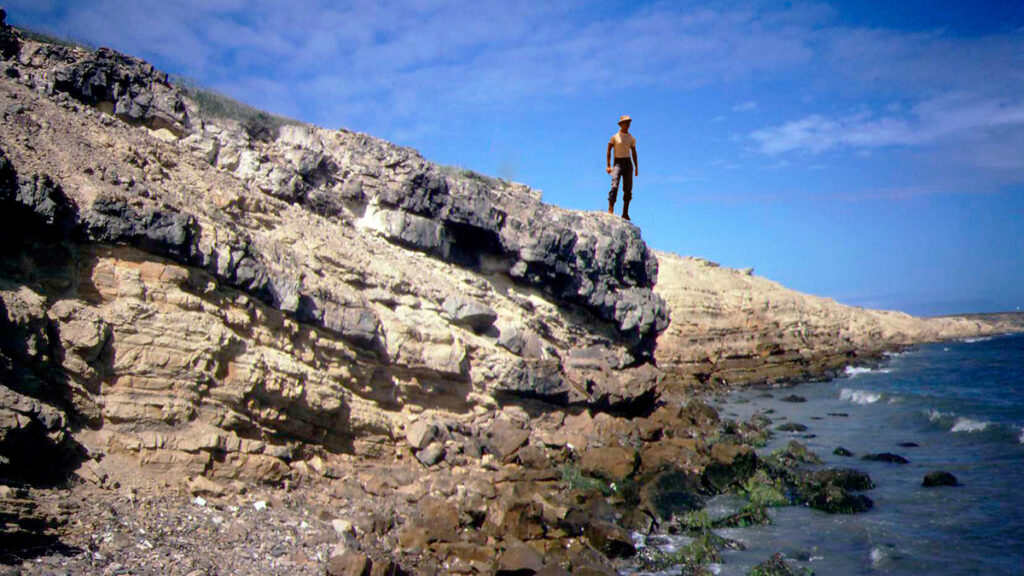
“The Oligocene record in the Maracaibo Basin reflects a major phase of uplift and basin-margin exposure along its central and northeastern flanks, resulting in the erosion of several thousand feet of Upper Eocene strata. Tectonically induced denudation is expected to have resulted in the development of a significant lowstand wedge in the southwestern portion of the basin. While its existence can be inferred from regional stratigraphic correlations, limited subsurface data has hindered comprehensive analysis of the geometry, facies distribution, and reservoir potential of this lowstand system tract.”
Arminio highlighted potential in the Maracaibo Basin, where three Tertiary foredeeps were superimposed on the prolific Cretaceous passive margin, resulting in multiple stratigraphic and structural plays, sometimes close together and often stacked on top of each other.
“Several of those plays remain unexplored or underexplored, some in the periphery of the basin in the mountain fronts, and some near and within commercial oilfields, defined through re-exploration of mature areas,” he said.
“Stratigraphic plays for heavy and light oil have been defined in Cretaceous and Tertiary subcrops, in Eocene incised valleys and in slope turbidites, while structural plays in Cretaceous limestones and sandstones and Paleogene clastics have been defined around the Lake and below already prolific Tertiary oil fields.”
Unconventional Reservoirs
Though most explorers cite opportunities in the conventional reservoirs, Lugo and Arminio have identified potential for shale oil and gas as well.
“The good-quality Late Cretaceous source system extends from west to east across the country, but it’s in the Maracaibo Basin where La Luna unconventional sweet spots are more evident,” Lugo said. “Once adequate field tests are done, more realistic volumetrics will be defined, as well as play-specific operational procedures for both production and environmental protection.”
Arminio, who witnessed social and environmental concerns stemming from unconventional projects in Colombia, said companies may proceed with caution before developing shale gas and oil projects in Venezuela.
With the necessary technical and environmental regulations, the unconventional resources will be viable, he said.
“Published assessments for continuous plays in Venezuela estimate resources in the order of 15.2 billion barrels of shale oil and 204.8 tcf of shale gas, most of them assigned to the La Luna Formation in the Maracaibo Basin,” he said.
Lugo shared how numerous opportunities in Venezuela mean there is something for everyone to explore.
“In short, even In Venezuela’s most mature basins, the combination of proven petroleum systems, large remaining prospect inventories, and vast underexplored corridors ensures that meaningful exploration upside still exists,” he said.
Production Opportunities
Given the cost and longer-term cycles of exploration projects, some companies might prefer production opportunities. Many experts think the country’s reactivation will start with incremental reserves.
Lugo said restarting existing projects is a natural first step, and applying new technologies is key.
“Because of Venezuela’s prolonged operational and institutional decline, hundreds of oil and gas fields across the Maracaibo, Barinas, and Eastern Venezuela basins were shut in or abandoned long before reaching depletion. Many producing areas were cannibalized for parts, and large portions of the remaining surface and subsurface infrastructure are now unusable,” he said.
“This is particularly true in the Maracaibo Basin. In the Eastern Venezuela Basin are several fields that the locals called ‘scorched land’ – not even the wellheads survived,” he added.
Despite current conditions, these mature fields represent some of the country’s most accessible “low-hanging fruit,” with targeted re-exploration, strategic workovers and recompletions, and drilling of reentry or twin wells, production could be restored quickly and at relatively low cost.
Lugo described how most fields were mapped originally with legacy 3-D seismic, but modern redevelopment would benefit enormously from new high-resolution 3-D broadband, multiazimuth, or full waveform inversion to better image the subsurface.
When integrated with AI-driven reservoir modeling and predictive stratigraphy tools, these datasets can reveal overlooked compartments, bypassed pay, and optimal redevelopment targets, transforming abandoned fields into rapid-cycle producers once again, he said.
Arminio identified significant opportunities for small, agile operators who can ramp up quickly.
“Oil fields in Venezuela are mature assets. Available information indicates that most of them have not undergone significant updates for several years. Under new regulations and improved operational conditions, brown fields can optimize their output and bring about incremental reserves with improved production technologies and reservoir management, attracting the full spectrum of energy players and service providers, from big IOCs and NOCs to middle and niche operators, together with large and small specialized service companies and technology suppliers,” he said.
“This should be stressed, because smaller assets that would not attract large players might be prime cut for smaller operators,” he added.
Preparing for Entry
Bob Erlich, upstream adviser at Cayo Energy who spent 16 years working on Venezuelan projects in the late 1980s to mid-2000s, encouraged companies to exercise caution when pursuing incremental reserve projects.
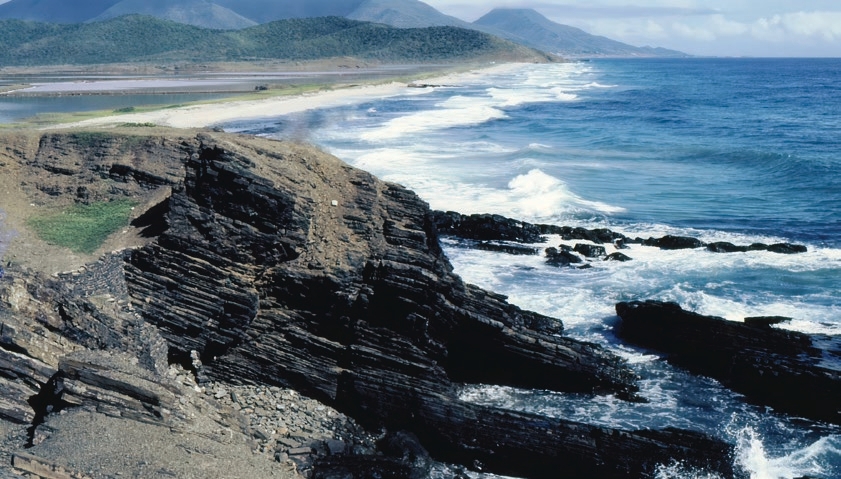
Venezuela’s Margarita Island
in the Caribbean Sea. Photo
by Jhonny Casas
“So much depends on the current condition of the reservoirs. I think a prudent prospective investor will want to do intensive data analytics and look at plenty of infill and DUC (drilled, uncompleted) locations before making large investments,” he said.
He also had advice for companies interested in exploring new projects.
“Do your homework. Look at the existing wells – what’s been drilled successfully and unsuccessfully – and determine if a play has been tested,” he said.
“Don’t assume that the La Luna petroleum system will bail you out; there are thousands of dry and non-commercial wells in Venezuela.”
Erlich participated in three marginal fields and exploration bid rounds with Amoco, during “La Apertura” (“the Opening” in Spanish), a national strategy in the 1990s that opened exploration acreage and existing mature fields to foreign investment.
Arminio, who worked for PDVSA during La Apertura, agreed that data is key.
“Information is paramount: the first round in Venezuela was painful, not the least because of problems getting access to the required data,” he said.
Reflecting on foreign operators’ experience in the 1990s rounds, Arminio encouraged companies to use as much data and information as possible.
“Don’t be shy about acquiring new critical data for both exploration and production,” he said. “Then, use data wisely with the technical teams, integrating as many tools and disciplines as possible to construct realistic development scenarios, avoiding rushed production outlooks and overspending in infrastructure, or expensive junk wells.”
Erlich added that companies need more than data; they need good geoscientists.
He encouraged companies interested in Venezuela to hire people familiar with the country and its geology.
“Unless you’re Chevron, it’s likely that staff that had actual experience in Venezuela have long-since retired. There are good consultants with verifiable experience in the geology of the country, many of them ex-PSVSA geoscientists living in places like Caracas, Bogotá, Calgary, Houston or Mexico, and are doing consulting,” he said.
“Contact them; I’m sure they’d love to get back to work in their home country!”
Advice to Companies
Meanwhile, ex-PDVSA geoscientist Lugo offers specific guidance to companies interested in his home country.
“For explorationists entering Venezuela for the first time, the most important advice is to recognize that, while many basins share predictable geological characteristics – structural styles, trap types, depositional systems, and stratigraphic configurations that often repeat from one basin to another – what truly sets Venezuela apart is the extraordinary efficiency of its petroleum systems,” he said.
In most countries, explorers must balance source, charge, migration, and timing risks, but in Venezuela, those risks are dramatically reduced, he said.
“The source rocks are so prolific and the charge system so effective that the primary challenge is not whether hydrocarbons are present, but how well the trap is defined. If the trap geometry is sound, it will almost certainly be filled to spill point,” he said.
“This shifts the exploration mindset: success depends less on proving a working petroleum system and much more on precise structural and stratigraphic definition, careful mapping, and disciplined trap evaluation,” he said.
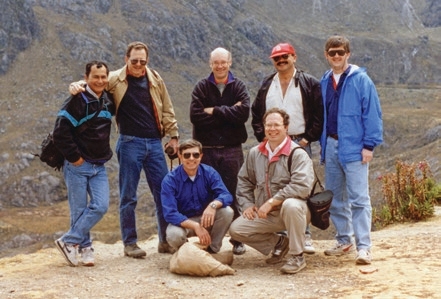
Testamarck, Roger Neal; Front row: Ralph Baker, George Kronman. Photo courtesy of Bob Erlich.
For companies returning to Venezuela after years of absence, Lugo’s key message is that the operating landscape will be changed fundamentally.
“With contractual security restored, a competitive and predictable fiscal regime in place, honoring the international compensation rulings and (bringing) the country back to institutional and democratic normality, Venezuela is actively rebuilding the trust that was lost during the years of expropriation and uncertainty,” he said.
For Lugo, what makes Venezuela compelling for the majors is not small scale redevelopment, but the combination of large, material production areas and significant exploration upside.
“The scale of the opportunity is unique: multi-billion-barrel mature areas that can be revitalized with new technology, plus frontier and near-frontier basins capable of delivering discoveries of the size and quality that major companies require to move the needle,” he said.
“As Wallace Pratt reminded us, ‘Oil is in the mind of men’ – and today it also lies in the ability of geoscientists to transform that vision into opportunity, to articulate the subsurface with clarity, and to convince investors that the next great discovery begins with a well-defined idea,” Lugo added.
Renewed interest in Venezuelan geology and exploration and production motivated AAPG Latin America and Caribbean Region staff and volunteers to add a new event to the annual calendar, a two-day technical and business event to be held in the Houston area.
“AAPG has a lot of events this year – we have six others in the region alone – but this is an opportunity we just couldn’t pass up,” Arminio said. “Everyone wants to talk about Venezuela, and AAPG has been providing technical information and industry news on Venezuela for decades. It makes sense for AAPG to host this important discussion at this particular time.”
The AAPG Venezuela Technical Symposium and E&P Summit will be held at The Woodlands Resort May 18-19.
Arminio forms part of the organizing committee, and Lugo will present a keynote talk introducing Venezuelan petroleum systems and prospectivity. They invited colleagues to join them in Houston for the event.
“We hope that our next event will be held in Venezuela,” he said. “For now, we look forward to seeing you in Houston for engaging discussions about the future of our country.”
To find additional information and register visit AAPG.org/venezuela2026.