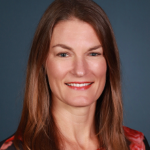
Disnahir Pinto, AAPG member and Latin America and Caribbean Region delegate, awoke early on the morning of January 3. He was on vacation outside Caracas with his wife and children when friends called to tell them that the U.S. military had entered Venezuela and carried out strikes in several areas of the city.
A few hours later, he learned though social media that President Nicolas Maduro had been removed from power.
“It was a moment of profound shock and uncertainty about what would happen next,” Pinto said.
The family, like most Venezuelans in-country, has maintained a low profile since that day.
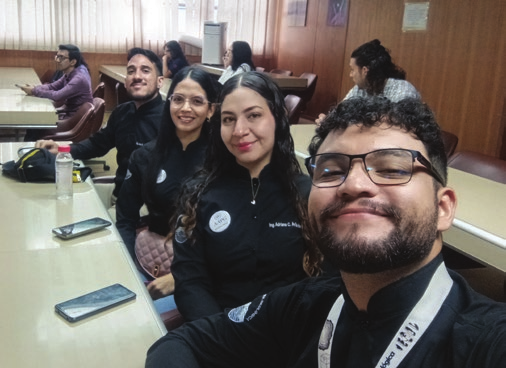
Pinto described the atmosphere in- Caracas as “quite tense and expectant.”
José (Pepé) Regueiro received the news while at home on Isla Margarita, an island located 360 kilometers from Caracas, in the Caribbean Sea.
“I was awakened, about 2:30 a.m., by tons of WhatsApp messages, videos of the strikes over Caracas, explosions, people shouting,” he said. “After that I could not sleep for the next 24 hours watching the developments on YouTube live channels.”
On Margarita Island, where he lives, nothing out of the ordinary happened.
“To-date, the overall environment has not changed much, except for prices and a total chaos with currency stability and devaluation,” he said. “Life goes on.”
Finding a Niche: Pepe’s Story
Regueiro, a geophysical engineer from Colorado School of Mines, SEG member, and retired Simon Bolivar University professor, has spent the past 25 years following changes in Venezuela’s energy sector.
“I can only speak from my experience, and everything I can gather implies a complete deterioration of conditions, primarily those related to industry and academia,” he said.
Venezuela’s energy sector suffered the mass exodus of professionals in three key moments:
- Early 2000s: After a general strike in the oil industry, President Hugo Chávez’s government responded by firing approximately 18,000 experienced employees from the state oil company, PDVSA, and replacing them with workers loyal to the government, many of whom lacked the same level of expertise.
- Circa 2007: The Venezuelan government mandated majority PDVSA ownership of all oil projects and expropriated assets from foreign companies that refused to accept the new terms. Major international firms left the country, taking technology, capital, and operational expertise with them.
- Late 2010s to present: Hyperinflation, a severe humanitarian crisis and deepening U.S. sanctions triggered a mass exodus of nearly 8 million Venezuelans. Thousands of workers left PDVSA around 2018, particularly after the company was placed under military control. (For a more comprehensive review of Venezuela’s oil history, see David Brown’s article “Power and Petroleum” in this issue.)
Regueiro started his career in the oil and gas sector but later diversified his focus when political differences with the government made it impossible for him to work for institutions controlled by the state.
“Politicization of both sectors has discriminated against all those not supporting the regime, and that implies not having the chance to work in the main areas of our expertise, that is oil and minerals,” he said.
Friends, colleagues and family members started leaving the country in the early 2000s, but Regueiro decided to stay.
“My children moved to the USA more than 25 years ago and made their way to stable lives. I continued working as an independent international consultant/instructor for those difficult times,” he said.
In 2010, Regueiro retired from the university and left Caracas.
“I moved to Margarita Island and began to develop a virtual academic niche that allowed me to work from a beautiful place and provided the possibility of traveling anywhere for teaching and consulting,” he said.
He currently serves as president of Geociencias Virtuales, a professional education and consulting company that provides services to the hydrocarbon industry. He also teaches seismic method classes and gives talks to student groups and professional societies.
Taking Charge of Professional Development: Alexander’s Story
Adapting to the environment is a strategy for other geoscientists, including Alexander Diaz, geophysical engineer from the Universidad Central de Venezuela and former PDVSA employee who left the company in 2019. He currently works as a consulting geophysicist for A&B Oil and Gas and is based in Caracas.
Díaz explained how the 2002 petroleum sector workers strike, and subsequent mass firing of PDVSA employees, led to a fundamental shift in Venezuela’s geosciences landscape, fracturing the conventional succession planning within the sector.
“This disruption bifurcated the workforce. Seasoned experts exiting PDVSA thrived globally, and junior professionals, despite early obstacles, ultimately achieved international success. Domestically, veteran geoscientists filled critical leadership vacancies,” he said.
“Simultaneously, the younger cohort staying in-country adapted by training under local and international advisers. As the domestic operational environment grew increasingly constrained and remuneration diminished, this group relied on professional resilience and constant self- education to maintain technical proficiency and stay current with industry standards.”
Díaz struggled to find international work before accepting a one-year project with SLB in Colombia in 2021.
After completing the assignment, he decided to return to Venezuela, where new opportunities emerged.
“Throughout my time in Venezuela, I have remained committed to contributing to the domestic oil industry, striving to identify and create opportunities despite the restrictive and challenging local environment,” he said.
Díaz said navigating the personal and economic challenges of recent years demanded high levels of perseverance and discipline.
“In the professional sphere, despite the cancelation of various projects and the reduction in production activities, I remained committed to the field. I mitigated these obstacles by prioritizing independent professional development and maintaining a strong presence at industry conferences,” he said.
“By taking ownership of my training, I ensured that my technical proficiency remained aligned with the evolving demands of the global energy market.”
Like many Venezuelan geoscientists, Díaz found opportunity in crisis.
“To ensure stability for my family, I proactively leveraged my analytical background to diversify my professional activities,” he said.
He collaborated with international firms as a freelance data analyst specializing in sports statistics, applying the same quantitative rigor he used in the geosciences. Additionally, he spent evenings tutoring high school students in advanced mathematics and physics.
“This multifaceted approach not only provided financial resilience but also allowed me to sharpen my communication and data-handling skills outside of traditional office hours,” he said.
Díaz remained involved with the geoscience community while working other jobs. His connections helped him to reenter the geoscience workforce when circumstances changed.
“Staying engaged during the challenging years ensured that I was perfectly positioned to capitalize on emerging opportunities as the operational landscape improved,” he said.
“I firmly believe that every crisis presents unique opportunities for personal and professional growth. By remaining active and visible within the energy sector, I was able to cultivate a robust professional network. These strategic relationships have been instrumental in launching new projects as the industry begins its gradual recovery.”
Following a Life Plan: Disnahir’s Story
For AAPG Delegate Disnahir Pinto, professional networks provide great benefits to Venezuelans who choose to stay in country.
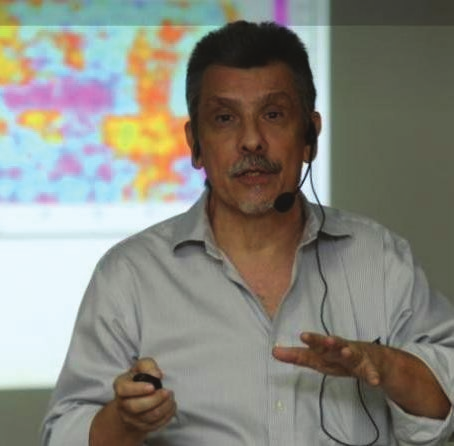
“The industry has become more challenging due to economic constraints and reduced operational activity, but geoscientists living and working here in Venezuela have adapted with creativity, collaboration, and a strong academic- industry connection,” he said.
“Despite limitations, technical excellence and integration remain very strong,” he added.
Pinto obtained a geological engineering degree at the Universidad de Oriente in Venezuela in 2002, the same year that 18,000 PDVSA workers left the company. He received postgraduate degrees from the Institut Français du Pétrole in France and the Complutense University of Madrid but, unlike many peers who took positions abroad, decided to pursue professional opportunities in Venezuela.
“I chose to stay in because my family is here and our life plan has been developed in our country,” he said. “I believe deeply in the technical potential of our country and the value of contributing locally.”
While he does not rule out leaving the country if a professional opportunity aligns with his family’s plans, for now, Pinto is content building his career in Venezuela.
“Venezuela has been my training ground for 20 years, and I’ve always felt a responsibility to apply my skills here and support younger geoscientists.”
Pinto works as senior reservoir geologist at CARDON IV, S.A., a joint venture of ENI and Repsol.
He said he credits his ongoing professional development, professional diversification (in both industry and academia) and strong technical capabilities with keeping him employable and valuable even under difficult conditions.
Pinto serves as vice president, education coordinator and event organizer for the Venezuelan Geological Society, which recently applied for affiliated-society status with AAPG.
Pinto shared how service to professional associations provides a sense of purpose and engagement to geoscience professionals in Venezuela.
“Motivation comes from passion for the geology of our country, pride in our technical heritage, and the sense of belonging in a closeknit professional community. Many of us also stay motivated by mentoring students and helping maintain high academic standards.”
In addition to his role as region delegate, Pinto has served as AAPG Latin America and Caribbean Region liaison to AAPG’s Division of Environmental Geosciences, and he has authored publications for AAPG conferences and publications.
He also supports AAPG student chapters in Venezuela and other LACR countries, serving as a judge for the Imperial Barrel Award competition and as an adviser and speaker for the AAPG Young Professionals Venezuela Chapter’s Ready to Work program.
Pinto describes the environment for students and young professionals as “challenging but inspiring.”
“Students face resource limitations, yet they remain highly motivated, creative, and eager to learn. Fieldwork and research often require extra effort, but the quality of geological training in core universities remains rigorous,” he said.
“As an AAPG delegate I keep in touch as an advisor and organize technical talks for students to learn as much as they can.”
Domestic Integration, International Collaboration: Mario’s Story
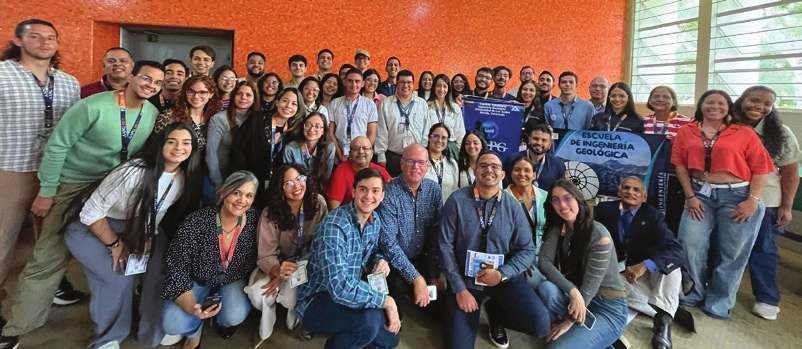
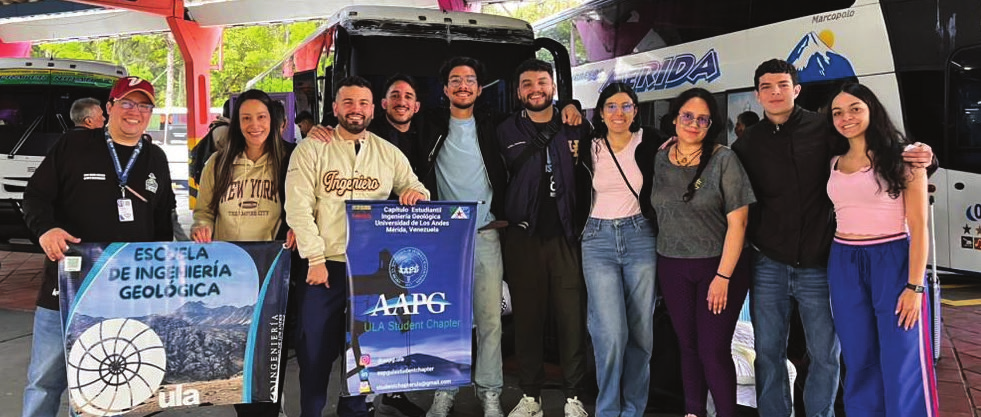
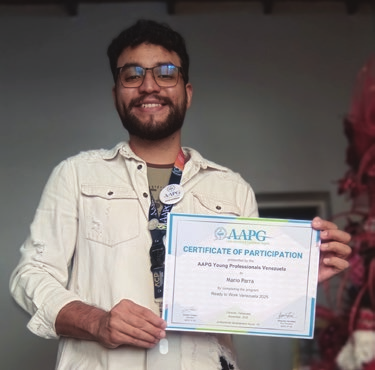
AAPG serves as a lifeline for students like Mario José Parra Mercado, vice president of the AAPG Student Chapter at the Universidad de Los Andes (ULA) in Mérida, Venezuela.
Parra, who is completing his undergraduate thesis in geological engineering, said AAPG helps to mitigate an issue faced by university students in Venezuela, direct connection with industry professionals.
“The absence of a large part of Venezuela’s geoscientific community affects connections between industry and universities, hindering opportunities to explore energy innovations and acquire technical learning. The result has impacted innovation in the sector and resulted in dependence on a single energy resource,” he said.
Parra represented the ULA chapter, and Venezuela, as the only Venezuela student to participate in the AAPG LACR Student and Young Professional Leadership Summit held in Rio de Janeiro last October. Parra represented Venezuela and joined a group of 11 students and nine young professionals for three days of intensive professional and personal development sessions and training in leadership, communications, ethics and service.
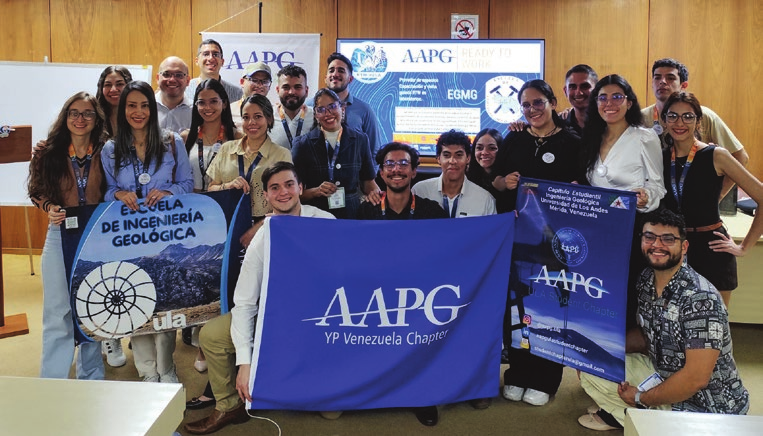
He worked with Summit graduates from Argentina, Bolivia, and Colombia to organize the Virtual Andean Summit, highlighting structural geology of the Andes mountains, in December 2025. He shared how service to the chapter provides him with a deep sense of fulfillment.
“For me, being vice president of my chapter is much more than a position; it is my way of serving and persevering,” he said.
“My work involves keeping hope alive in our classrooms, demonstrating that Venezuelan students have the talent to shine anywhere – whether organizing the Andean Summit or flying our flag in Rio de Janeiro.”
Parra hopes to use AAPG as a platform to inspire others and to give back what AAPG has given to him.
“Through the AAPG, I want my colleagues to know they are not alone and for the world to see that, although we may lack resources, we have more than enough heart, creativity, and resilience,” he said.
“My commitment is to build bridges so that our generation can be the one to rebuild the industry and the pride of our beloved Venezuela.”
Parra credits his AAPG leadership role with helping to promote integration within AAPG chapters in Venezuela, to build bridges with chapters in other countries and to connect with other geoscience professionals and development initiatives.
Parra expects to graduate in August 2026, and he plans to stay in Venezuela. He hopes that any future transition will provide a better environment for geoscience students.
“I’d like to see greater investment in industry-academic programs that allow students to learn about the job market from the initial stages to create a sense of belonging and motivation, and advanced professional development programs focused on the diversification of energy resources,” he said.
He also hopes to see increased diversification in a new Venezuelan economy.
“Venezuela’s economy is currently driven primarily by the oil and gas sectors; however, the role of geoscientists, especially those with experience working with new technologies, contributes to economic improvements in the country. Their ability to adapt and implement these technologies in subsurface production and their capabilities will establish an economic system geared towards growth.”
When asked if a political and economic transition in Venezuela are forthcoming, many geoscientists express cautious optimism.
Regueiro said he hopes that Maduro’s exit from the country is only the beginning of a series of positive developments for Venezuela.
“In the short term there are still many political challenges and internal disputes that might interfere with the required changes, but if those are solved, the midterm and long term look very promising,” he said.
Diaz said talk of a new energy policy in Venezuela provides a “highly optimistic outlook” for the country.
He recalled how a brief period of industry momentum in 2023 demonstrated that even a slight recovery in oil activities significantly revitalized the broader economy.
“Because the energy sector is the backbone of our national infrastructure, the revitalization of mature fields and the launch of new exploration campaigns represent a vital path forward. These developments will not only benefit the nation,” he said.
Rebuilding the Work Force
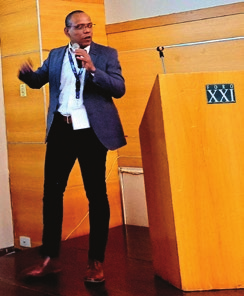
Díaz said the gradual rebuilding of the energy sector will lead eventually to the return of technical professionals.
“A critical first step will be evaluating the new legal landscape governing oil and gas operations. While the first phase of recovery will likely attract international operators and service providers, the repatriation of expert talent will be more gradual,” he said.
“Many high-achieving professionals abroad will wait for tangible improvements in the country’s socio-economic and professional infrastructure before committing to a return.”
Regueiro believes most Venezuelans who left the country for better opportunities are unlikely to move back.
“Those who have made a new home will not return. Those that have had problems adapting to other countries will maybe think of returning,” he said. “Maybe many will come as companies’ expatriates, but I see it difficult for many to return. Not for the next five or 10 years, if the country gets much better.”
Pinto agreed, noting that major transitions take time.
“In the long term, stability and well designed institutional frameworks could create better conditions for the energy sector and for science in general. What geoscientists hope for is an environment that supports investment, research, and sustainable resource development,” he said.
“In my understanding geoscientists would return when institutional stability, clear long-term energy policies, competitive professional opportunities, and access to modern technology and research environments.”
Role of Geoscientists, AAPG
Pinto noted that, regardless of the timeline, geoscientists will be an important part of Venezuela’s transformation.
“Geoscientists are essential for revitalizing conventional and unconventional resources, optimizing mature fields, improving exploration and production efficiency, and supporting energy transition strategies,” he said.
“We can help rebuild technical capacity and train the next generation.”
He said professional associations like AAPG can play a key role in training the local workforce and preparing the next generation of energy leaders.
“AAPG can support geoscientists by expanding access to online training for all geoscientist professionals working in Venezuela. The Association also can help by supporting technical publications, student programs, travel grants and opportunities for Venezuelan professionals to publish and present their work.”
Parra said AAPG can facilitate connections between professionals and consultants, organize courses and serve as a bridge to global knowledge needed to modernize the country’s energy industry.
When asked what other geoscientists should know about their country, Venezuelan geoscientists had several key messages to share.
Diaz described Venezuela as a country defined by the warmth of its climate and the even greater warmth of its people.
“Beyond our natural beauty, we possess a high standard of academic excellence and a workforce of exceptional caliber,” he said. “Above all, I want the world to know about the profound resilience of my fellow citizens; we are a people ready and determined to rebuild our nation with passion and expertise as soon as the circumstances allow. We carry a spirit that remains undeterred by challenge.”
Pinto said Venezuela has worldclass geology and worldclass geoscientists.
“Supporting scientific connections with our community helps ensure that our knowledge, experience, and potential continue to contribute meaningfully to the global geoscience community,” he said.
“Despite all challenges, our technical community remains strong, knowledgeable, collaborative, and deeply proud of our geological heritage. We remain committed to excellence and to contributing globally.”
Message for the AAPG Community
Parra had a special word for the AAPG community.
“Being part of the geoscientific community, and above all, being Venezuelan, is an act of pure love and resilience. As young people who learned by the skin of our teeth, sometimes without transportation, without electricity, sometimes without food in our stomachs, we have learned that our greatest wealth is not oil, but our unwavering will to succeed,” he said.
“Those who emigrated carry the country in their suitcases, and plan to carry knowledge back. Those of us who remain in the classroom have a commitment: to learn from the best to recover our land and its greatness. We don’t just study rocks; we study to rebuild our home.”
He also expressed deep gratitude for the opportunity to contribute to an AAPG Explorer article.
“For us students continuing our education in Venezuela, these communication channels are much more than an interview; they are a chance to make our struggle and our hope visible,” he said.
“Thank you for allowing the world to hear the voice of a generation that, despite the challenges, refuses to give up. It is vital that people know that in our universities, like the University of Los Andes, we are still working tirelessly, passionately pursuing science, with our eyes fixed on the future.”