
Years back on a family vacation, my teenage niece pronounced to me that “Oil is bad.” After letting her know that my oil industry salary was partially funding her summer beach vacation, we started the conversation about how much oil is a part of her life. From tires to plastics to make-up to medications, we covered it all and by the time I started to talk about the geologic time scale and the eustatic sea level curve, I lost her to her cell phone. Her thoughts are not unique and are commonly held by others. This perception has farranging implications and has impacted a generation of perspective geology students.
A Call for Assistance
In September, I was contacted by a University of Nebraska at Lincoln geology professor and AAPG member asking me to author a letter on behalf of her geology department. The university is considering the elimination of the department for budget reduction purposes. The university’s goal is to reduce costs by $27.5 million. Several other departments are also being considered in this reduction. The Earth and Atmospheric along with the Meteorology and Climatology departments contain 12 full-time employees and represent about $1.85 million in annual cost. Although enrollment numbers are difficult to obtain, approximately 35 graduate students are in the program, according to the graduate student directory posted on the departmental website. A final determination of the department’s fate will be made on or about Dec. 5, when the Board of Regents vote on the final recommendation tabled by the university’s chancellor.
Geoscience Department Closures
Other geoscience departments across the globe have been facing similar determinations. In the United Kingdom, six years ago there were 11 universities that offered degrees in geophysics. Today there are only eight. The United States’ university geoscience departments have experienced similar contraction, especially since 2018 (figure 1).
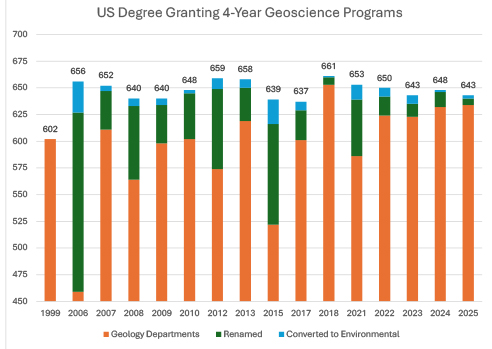
This data shows that in the past seven years, 18 geoscience departments have been shuttered or rolled into environmental studies or other similar departments. This dropped the total count of geoscience programs granting four-year degrees from 661 to 643 (3-percent decline).
Geoscience Enrollments
What is driving these decisions?
The short answer appears to be enrollment. Student geoscience enrollments across the globe are cyclical and presently are heading downward. Several spikes in enrollment data can be observed in the early 1980s, the late ‘90s to early 2000s, and from 2010 to 2020 (figure 2).
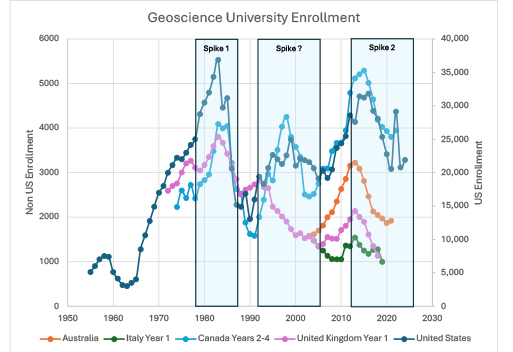
This volatility is likely unsettling to universities and equates to financial risk. Enrollment clearly matters to university leadership. It is hard to justify geoscience departments when enrollment numbers are so low and they do not support the load of faculty and other departmental costs.
Geoscience is also not one of the easier majors on campus. Geoscience students are typically required to take chemistry, physics and calculus along with their geoscience courses.
The logical next question becomes: What is causing these spikes in enrollment or volatility?
Oil and Enrollment
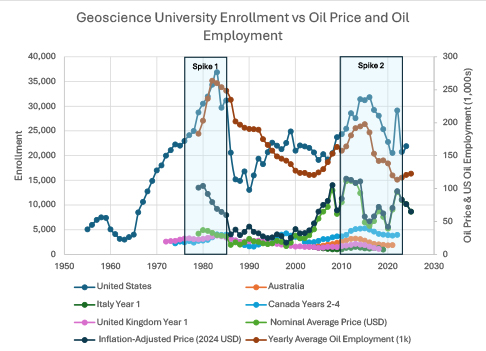
I believe it is linked to the availability of sufficient and rewarding employment opportunities. When oil price and U.S. oil extraction employment data are charted against geoscience enrollment data, the spikes in enrollment can largely be explained (figure 3). When the oil industry employs larger numbers and commodity prices are higher, more students enroll in geoscience majors. The oil industry has high-paying jobs that are professionally enriching. Inherently, this attracts students.
Firsthand Observations
Clearly this has implications for the petroleum industry and our membership. In the span of two weeks this past month, I had two discordant experiences where I could witness the implications of geoscience enrollments. I attended the Geological Society of America’s Connects event in San Antonio, Texas and the AAPG International Research Symposium on the Interaction between Earth’s Spheres and Deep Oil and Gas at the China University of Petroleum in Qingdao, China. Both were exceptional events with high student engagement, but the pulses were different.
At the GSA event, I not only met with AAPG student chapter leaders, but I also met with university faculty professors and other directors of geological societies. Three themes emerged from my discussions. First, students are either dismissive of the oil industry or keenly interested and engaged. It was enjoyable to talk to all of them and their enthusiasm was energizing.
Second, academic departments and other societies are fighting for their lives. Enrollment concerns have universities scrambling and membership is down in other professional societies. Students are often seeking climate change degrees that are either unstructured or lack career and licensing potential. Regretfully, the number of geoscience students is just not there for the departments. Thirdly, all of these parties were starved for funds and are expressing concerns about government grants. Students want scholarships and their AAPG memberships funded. Research universities have learned that initiatives or research that was once funded is no longer viable and they are scared. They are also keenly aware of who sits in the Oval Office and the implications this has on governmental funding. In short, the AAPG’s Foundation has a lot of fertile ground in which to plant seeds.
In China and other foreign or region locals, the calculus is different. China has at least four universities dedicated to petroleum. The China University of Petroleum in Qingdau (East Campus) has 180 faculty members and between 1,500 to 2,000 students focused on geoscience. Approximately 50 percent of that student count are graduate students. This large department has firm funding in place, world class labs with specialty equipment and is building a new campus. Students on this campus have historically been able to find employment in industry. Additionally, the following are sibling universities with similar scope and size; China University of PetroleumBeijing, Southwest Petroleum University and Northeast Petroleum University. Furthermore, these universities view the AAPG Bulletin as the highest-ranking journal in which to publish their research. It is no wonder such high amounts of articles are submitted for publication from the Asia Pacific Region, because of their scale and resources.
Tale of Two Events
So I am left to wonder if this is not “A Tale of Two Cities”? Charles Dickens’ tale starts with, “It was the best of times, it was the worst of times, it was the age of wisdom, it was the age of foolishness, it was the epoch of belief, it was the epoch of incredulity, it was the season of Light, it was the season of Darkness, it was the spring of hope, it was the winter of despair.” The climate change discourse and the ebb and flow of oil and gas employment invariably has had an impact on geoscience university enrollments. In the future, it will become apparent that subsurface geoscience will play a critical role in the future of our energy needs and climate change aspirations.
Subsurface geologists are needed to sequester carbon, to enable geothermal energy development and to mine lithium from produced water for electrical vehicle use. Moreover, the skills and competencies of the oilfield are applicable to these arenas. This inside knowledge, however, is a longterm view and likely beyond the actionable time frame of the universities. When the geoscience enrollment cycle swings back — and it will – enrollments will rise into an environment of fewer departments. The AAPG will need to be ready and positioned to address the needs of the next generation of geoscientists. It will also need to act now to help our current members upskill and reskill to meet tomorrow’s subsurface energy needs.
Conclusion
In the interim – When was the last time you visited your alma matter and its department of geology? AAPG member and Foundation involvement at the university level is needed now more than ever to help students and university leadership see that the perception that “Oil is bad” is not anchored in reality and fails to see how critical it and the study of geology are to our energy security future.
And finally, I think my niece might be coming around. She has graduated college, has a sea captain’s license and now schedules ship traffic for an eastern seaport. She ensures freighters and oil tankers make it safely to port.