
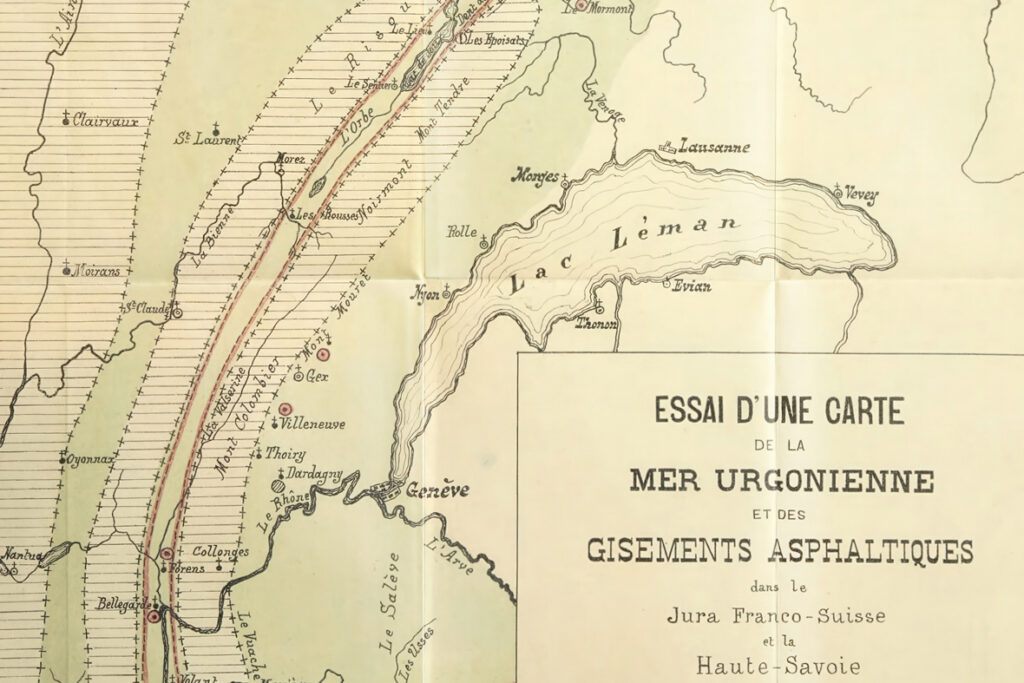
Switzerland is well known for its watchmaking, electronics, chemical and pharmaceutical industries, as well as its chocolates, cheeses, banking sector and world-class ski resorts. It is also home to the headquarters of numerous international institutions and co-hosts the European Organization for Nuclear Research – or “CERN,” as it is better known – the world’s largest particle physics laboratory. Nevertheless, one of Switzerland’s most successful and leastknown legacies is its longstanding asphalt mining industry, spanning more than 270 years. Its renowned asphaltic products were marketed worldwide from the mid-19th to late-20th century.
Switzerland’s diverse and complex geology, stretching from the Alpine nappes to the Molasse foreland basin and the Jura fold belt, has nurtured the development of highly skilled geologists trained in one of the world’s most intricate geological settings. However, despite this expertise and the drilling of almost 40 petroleum exploration wells, Switzerland has not yielded any significant commercial success in such a structurally complex subsurface. This is despite the frequent recording of oil and gas shows while drilling, in addition to surface oil and gas seeps and asphalt impregnations, which are not unusual in this mountainous country, as is the case of Val-de-Travers in the Jura fold belt of western Switzerland.
Discovery and Early Exploitation
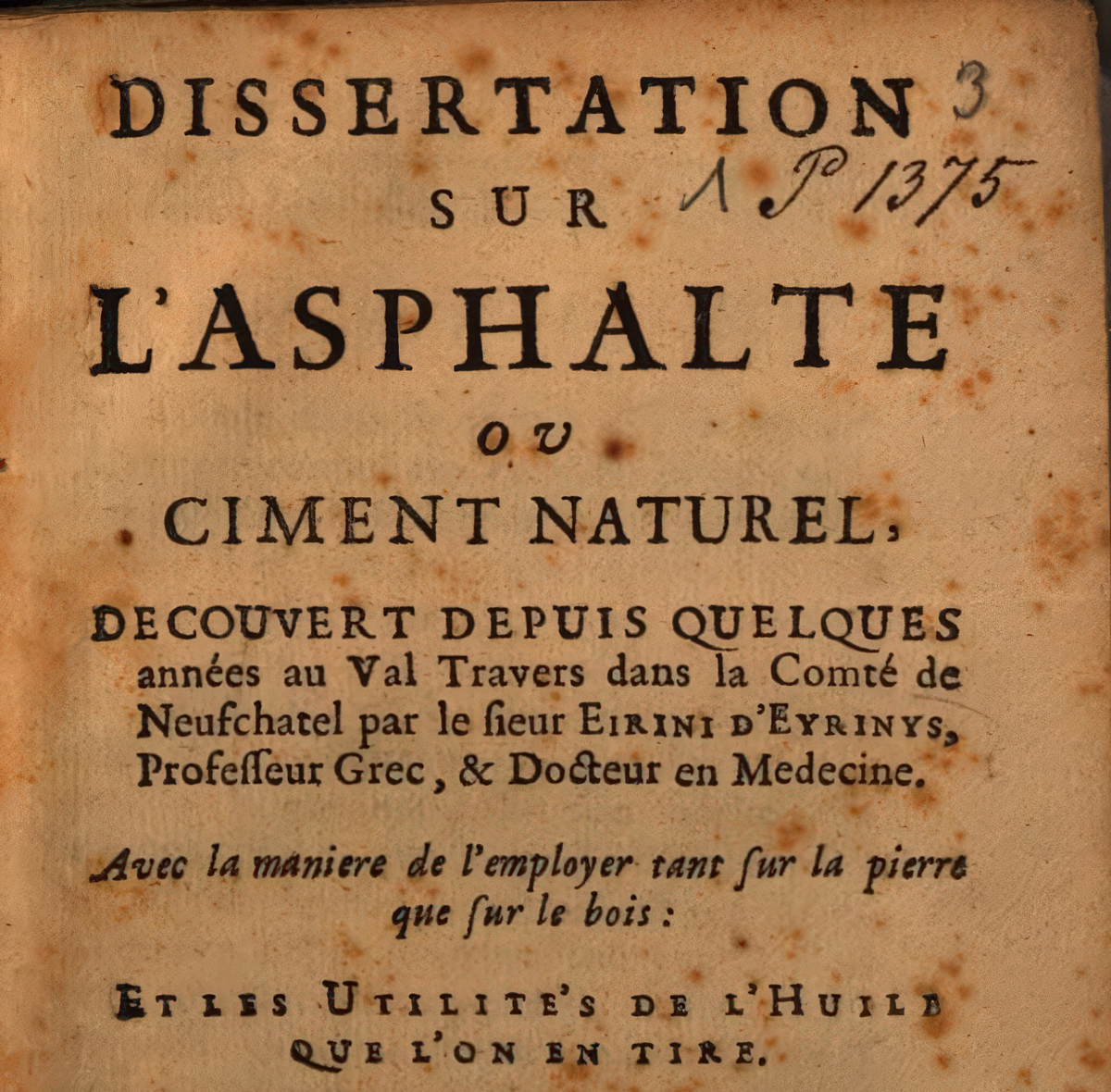
In 1711, Eirini d’ Eyrinys, an elderly Greek physician, identified the first asphalt deposits in the Val-de-Travers region of the Canton of Neuchâtel, along both sides of a narrow valley traversed by the Areuse River. Eyrinys was more intrigued by the therapeutic properties of asphalt than its geological significance. However, he laid the groundwork for modern commercial asphalt applications years later. His 1721 manual, “Dissertation sur L’Asphalte ou Ciment Naturel” documented asphalt’s diverse uses and explored the various applications of the oil extracted from it.
The Eyrinys text, while written for the public, also served to legitimate his claim for mineral rights at Val-deTravers. It provided valuable insights into the production of asphalt cement and highlighted the material’s potential for building construction, paving surfaces and waterproofing, as well as for medicinal uses for humans and animals. Eyrinys was sure that it would cure rheumatism, wounds and other scourges. The text’s didactic nature contributed to its recognition in the renowned “Encyclopédie” by Diderot and d’Alembert.
In December 1717, the King of Prussia – who ruled over the Principality of Neuchâtel at the time – granted the region’s first official mining concession for various minerals to Eyrinys, and exploitation of asphalt began in Val-deTravers. Initially, asphalt was primarily used for waterproofing and coating. Despite a promising start, the exploitation fell into neglect following Eyrinys’ death. After his death, the exploitation was made by several different companies, of which there are a few records. Extraction remained open-pit and was limited to the Bois de Croix deposit, situated on the northern bank of the Areuse River.
Records suggest large-scale underground mining began around the mid-19th century at the La Presta asphalt deposit on the Val-de-Travers’s southern side. By then, this asphalt was mainly marketed as a waterproofing material for pools, pipes and boat caulking. La Presta was in tough competition with other mines that began to open in France’s Jura Mountains, including the Seyssel deposit discovered in 1735 in the Rhone Valley.
However, it was the business acumen of Swiss chocolatier Philippe Suchard who transformed the mining operation in Val-de-Travers from an occasional venture into a thriving industry between 1841 and 1849. His operation achieved great commercial success and quickly reached a production level of 1,500 tons of asphalt per year. Suchard actively promoted asphalt use while also expanding his chocolate business. He started to asphalt the roofs of his factories and to pave the roads to his vineyards. By 1846, the asphalt extracted in Val-de-Travers represented 20 percent of the world’s production, mainly used for paving sidewalks and streets in European cities.
Asphalt Geology
The Val-de-Travers is in the folded Jura Mountains. The asphalt is found impregnating the pore spaces of Early Cretaceous-aged limestone beds in the upper section of the “calcaires urgoniens (Urgonian limestones) du Jura.” The asphalt-rich beds are exposed along the northern and southern flanks of a gentle anticline within the narrow Val-de-Travers syncline.
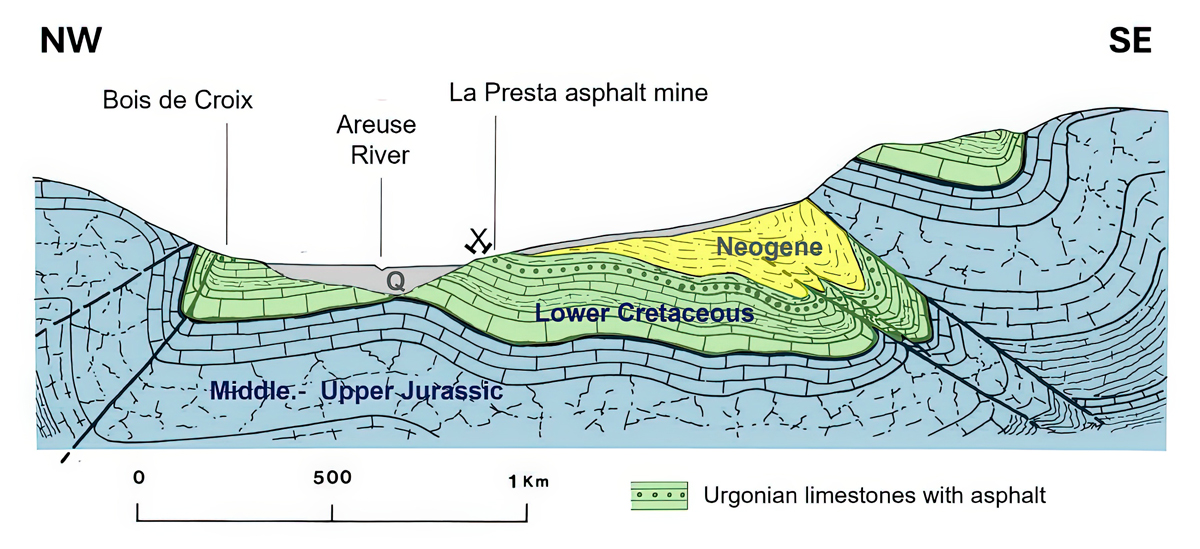
While several limestone layers contain asphalt, only two were economically viable for exploitation, They were named “Bon Banc” (good bed) and “Petite Couche” (small layer) by the miners in La Presta. As the name suggests, the Bon Banc is the main layer – a 4 to 6-meter thick grainstone bed with 20-percent porosity on average. It appears irregularly impregnated with 8 to 12 percent of asphalt along an area 1,300 meters-long by 700 meters-wide.
The origin of asphalt is related to the biodegradation of a precursor oil that once accumulated within the pore spaces of the carbonates. The widely accepted model suggests that oil was generated from an uncertain source rock and later migrated into the upper section of the Urgonian carbonate layers, although some authors have proposed an in-situ origin for the precursor oil. Subsequent tectonic uplift and folding triggered oil remigration along these carbonate layers. Over time, erosion and subaerial exposure created favorable conditions for bacterial activity, which gradually degraded the oil, transforming it into a highly viscous asphalt that remained pooled within the porous carbonate layers.
Industrial Expansion, International Reach
In the second half of the 19th century, ownership of the asphalt concessions changed hands several times. It passed through companies such as the French Compagnie Générale des Asphaltes, the Swiss Société des Asphaltes du Val-deTravers and the Val-de-Travers Asphalt Society – the first English company associated with Neuchâtel asphalt, which held a monopoly on its application in England and the British colonies. Eventually, control of the concessions was consolidated under the Neuchatel Rock Paving Company Ltd. (NRPC Ltd.), along with five other small British firms.
In July 1873, the English firm The Neuchâtel Asphalte Company Ltd. (NACO Ltd.) was established in London to acquire all concessions and the mines, works, business, properties and assets of NRPC Ltd. and other companies. After the acquisition, NACO secured the exclusive rights to get the bituminous rock and mineral products from the Val-de-Travers and to operate all the concessions granted by the Neuchâtel Government. This began a century-long reign by NACO over the Neuchâtel asphalt economy.
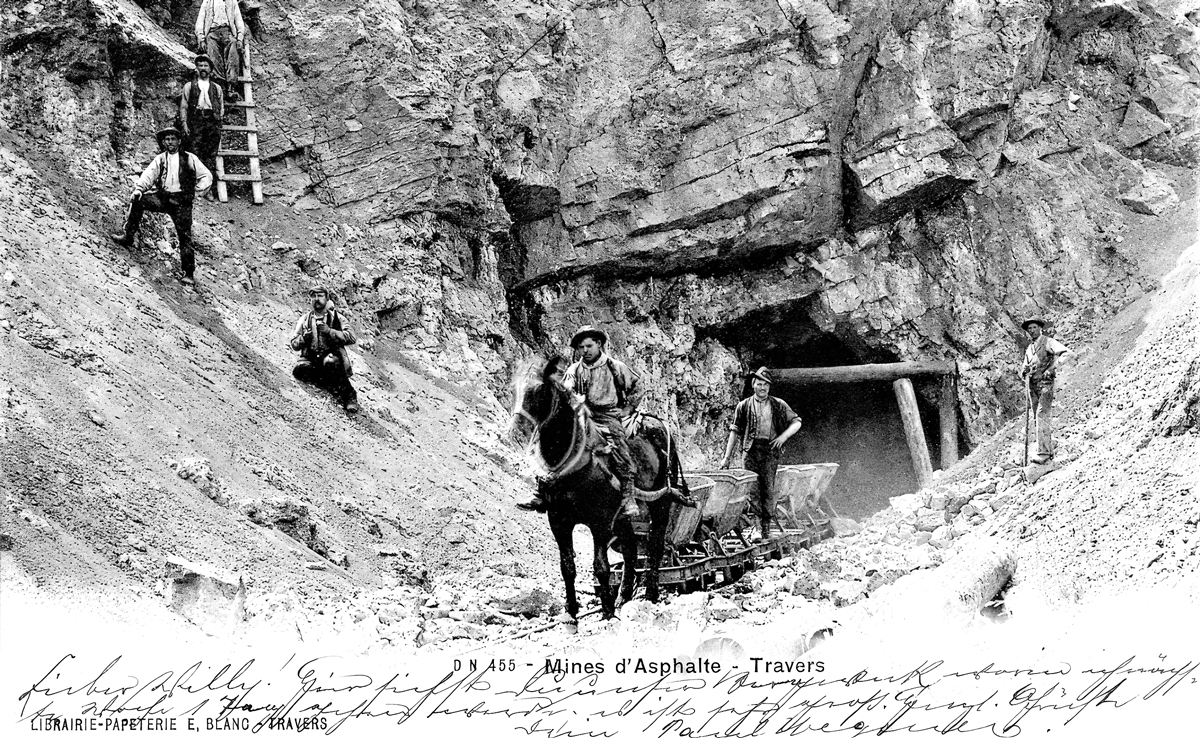
NACO Ltd. played a pivotal role in the commercialization, extraction and distribution of asphalt in Val-de-Travers for nearly a century. Large-scale underground mining operations expanded significantly, excavating a vast network of tunnels exceeding 100 kilometers in length, the deepest 150 meters below the surface. To facilitate transportation, mine rails were installed in the galleries, on which horsedrawn wagons transported asphalt to the surface processing facilities.
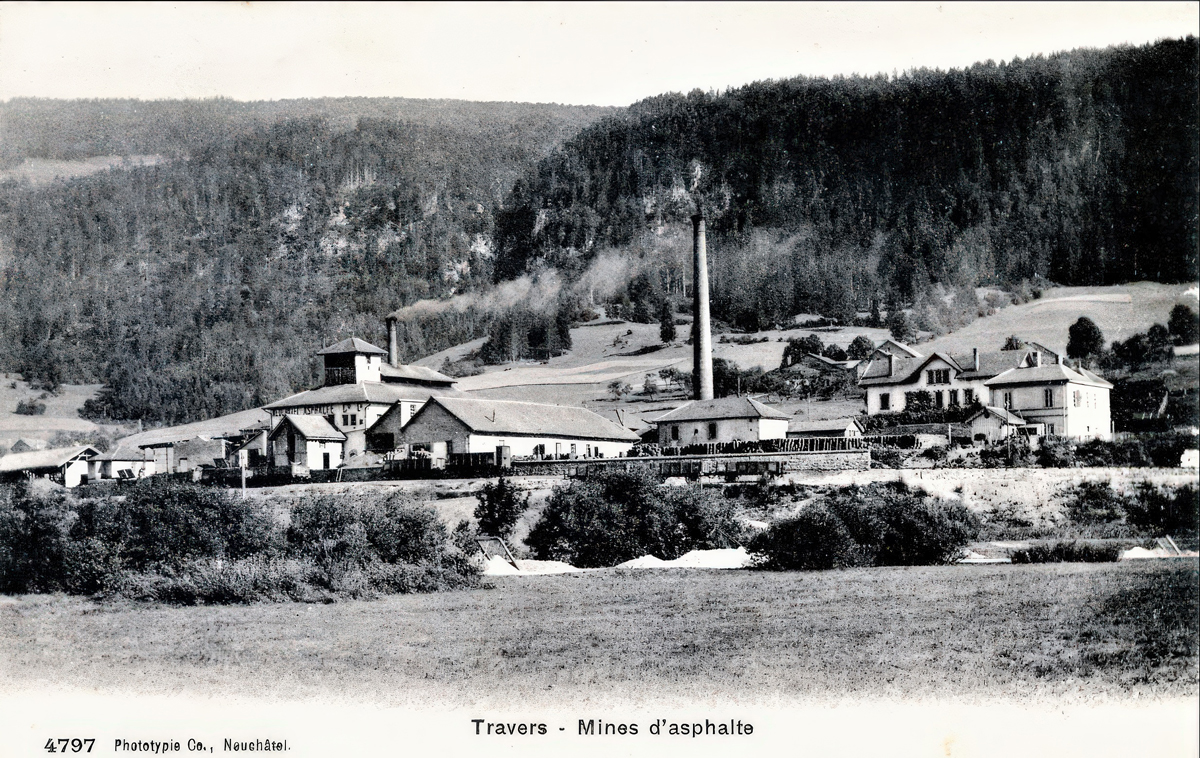
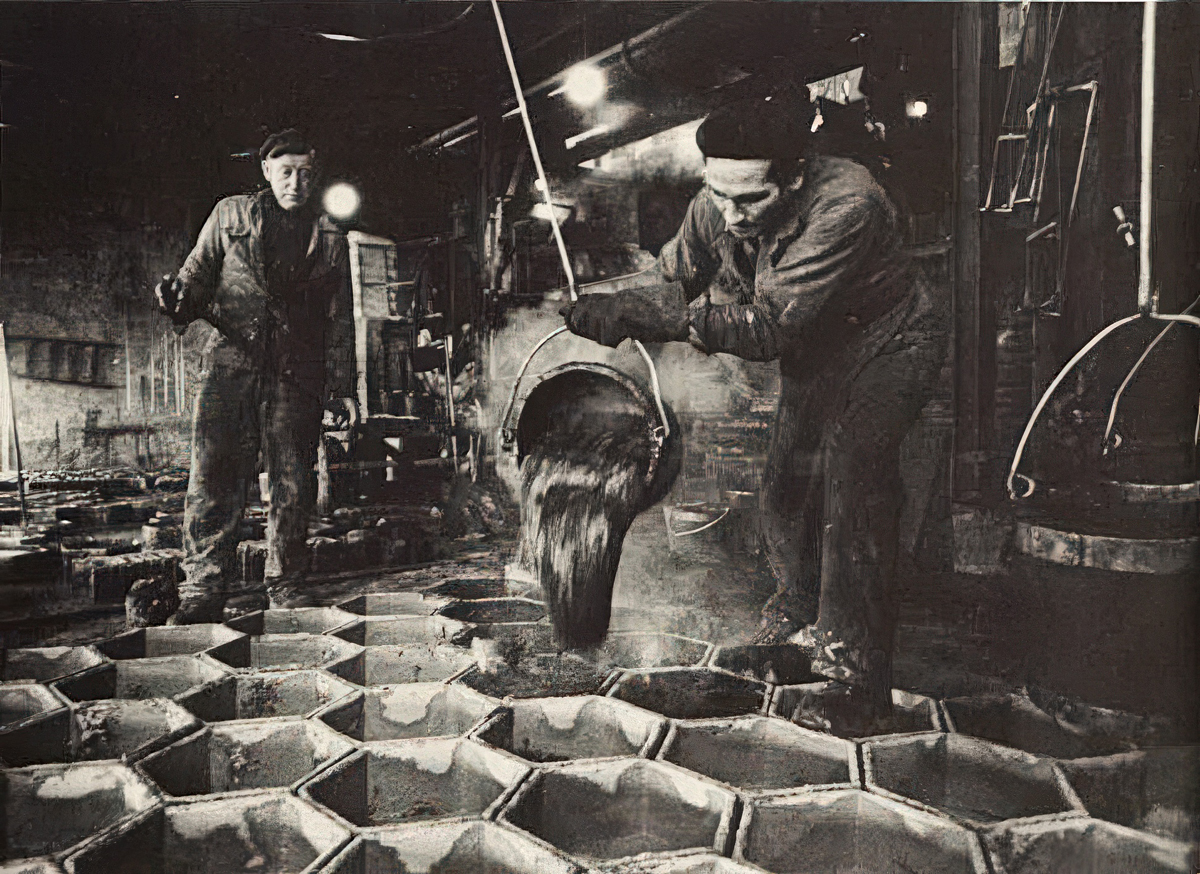
Once at the surface, the limestone and asphalt blocks were reduced to powder and brought to their melting point by heating up to 200-degrees Celsius in enormous boilers. Then the fluid was poured into molds from which, after hardening, the famous Val-de-Travers asphalt hexagonal blocks or “mastic” emerged, each weighing a quarter of a French quintal, equivalent to some 12 kilograms. The hexagonal blocks were sent to contractors who heated and re-melted them to obtain liquid asphalt. The mastic was used for footpaths, flooring, roofing and waterproofing.
NACO also refined and enhanced the paving method originally developed by John Loudon McAdam, a Scottish engineer who, in the 1820s, invented the “macadam” process for road construction. This technique involved laying and compacting crushed stones mixed with sand onto the ground, then covering the surface with an asphalt layer. Mixing crushed rocks with asphalt eventually led to the term “tarmacadam,” later shortened to “tarmac,” a colloquial term widely used to refer to paved surfaces, particularly at airports. Building on this foundation, NACO Ltd. introduced a new product in which bituminous rock was ground to a fine powder and then compressed without any admixture. This innovative product became known as “compressed asphalt” and was mainly used for road paving.
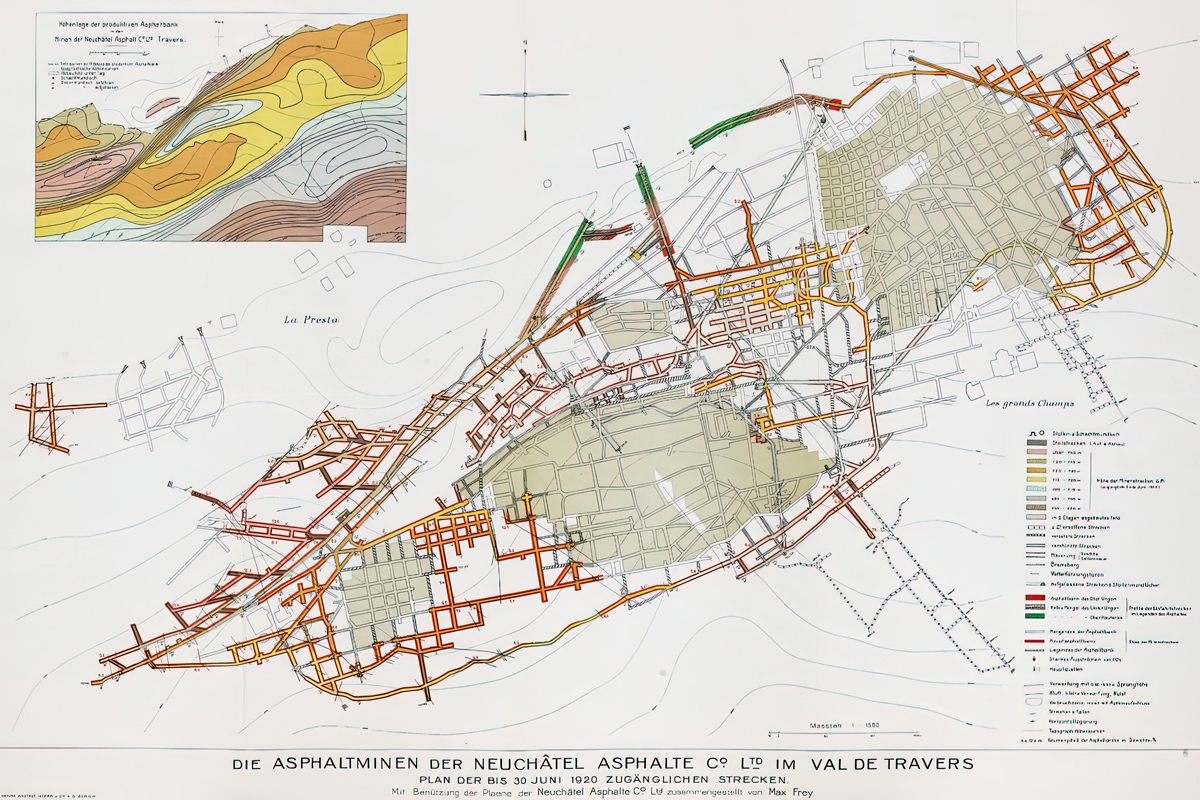
By the late 19th century, asphaltic products from Val-de-Travers had steadily gained international fame and reputation and were exported worldwide. Commonly known as Neuchâtel asphalt, it was considered an almost perfectly natural combination of calcareous rock and bitumen for paving. The streets and sidewalks of London, Paris, Berlin, Stockholm, Sydney and New York started to be quite literally paved with Swiss asphalt.
The main international competitor of the Val-de-Travers asphalt was Pitch Lake in southwestern Trinidad, which has been deemed the largest natural deposit of bitumen in the world. It was cheaper to extract than the Swiss asphalt. The Trinidad Lake Asphalt Operating Company Ltd. started its massive commercial harvesting in the 1870s, with asphalt being largely exported for road-surfacing material in the United States and Europe. Despite the competition between the sources, asphalt from Trinidad was exported to Switzerland and blended with Neuchâtel asphalt to increase the bitumen content and enhance its fluidity.
The late 19th and early 20th centuries were characterized by technical progress and modernization of mining techniques in La Presta. During this time, the mine was at the height of its expansion, peaking at a production of 53,000 tons in 1913. Until the First World War, several hundred foreign workers arrived each summer to support operations, highlighting the mine’s growing importance and demand. However, exports were disrupted by both the first and second world wars.
Absorption into Tarmac, Decline
In 1969, NACO Ltd. was absorbed by Tarmac Ltd., an English company and one of Europe’s largest road construction concerns. This also coincided with profound changes in the mining and manufacturing operations. While extraction continued in some sectors traditionally with horse-drawn wagons, from 1971 onwards the exploitation system was mechanized and replaced by electric railways. Remarkably, the last horse retired in 1973.
The exploitation of the La Presta mines ceased at the end of 1986 because of intense competition with asphalt obtained as a heavy byproduct from crude oil refining and the exhaustion of the asphalt deposits. The main asphalt layer was becoming increasingly irregular, displaying rapid lateral variations in impregnation.
Until water pumping ceased in 1983, drainage had been a constant concern for miners since the early days, with reported pumping flow rates often reaching up to 100,000 barrels of water per day in the late 1960s. Coupled with severe water invasion, which rendered the lowest galleries impracticable, the mine became economically unprofitable. A total of 2 million tons of asphalt is estimated to have been extracted since the early exploitation days, back in the early 18th century.
La Presta Mine, a Touristic Attraction
Today the La Presta mine is no longer in operation and is partially open to the public for tourism. It includes a museum that evokes the hard work of the miners and the importance, richness and long history of the asphalt mining industry in Val-de-Travers.
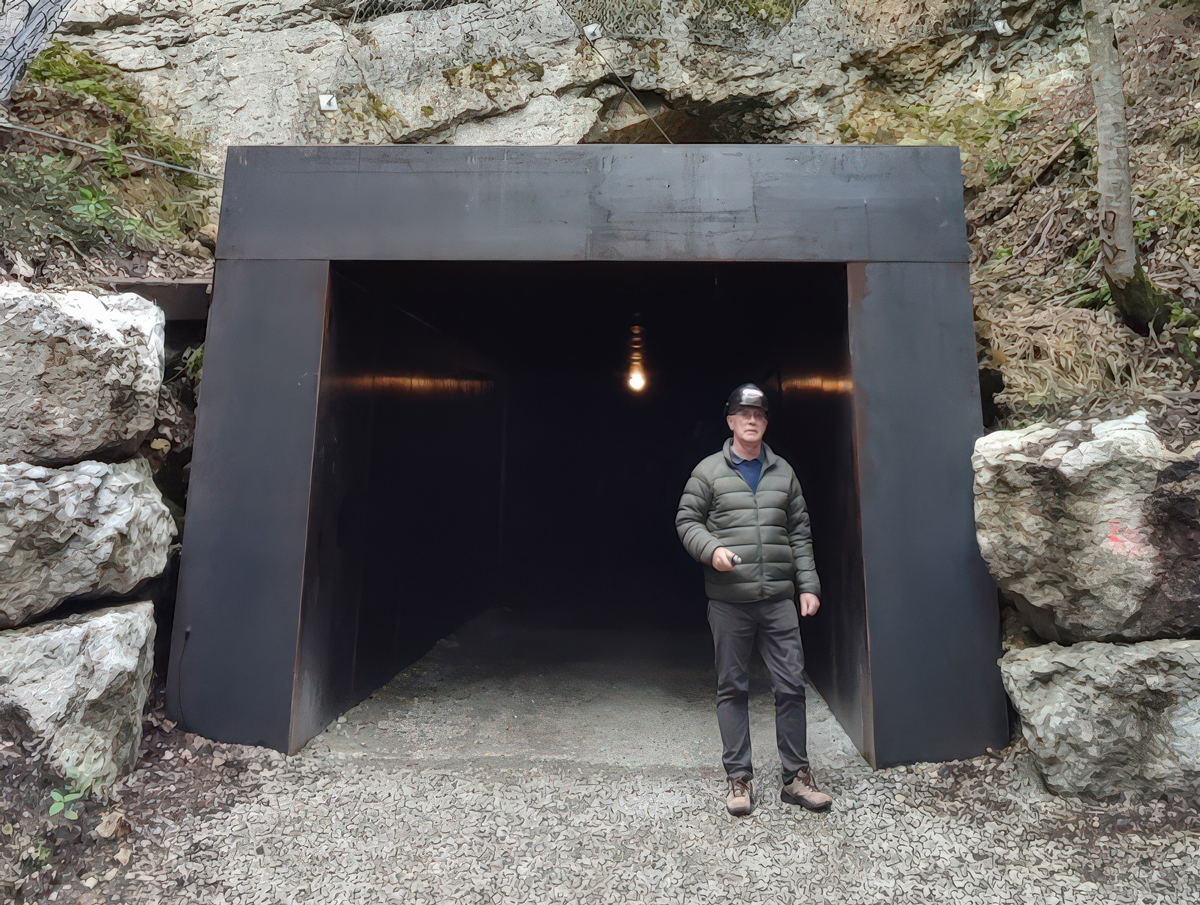
A visit to the mine galleries covers approximately one kilometer of the estimated 100 kilometers of excavated tunnels. The only equipment needed is a hard hat and a sturdy flashlight, both provided by the museum. Visitors are advised to bring a jacket or sweater to protect themselves against the constant 8-degree Celsius temperature and 90-percent humidity.
While Switzerland is rarely associated with petroleum geology, its asphalt mines in Val-de-Travers played a significant role in the industrial history of road paving, building and waterproofing, leaving behind a rich but often overlooked legacy. Tourism in the La Presta asphalt mine, once the world’s main source of this material, has emerged as a new, historical business opportunity.