
There’s truly a world full of promising oil and gas prospects waiting to be explored. Current conditions in the energy industry suggest that drilling them will happen later instead of sooner, though.
Last year “was not a vintage year” for exploration, said Andrew Latham, senior vice president of energy research for Wood Mackenzie in Edinburgh.
So far, nobody else is calling 2025 a banner year, either.
By “investment and well count and whatever measure you want, things aren’t showing an uptick at the moment. There aren’t many companies that are talking about increasing their budgets. There are companies that are increasing their footprint,” Latham noted.
Total proved discoveries and additions this year have been only fair to middling, despite some headline successes. The takeaway might be that today’s international exploration is (a) somewhat effective, and (b) expensive.
“We’re currently holding at about 5 billion barrels of oil, 3 billion barrels of oil-equivalent gas discovered year to date. It wouldn’t be too surprising if the (annual) total were to double from that,” Latham said.
“We won’t know until well into next year, when the dust has settled,” he added.
Those numbers won’t come close to offsetting worldwide energy consumption, and that’s a paradox. Oil and gas companies need to replenish reserves in a big way. But prices and revenues have slumped, throttling back exploration activity.
Economic uncertainty, reduced tensions in the Middle East and increased OPEC output threaten to send world oil prices below $60 a barrel. A recent Baker Hughes Rig Count report shows global offshore activity down by 36 rigs, with declines everywhere except offshore Africa.
Where are the Discoveries?
At the moment, planned and projected exploration drilling looks highly likely only in established areas, including offshore Guayana and Suriname, offshore Namibia and Angola, in the basins offshore Brazil. For most other prospects, it’s wait and see.
Asia/Southeast Asia:
Several recent exploration successes are being evaluated for further exploration potential in Asia, especially in offshore plays.
“We’re seeing some nice oil discoveries from Murphy Oil offshore Vietnam, for example,” Latham said.
Earlier this year, Murphy reported discoveries with its Hai Su Vang (Golden Sea Lion) and Lac Da Hong (Pink Camel) exploration wells off Vietnam. The first has a gross resource potential of 170 million-430 million barrels of oil equivalent, according to the company. Both wells were drilled in about 150 feet of water.
Eni reported significant gas reserves of up to 5 trillion cubic feet two years ago from its Geng North discovery offshore Indonesia, about 85 kilometers off East Kalimantan. It followed up with an Indonesian evaluation-and-exploration drilling program.
“I would call out the drilling Eni has been doing, particularly this year. Really valuable, successful drilling there,” Latham said.
Basins north of Sumatra, in the Andaman and Nicobar Islands area and off of east India are gaining interest as potential exploration areas. Harbour Energy’s Timpan exploration well made a natural gas discovery in the Andaman Sea off Sumatra three years ago, in a block estimated to hold 6 Tcf of resources.
That was followed by Mubadala Energy’s Layaran and Tangkulo major finds, also off north Sumatra. The Tangkulo discovery, announced last year, was reported as a high quality, gas-condensate Oligocene sandstone reservoir.
“We’re watching with interest what’s going to happen with those discoveries offshore Sumatra. And Malaysia has just had a successful licensing round,” Latham said.
“We are waiting to see what commercialization plans emerge for these discoveries, which are rather large for the local market,” he added.
China continues to explore offshore in the South China Sea and the Bohai Bay area and continues to make discoveries. China National Offshore Oil Corporation announced a substantial oil discovery this year, described by a CNOOC geologist as the “largest integrated clastic oilfield in the northern South China Sea in terms of original oil in place.”
“In the offshore basins the Chinese do a lot of drilling and they tend to have a great deal of success. For (China’s) domestic companies, those are very high-value barrels,” Latham noted.
Notably, China has introduced an onshore exploration program targeting resources more than 25,000 feet (7,620 meters) deep in the Xinjiang Uygur region and Taklamakan desert.
“Some of the well depths there are remarkable,” Latham said.
North Sea/Europe:
In July, Poland announced the discovery of the Baltic Sea’s largest-ever oil and gas field. The shallow-water Wolin East find, operated by Central European Petroleum, was estimated to hold recoverable resources totaling 200 million boe, in a project area that could contain twice that amount.
Exploration drilling continues in the North Sea, where Aker BP and Equinor reported recent discoveries in August. In the Yggdrasil area, site of the biggest ongoing development on the Norwegian Continental Shelf, Aker BP’s Omega Alfa exploration campaign found an additional 96 million-134 million boe of recoverable resources. Equinor and partners made a dual-reservoir oil and gas discovery, the F-South, in the North Seas’ Fram area north of the Troll field.
New discoveries and a commitment to continued prospecting portend favorably for exploration in northern European waters. Operators had pulled back in the area, partly because of Europe’s climate and energy-transition concerns. Then sanctions on Russian energy imports gave drilling a new urgency.
“Suddenly when electricity or gas prices spiked, the political barriers to investment have eased,” Latham observed.
Terle Aasland, Norway’s energy minister, has advocated for exploration and said the country wants to be a long-term supplier of oil and gas to Europe. Aasland was reappointed to the post in September.
“Norwegian financial terms are quite favorable for exploration investment,” Latham noted. By contrast, he said, in the United Kingdom “there’s not many encouraging noises coming for people to drill exploration wells.”
“I don’t think we’ll see a lot of exploration happening in the UK, unless something changes,” he said.
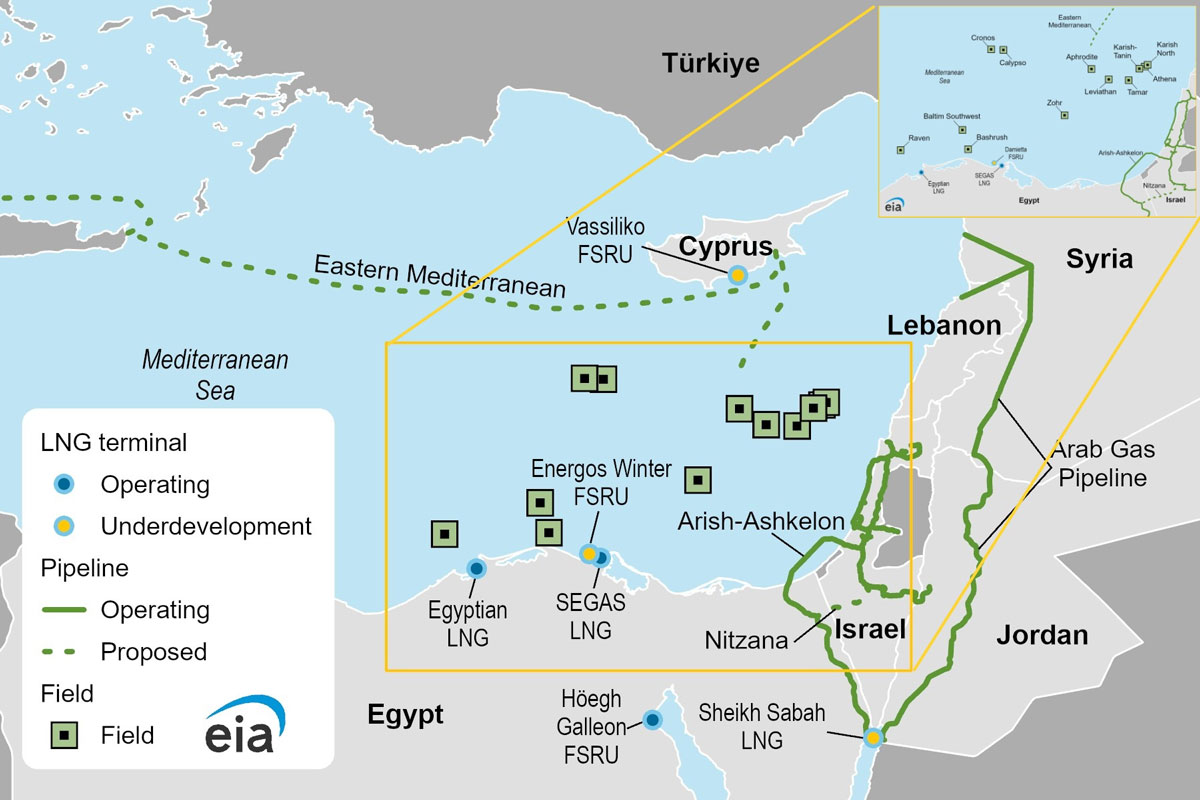
Middle East/Eastern Mediterranean:
“In the Eastern Mediterranean we’ve seen companies picking up acreage in Greek waters. We’re seeing large structures there. Turkey is very interesting,” Latham observed.
In addition, “Cyprus now looks like it’s going to be commercial volumes,” he said.
ExxonMobil and partner QatarEnergy identified a new gas accumulation with the Pegasus well in Cyprus offshore Block 10, announced in July. Combined with the 2019 Glaucus discovery and a subsequent appraisal well, also in Block 10, the project area could hold 142-227 billion cubic meters of gas, between 5.2 and 8.1 Tcf, the companies reported.
Multiple operators are evaluating exploration prospects in waters south of Cyprus. Major companies have opened several fields there, including Chevron’s Aphrodite and Eni’s Cronos.
“It’s quietly becoming a hot spot,” Latham said.
The entire area, including Cyprus, Turkey, Syria, Lebanon, Israel and Egypt, is prospective for hydrocarbon exploration – and also politically iffy. According to a recent report on the Eastern Mediterranean from the U.S. Energy Information Administration:
“In August 2024, the (Egyptian) government opened its latest exploration licensing round, offering 10 offshore blocks and 2 onshore blocks in the Eastern Mediterranean and the Nile Delta.
“In February 2025, Egypt launched an additional bidding round … that allows investors to bid on seven undeveloped fields in the Mediterranean Sea, as well as six other onshore and offshore areas in the Gulf of Suez and the Western Desert.”
Lebanon extended the deadline for bid submissions in its third offshore licensing round to late November this year, and Israel is expected to begin a fifth offshore round in the near future, the EIA reported.
“Six of the seven majors have acreage in the eastern Egyptian offshore, south of the Herodotus Basin,” Latham noted. To encourage exploration, Egypt introduced a major ocean-bottom node seismic project this year covering 95,000 square kilometers offshore, according to its petroleum ministry.
Latin America:
Northeastern South America and Brazil dominate the conversation about Latin American offshore exploration. Additional possibilities exist all the way around the continent.
“I’m really interested in the unproven southern margin of Latin America. A lot of companies have a footprint there. A couple of wells have gone down, without discoveries,” Latham said.
Those prospects begin immediately south of Brazilian waters, off Uruguay and northern Argentina. Last year Equinor with partners YPF and Shell drilled the deepwater Argerich-1 well off the Argentine port city of Mar del Plata. The well was reported dry, and well data is still being evaluated.
Onshore Argentina, operators are trying to extend the Vaca Muerta unconventional play in the Neuquén Basin and are just beginning to launch a shale oil exploration play in the Cuyo Basin to the north. The Cuyo play is based on organic-matter rich, Triassic-age lacustrine shales.
“On the other side, Peru is quite interesting,” Latham noted.
Chevron, Anadarko and private investment fund Westlawn have formed a partnership aimed at exploration in Peru’s offshore Trujillo basin. They recently signed an amended license agreement with Perupetro for three exploration blocks. A drilling decision partly hinges on final results from a completed 3-D marine seismic survey.
Farther up the coast, a shift away from oil and gas incentives and stricter regulation by the Colombian government have constrained exploration. However, state oil company Ecopetrol and Brazil’s Petrobras reported positive tests at their offshore Sirius gas project, indicating further drilling. Other prospects lie in the ultra-deep.
“Colombia is super-deep water, 4,000 meters of water or more. It’s mind boggling, the depths they’re talking about,” Latham said.
National Oil Companies:
For years, national oil companies have been looking at exploration beyond their home countries. Latham cited QatarEnergy and Indonesia’s Petronas as examples.
And “it’s no secret that Petrobras has been getting interested internationally, after having had not much of a footprint except in Brazil,” he said.
Except for Petrobras, NOCs have participated in outside exploration mainly through partnership investing but not operating. Their considerable cash flows could help underpin future international exploration efforts.
International oil companies have scaled back exploration capital spending and seem to be hunkering down, waiting for better conditions. Despite the near-term gloom, the need to replenish reserves remains and the world still offers ample exploration prospects for drilling.
“Right now the mood music can feel a little downbeat. If you can look beyond that to the way companies are reloading their acreage, there’s hope,” Latham noted.
“Explorers can be optimistic they will be needed in the next three to five years,” he said.