
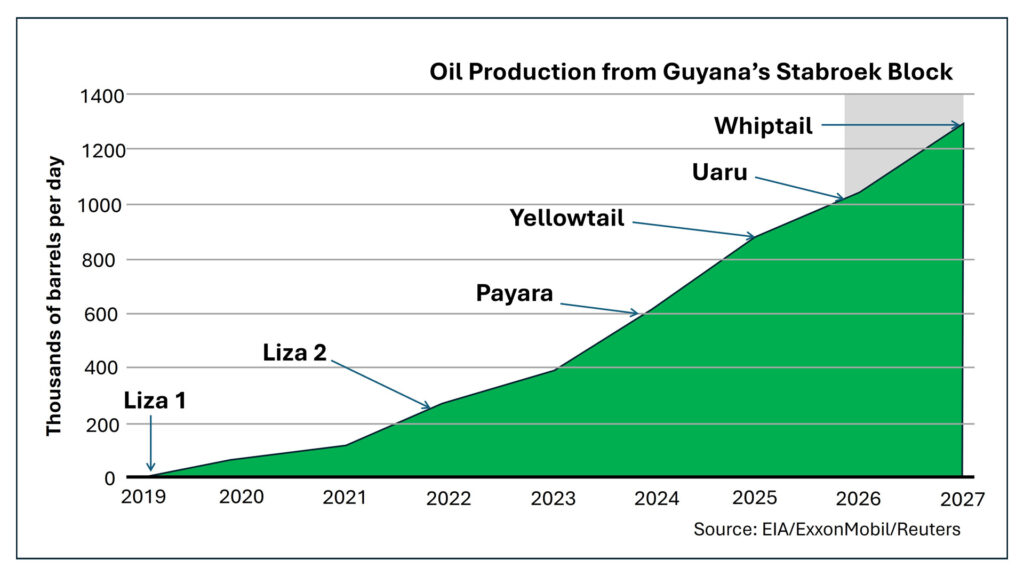
Over the past decade, the Guyana and Suriname basins in the Equatorial Atlantic Margin of South America have witnessed the largest increases in offshore oil reserves growth and production worldwide. Guyana is now on par with established deepwater super basins such as the Nile Delta, the North Sea and Brazil’s Santos basins.
Two recent events have put Guyana in the spotlight:
- ExxonMobil began producing from its Yellowtail Field using the One Guyana floating storage and offloading vessel in the offshore Stabroek Block. ExxonMobil produces roughly 900,000 barrels of oil per day from the Stabroek Block. The company forecasts it will produce 1.7 million barrels of oil equivalent per day by 2030 from eight developments in offshore Guyana.
- After a year-long legal battle, Chevron completed its acquisition of Hess, which holds a 30-percent interest in the Stabroek Block alongside ExxonMobil (45-percent share) and CNOOC (25-percent share). ExxonMobil and China National Offshore Oil Co. filed arbitration disputes for having pre-emptive rights to purchase Hess’ share in the block, but the International Chamber of Commerce sided with Chevron. With its purchase of Hess for $53 billion, Chevron is now a partner with its former rivals in offshore Guyana.
From Discovery to Success
ExxonMobil’s 2015 discovery of the Liza Oil Field in Upper Cretaceous turbidite fans opened a new chapter in the history of oil in Guyana and Suriname. This discovery was made against a backdrop of offshore drills in the 1960 and 1970s. Prior to the Liza discovery, 13 wells were drilled in offshore Guyana, of which 10 had oil and gas shows, and one well, Abary-1 drilled by Shell in 1975, had light crude flow. Nine wells were drilled in offshore Suriname at that time, three of which had oil shows. In 2003, Ocean Drilling Project Leg 207 drilled five sites on the northern edge of Demerara Plateau and encountered Cenomanian-Turonian-age Canje Formation – an organic-rich petroleum source rock deposited under anoxic conditions.
The Stabroek Block has seen 45 discoveries as of January 2025 and has emerged as the most prolific region in Guyana. The success has extended to Block 58 in offshore Suriname where TotalEnergies and Apache discovered the Maka Central, Kwaskwasi and GranMorgu (formerly Sapakara South-Krabdagu) fields. Last year, Total and Apache made a $10.5-billion final investment decision on GranMorgu with recoverable 760 million barrels of oil equivalent. GranMorgu is expected to come onstream in 2028.
In Suriname Block 52, Petronas has made three successful discoveries: Solaenea-1 (2020), Roystonea-1 (2023), and Fusaea-1 (2024). Block 52 is estimated to contain more than 500 million barrels of oil equivalent.
Tectonostratigraphic Template
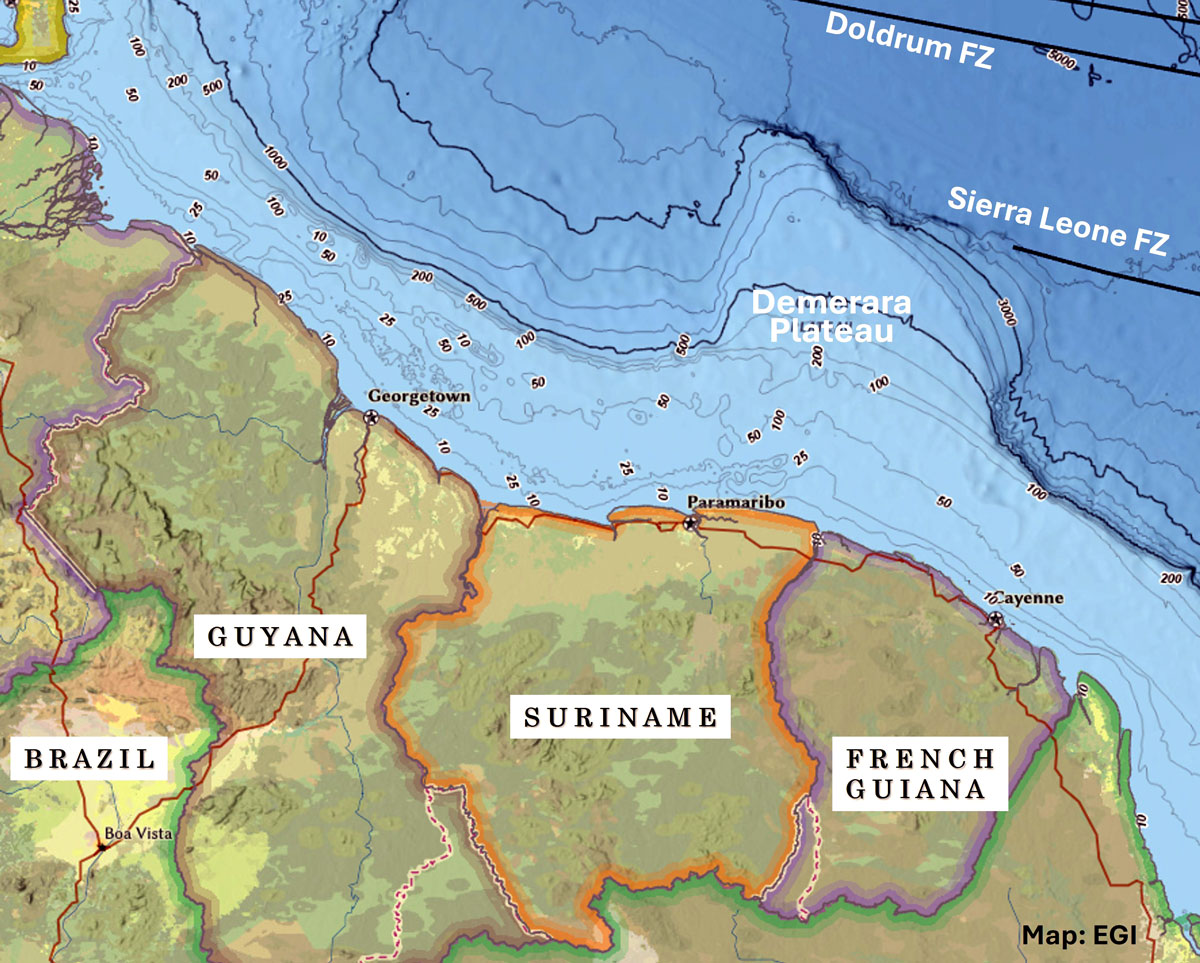
The Guyana, Suriname and French Guiana basins formed at a triple junction related to the separation of Guyana Craton (South American plate), West African Craton (African plate) and Florida Platform (North American plate) in the Late Jurassic. A failed rift arm, represented by the onshore Takutu Basin on the Guyana-Brazil border and the subsequent Berbice and Maroni paleo-river courses, focused sediment transportation from the quartz-rich Guyana craton into the offshore basins.
The submerged Demerara Plateau – a Precambrian Guyana continental crust capped by Late Jurassic rift-related flood basalts (probably associated with the magmatic activity of the Sierra Leone hotspot 180–170 million years ago) – lies at the base of thick post-Jurassic sediments. Pelagic black shales, notably Canje Formation (equivalent of La Luna source rock in Venezuela), were deposited 100–86 million years ago. Steep continental slopes and associated canyons provided space for massive turbidite sediments and slope-lobe sandstone complexes in Late Cretaceous and Tertiary times.
Currently, most of the oil and gas discoveries are in Upper Cretaceous submarine fans. The Ranger-1 discovery in a Lower Cretaceous carbonate atop a relic volcano in the Stabroek Block indicates deeper plays. Jurassic-age lacustrine or restricted marine plays also probably exist but have not been drilled.
In 2019, Tullow Oil drilled the Joe-1 and Jethro-1 wells in Paleogene slope channel sandstones. The wells encountered heavy oil (10 to 15-degree API), similar to the onshore Tambaredjo and Calcutta fields in Suriname discovered in 1960s.
Bright Horizons
Guyana, Suriname and French Guiana have a combined population of just 1.8 million. Oil boom will significantly contribute to their economic development. The submerged Guinea volcanic platform and surrounding basins in West Africa represent the conjugate margin of the Guyana-Suriname basins across the equatorial Atlantic.
Success Factors
Several factors have contributed to discovery successes in Guyana:
- Even after the Liza discovery, several dry or uncommercial wells were drilled in Guyana and Suriname. However, this has not discouraged wildcatters and, instead, companies utilized information from the dry wells to better characterize promising prospects.
- Turbidite stratigraphic traps are usually subtle and difficult prospects to drill. Companies used advanced seismic stratigraphy to distinguish between water-saturated and hydrocarbon-saturated reservoirs.
- The Guyana Basin offers a relatively low cost for oil production. Breakeven costs for oil from the Liza and Payara fields are $25–32 a barrel, compared to $36 a barrel for Brent.