
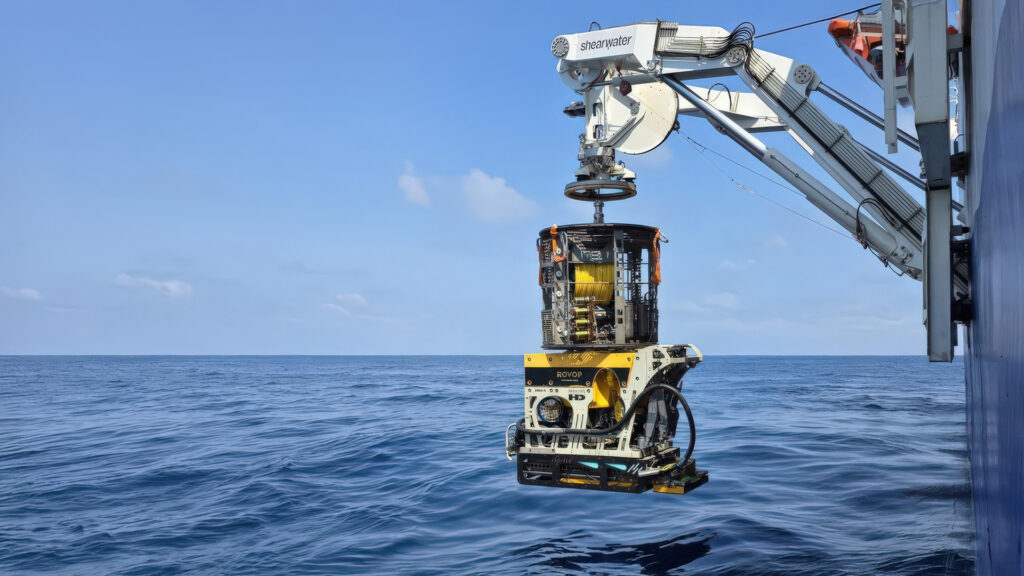
One global geophysical company called recent demand “flattish.” Another described its clients as increasingly cautious. But seismic acquisition continues around the world, with some important projects kicking off in the second half of 2025.
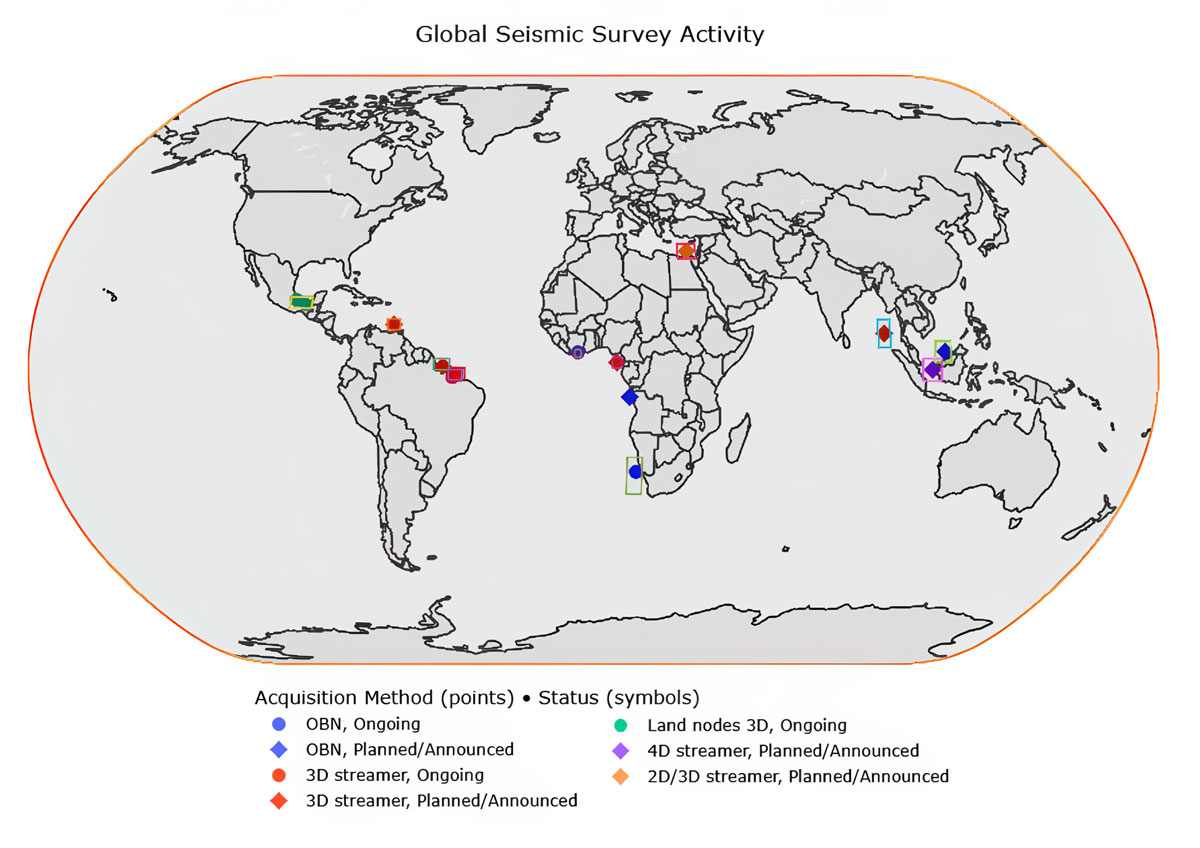
Multiple seismic survey programs now target the world’s two hottest exploration areas: offshore West Africa and the eastern coast of South America. Others are set for Southeast Asia, the Caribbean and the eastern Mediterranean.
A $20-per-barrel decline in world oil prices has definitely softened demand. The energy industry is dealing with global economic uncertainty, including the effect of U.S. tariffs. But growing pressure to replace reserves has left the geophysical sector feeling pretty good about its future.
“Although significant macroeconomic uncertainty and high oil price volatility during (the second quarter of the year) caused our clients to be more cautious in the short term, the long-term need for more exploration remains intact,” said Kristian Johansen, chief executive of TGS geophysical, in a message to shareholders.
“With falling remaining reserve life, many large E&P companies will face declining production rates unless more reserves are added and brought on stream. As a result, we remain optimistic for the long-term opportunities,” he added.
Recent discoveries in the Orange Basin brought intense interest and a slew of geophysical work to the waters offshore Namibia. Explorers are now looking north, up the West African coast to Ghana and the Gulf of Guinea, where Shearwater GeoServices is active.
São Tomé and Príncipe
A survey off this part of Africa might be described as offshore Gabon, but the small island nation of Sao Tome and Principe is right there. Earlier this year, Shearwater announced a 3-D marine seismic acquisition contract awarded by TotalEnergies on block STP-02.
Total entered the offshore block in 2024 as operator, with partners ANP-STP (the national petroleum agency) and Sonangol. The block is about 35 kilometers north of the island of Principe.
Set to begin in the second half of 2025, the two-month exploration survey marks the first project in an extended Shearwater-Total collaboration, according to the company.
Ghana
Shearwater landed a contract from Tullow Oil for the first ocean-bottom node survey offshore Ghana, extending across the deepwater Jubilee and TEN oil fields. Both fields are operated by Tullow. Shearwater also conducted a streamer survey over the fields early this year.
Jubilee was discovered by Kosmos Energy in 2007 and later developed by Tullow. Its total proven reserves are around 3 billion barrels. Tullow recently resumed drilling to address production underperformance.
“The high quality 4-D seismic data acquired at the start of the year is now being used to generate improved models that will directly inform the well-planning process and will be further supported with the capture of an ocean-bottom node seismic survey in the fourth quarter this year,” Tullow reported.
Angola
ExxonMobil affiliate Esso Exploration Angola awarded Shearwater GeoServices an OBN survey contract for offshore concession Block 15, Shearwater reported in August. The two-month project was scheduled to begin during the third quarter of 2025.
Exxon and its partners notched several discoveries on the block and have launched a redevelopment program. Three years ago, the Bavuca South-1 exploration well made a new oil discovery in hydrocarbon-bearing sandstone on Block 15.
Barreirinhas Basin, Brazil
Near-coast basins offshore northern Brazil are drawing significant attention. Operators want 3-D seismic to help identify exploration possibilities.
In September, TGS announced commencement of its Megabar Extension streamer seismic survey in the Barreirinhas Basin off Brazil. TGS will acquire the 5,300 square kilometer, multiclient 3-D survey and imaging will be provided by service and equipment company Viridien.
The basin includes proven petroleum systems and likely analogues with giant discoveries in adjacent Guyana and Suriname basins, according to TGS. Recent licensing activity in Brazil’s successful 5th Cycle Permanent Concession Offer supports growing momentum for the region, it reported.
Acquisition work is scheduled to conclude by late November 2025, with initial imaging products expected by third-quarter 2026 and final data projected to be available in first-quarter 2027.
Foz do Amazonas Basin
Shearwater reportedly plans to begin a 3-D seismic survey in the Foz do Amazonas Basin on Brazil’s Equatorial Margin in early 2026. The non-exclusive campaign includes an area of 47,264 square kilometers. Its seismic array will consist of 10 floating and solid seismic cables, 10,050 meters long each, with a maximum spacing of 150 meters.
Many analysts consider this basin key to expanding Brazil’s oil output, but drilling in the area is environmentally sensitive, especially near the mouth of the Amazon River.
Also, TGS is finishing a Phase II multiclient 3-D survey extension in the adjacent Pará-Maranhao Basin. Completion is projected in March 2026.
Malaysia
Marine geophysical provider PXGEO announced in August it had received its first survey contract offshore Malaysia.
“The campaign will play a key role in supporting Malaysia’s drive to unlock new hydrocarbon resources and accelerate upstream exploration aligning with the Malaysia Petroleum Management aspiration,” the company reported.
Delivery will include multiple surveys using 2-D- and 3-D-towed streamer technology with the added possibility of OBN. The two-year agreement includes a minimum of 365 days of acquisition activity, the company reported.
Indonesia
TGS planned to begin a roughly 10,000 square kilometer streamer survey offshore Indonesia before the end of this year. The eight-month project will include 3-D seismic acquisition for exploration, utilizing a purpose-built Ramform vessel with GeoStreamer technology, it reported.
A month-long final phase will then involve 4-D seismic data acquisition for production monitoring.
Trinidad and Tobago
ExxonMobil has agreed to acquire 3-D seismic data over part of ultra-deepwater Caribbean block TTUD-1, in a projected $42.5 million initial investment. Part of a production sharing contract, the block is about 300 kilometers offshore Trinidad and Tobago.
Exxon is expected to drill at least two wells in the initial exploration phase. The 7,165 square kilometer consolidated area lies northwest of the company’s highly successful and prolific discoveries in the Stabroek block offshore Guyana.
Other Seismic Projects
In other areas, Chinese energy company Sinopec deployed up to 65,000 land nodes in a 3-D seismic survey covering about 3,000 square kilometers in the Tabasco and Veracruz regions of Mexico, according to equipment supplier Viridien.
India is encouraging additional seismic data acquisition in the Andaman-Nicobar Basin area, part of the country’s National Deep Water Exploration Mission announced in August. To date, 3,270 square kilometers of 3-D data have been acquired in the basin.
Egypt has issued a tender for seismic work covering up to 100,000 square kilometers in the Eastern Mediterranean. The project aims primarily to assess potential natural gas reserves and identify exploration possibilities.