
Since prehistoric times, the Indigenous peoples of present-day northern Venezuela have obtained oil and asphalt from natural seeps, known to them as “menes.” The Natives used these substances for various purposes, as fuel for lighting, as glue, to waterproof their canoes and baskets, and for medicinal treatments.
The diverse uses that the Natives found for these oily and viscous substances caught the attention of the 16th and 17th century Spanish conquistadors, who began using the oils, not only to waterproof the hulls of their ships but also as medicinal remedies. Although this might seem surprising today, crude oil was widely believed to possess healing and miraculous properties, a belief that dates back to ancient times.
Cubagua Island
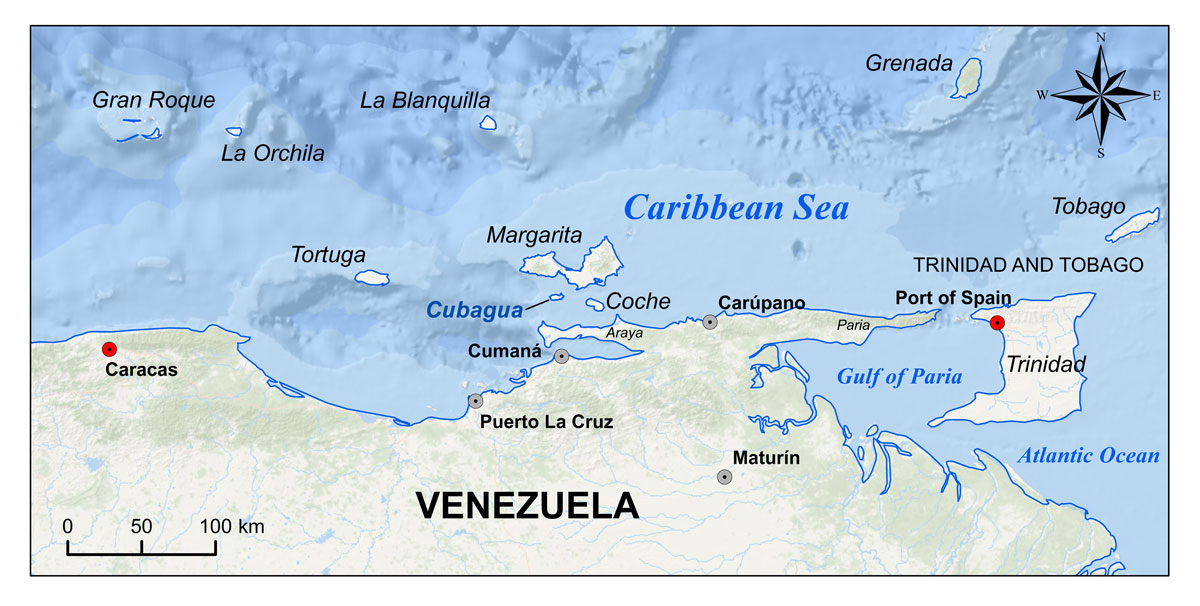
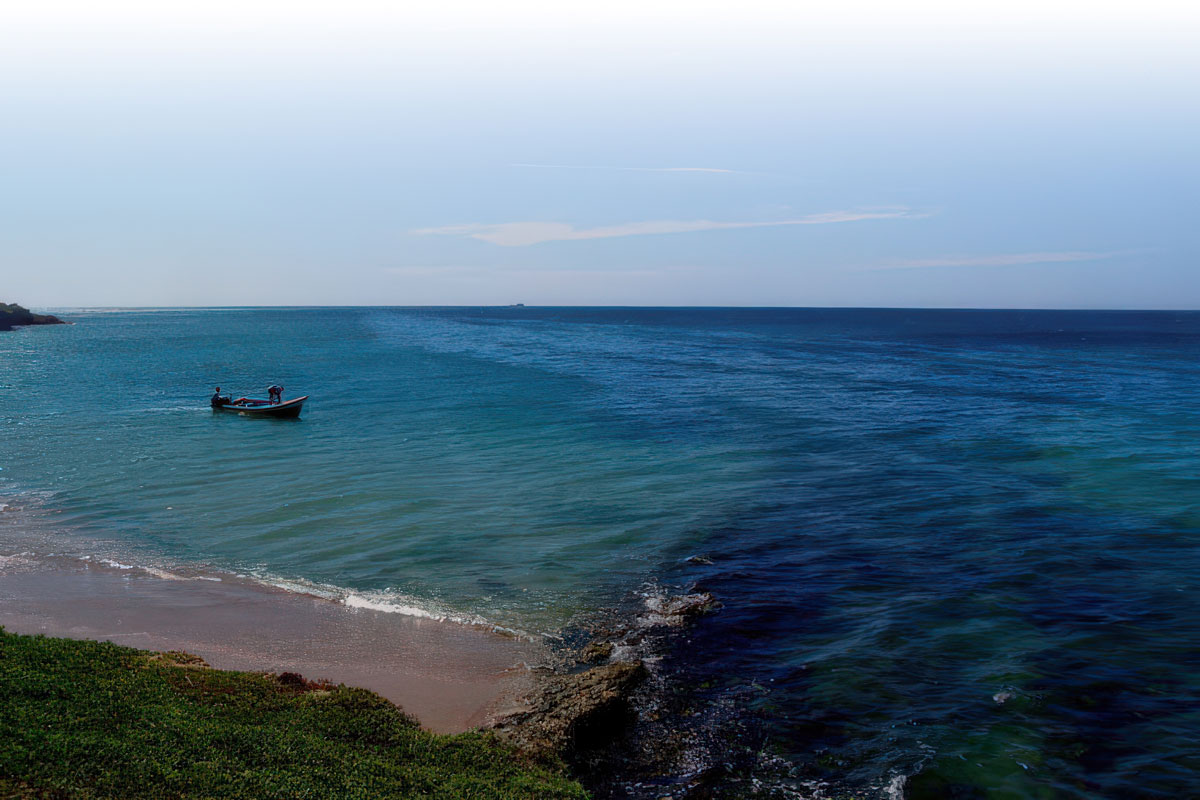
One of the first Spanish discoveries of a natural oil seep occurred on small Cubagua Island, now part of Venezuelan territory. Cubagua is situated off Venezuela’s northeastern coast in the southern Caribbean Sea, between the Island of Margarita to the north and the Araya Peninsula to the south. Along with Margarita and Coche islands, Cubagua forms Nueva Esparta State.
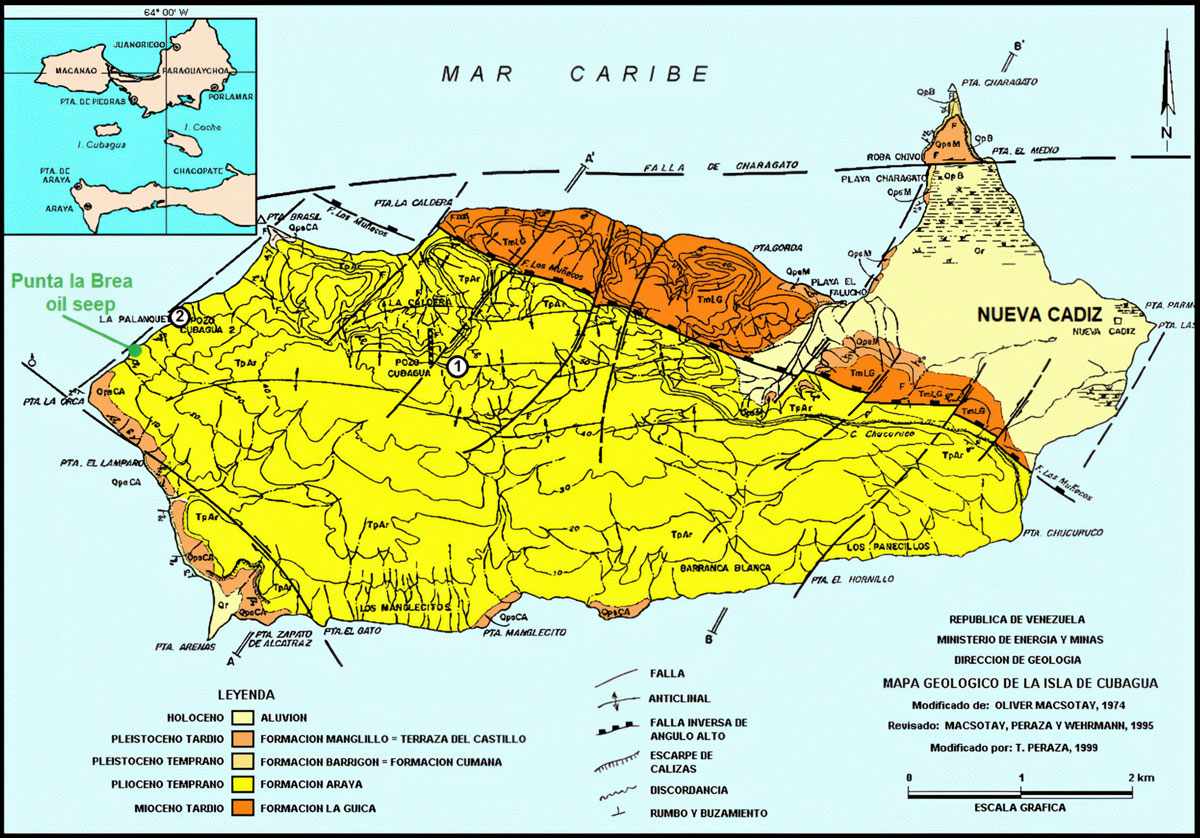
Cubagua lies within a complex geological setting at the boundary zone between the Caribbean and South American tectonic plates. Structurally, the island forms an asymmetric anticline with a gently dipping southern flank and a slightly steeper, faulted northern flank. The Charagato, a regional east-west trending left-lateral strike-slip fault, traverses the island’s northeast tip.
The island features outcrops primarily composed of marine shales interbedded with fine-grained calcareous sands rich in fossils (mollusks, echinoderms and shark teeth) from the Late Miocene to the Holocene. Its semi-arid, low-relief landscape lacks both permanent rivers and freshwater aquifers.
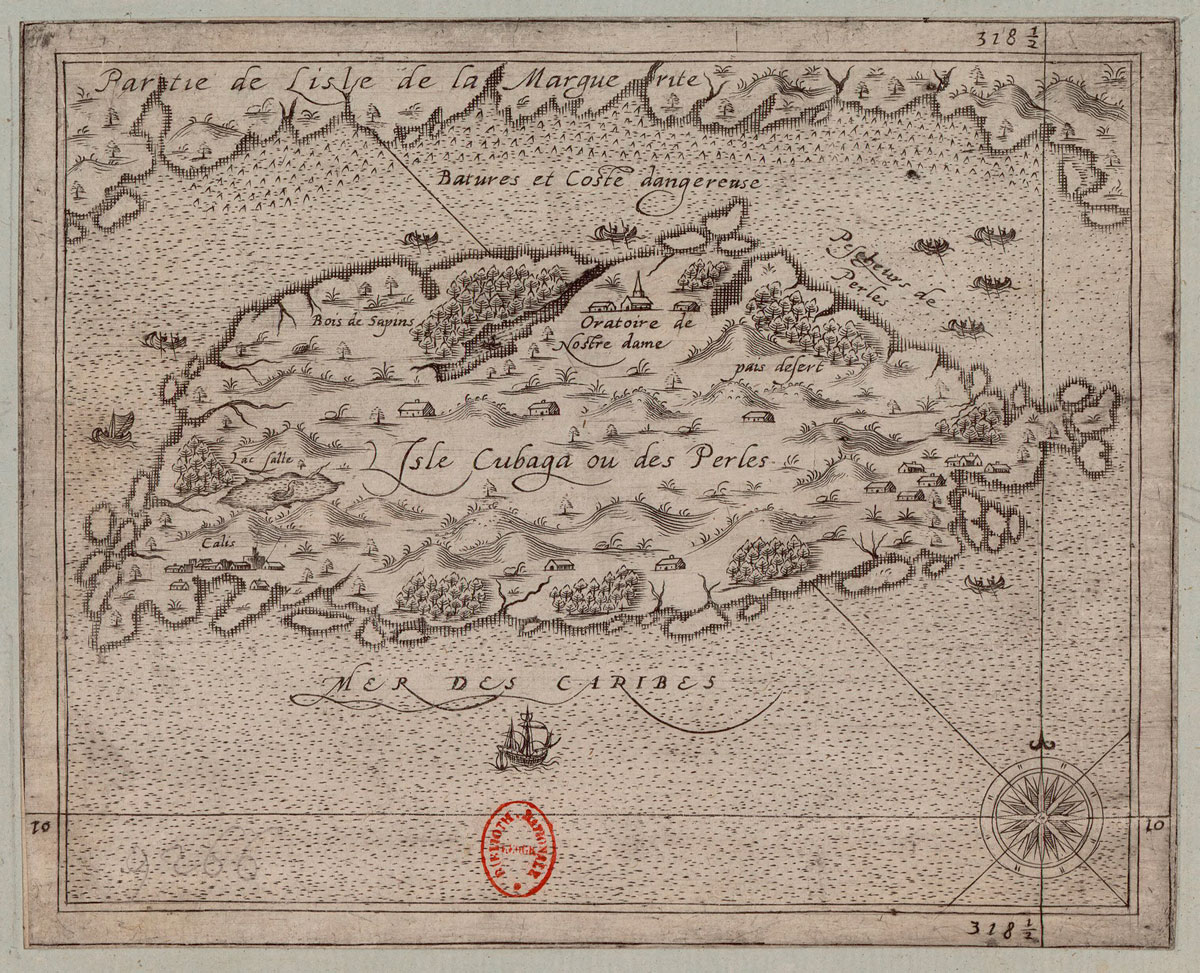
Cubagua Island has a rich history despite its modest size of just 24 square kilometers. The island was once the site of Nueva Cádiz, one of the first Spanish cities in the New World. This young city played a crucial role in the early colonization of the Americas. Its lively and unruly social life inspired the earliest chroniclers and engravers of the New World, while later capturing the interest of historians, archaeologists, paleontologists and petroleum geologists drawn by the presence of oil.
The Rise of Nueva Cádiz
Christopher Columbus discovered Cubagua Island during his third voyage to the Americas in August 1498. He was stunned by the abundance of pearls and their widespread use as Indigenous body ornaments.
News of Cubagua’s pearl richness quickly spread across Europe. In the early 16th century, a cluster of temporary campsites, known as “rancherias,” began evolving into a vibrant commercial center on the island’s eastern side, attracting pearl merchants, traders, officials, explorers and fortune seekers from Europe. The settlement flourished in 1520, one year after King Charles I of Spain was elected Holy Roman Emperor under the name Charles V, making him the most powerful sovereign in the world at the time.
The wealth and rapid growth of Cubagua were largely fueled by the pearl-diving industry and thriving trade. The pristine waters surrounding the island provided perfect ecological conditions for an abundant oyster population that produced exquisite pearls, greatly appreciated by European nobility. So abundant were the oysters that it was thought that the pearl industry would never die.
Significant development began in Cubagua with the stonework construction of a church, a town hall, a Franciscan convent, private homes and shops. At its peak, the island counted more than 1,000 inhabitants. The grim counterpart to this wealth was the recruitment of many natives and African slaves who were forced to work in the pearl industry under extremely hard conditions, diving with little rest from morning to evening in waters where sharks were common – a labor more dangerous than mining.
For several years, Cubagua was the main center for pearl trading in the Caribbean, when pearls were valued as highly as, if not more than, gold. In 1528, recognizing the island’s growing economic significance, the settlement was granted city status and officially named “Nueva Cádiz” in honor of its namesake, the port city of Cádiz in Spain. A group of royal officials was appointed and residents were given the right to elect a mayor annually. However, survival on the island depended entirely on external supplies; aside from fish, all food, fresh water, and firewood had to be imported.
Today, Nueva Cádiz is recognized as the first Hispanic city established in South America. However, as we will explore later, it had a short-lived existence.
First Written Reference to the Presence of Oil in Venezuela
From 1520 until the early 1530s, Cubagua, also known as the “Ysla de Perlas” (Isle of Pearls), became one of the richest commercial hubs of the emerging Spanish Empire, until the oyster beds gradually became exhausted due to intensive exploitation. After a decade of prosperity, the island’s wealth began to decline.
Another natural resource found on the island, though far less valuable than pearls, was the oil seepage present on Cubagua’s western coast. The decline of the pearl trade, coupled with the increasing demand for this oil as a medicine, likely influenced the Spanish Crown’s decision to grant a license on Dec. 10, 1532, allowing Cubagua Island’s inhabitants to freely use the discovered source of “licor de azeite” (oil liquor) as it was named in the Royal Order, considered “very beneficial for treating people’s illnesses.”
This license grant is the first written reference to the presence of oil in Cubagua – and the first in Venezuela – as documented in the Archivo General de Indias in Seville, Spain, the repository of archival materials recording the history of the Spanish Empire in the Americas and Asia.
Cubagua’s Oil as a Medicinal Remedy
Captain Gonzalo Fernández de Oviedo y Valdés’s monumental book, “Historia general y natural de las Indias, Islas y Tierra Firme del Mar Océano” (“General and Natural History of the Indies, Islands, and Mainland of the Ocean Sea”), was published in Seville in 1535. It produced one of the earliest and most significant chronicles on the initial Spanish presence in the New World. Fernández de Oviedo had keen powers of observation and provided detailed descriptions of the geography, climate, flora, fauna and customs of the Indigenous peoples.
In the chapters dedicated to Cubagua, Fernández de Oviedo highlights the island’s wealth in pearls and records the existence of oil. He mentions the presence on the island’s western tip of a natural source that produces “a liquor, like ‘azeite’ (oil), beside the sea, so abundantly that it flows over the seawater surface, leaving a trail throughout more than two or three leagues (some 10 to 15 kilometers) from the island where this ‘azeite’ still gives off a smell.” The oil seep’s location, known today as Punta la Brea, is marked by natural gas bubbling to the sea’s surface and a steady oil flow, which leaves a visible trail in the waters off the northwestern coast.
Fernández de Oviedo did not visit the oil source but clarified that “some of those who have seen it say it is called by the natives ‘stercus demonis’ (devil’s excrement), and others call it ‘petrolio’ (petroleum), and others ‘asphalto’ (asphalt).” He wrote that this “liquor of Cubagua is found to be extremely useful, and from Spain, it is requested persistently as it is considered a very beneficial remedy for gout and other illnesses.”
Although some authors cite Fernandez de Oviedo’s 1535 chronicle as the earliest literary reference to Venezuelan oil, the Royal Order issued on Dec. 10, 1532, had already recognized its existence by permitting the island’s inhabitants to exploit the oil seepage on Cubagua.
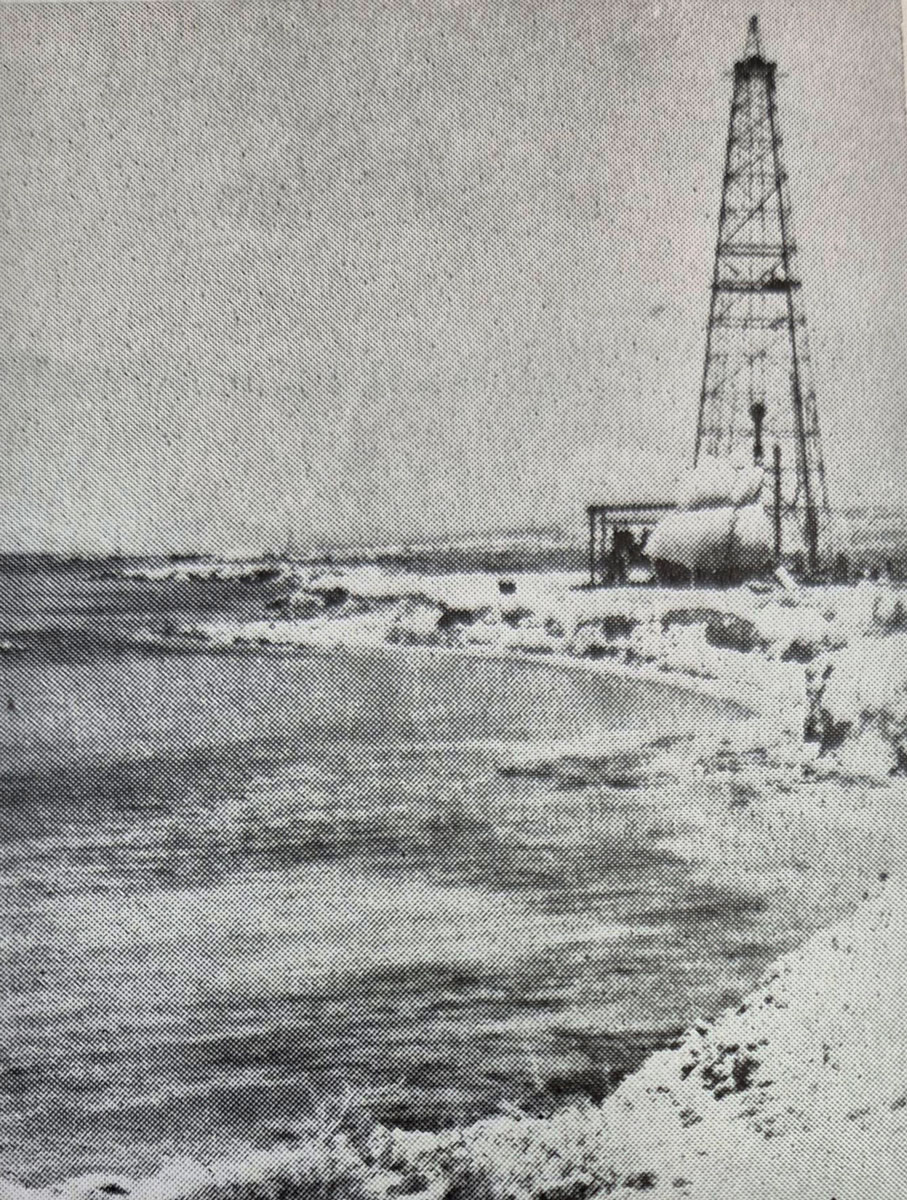
Curiously, four centuries later, in 1939, after running geological and geophysical surveys on the island and analyzing the 15-degree API oil seep, Socony Vacuum Oil Company drilled the onshore Cubagua-1 exploration well. The well reached a total depth of 4,670 feet after drilling through a Miocene to Eocene section dominated by marine shales with minor sand streaks, but no oil shows were recorded. A second well, Cubagua-2, was drilled back-to-back along the coast, some 500 meters northeast of the oil seepage, reaching a depth of 5,155 feet after penetrating a section of Middle Miocene massive shales with no shows.
Queen Isabella’s Request for Cubagua Oil
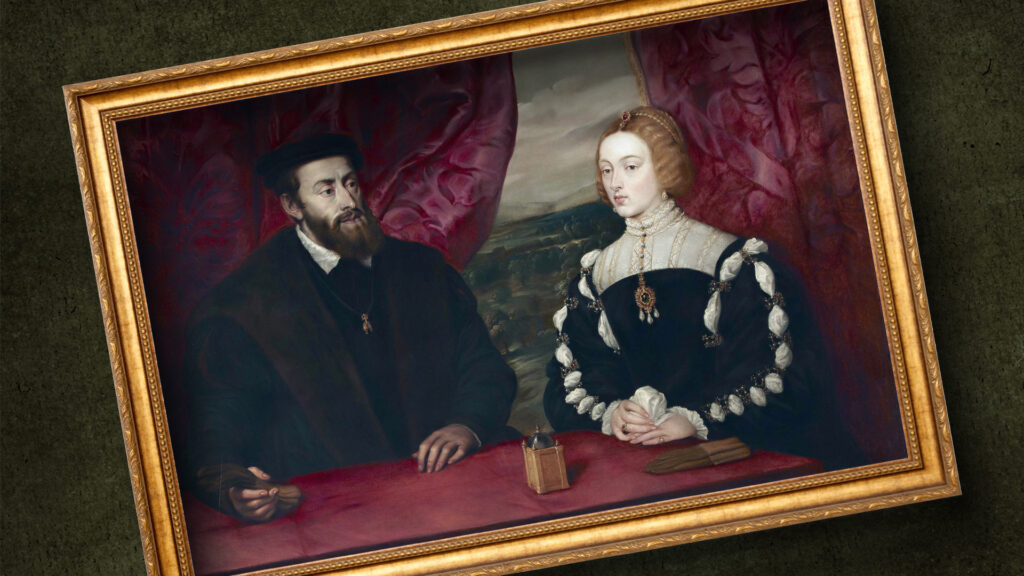
Returning to our story, it is likely that the presumed healing properties of petroleum, particularly for the treatment of gout, came to the attention of Queen Isabella of Portugal, wife of Emperor Charles V. (Isabella became Queen of Spain upon marrying Charles I but retained “of Portugal” due to her origin and to distinguish her from her grandmother, Queen Isabella the Catholic, who, along with her husband, King Ferdinand II, sponsored Columbus’s voyages to the New World.)
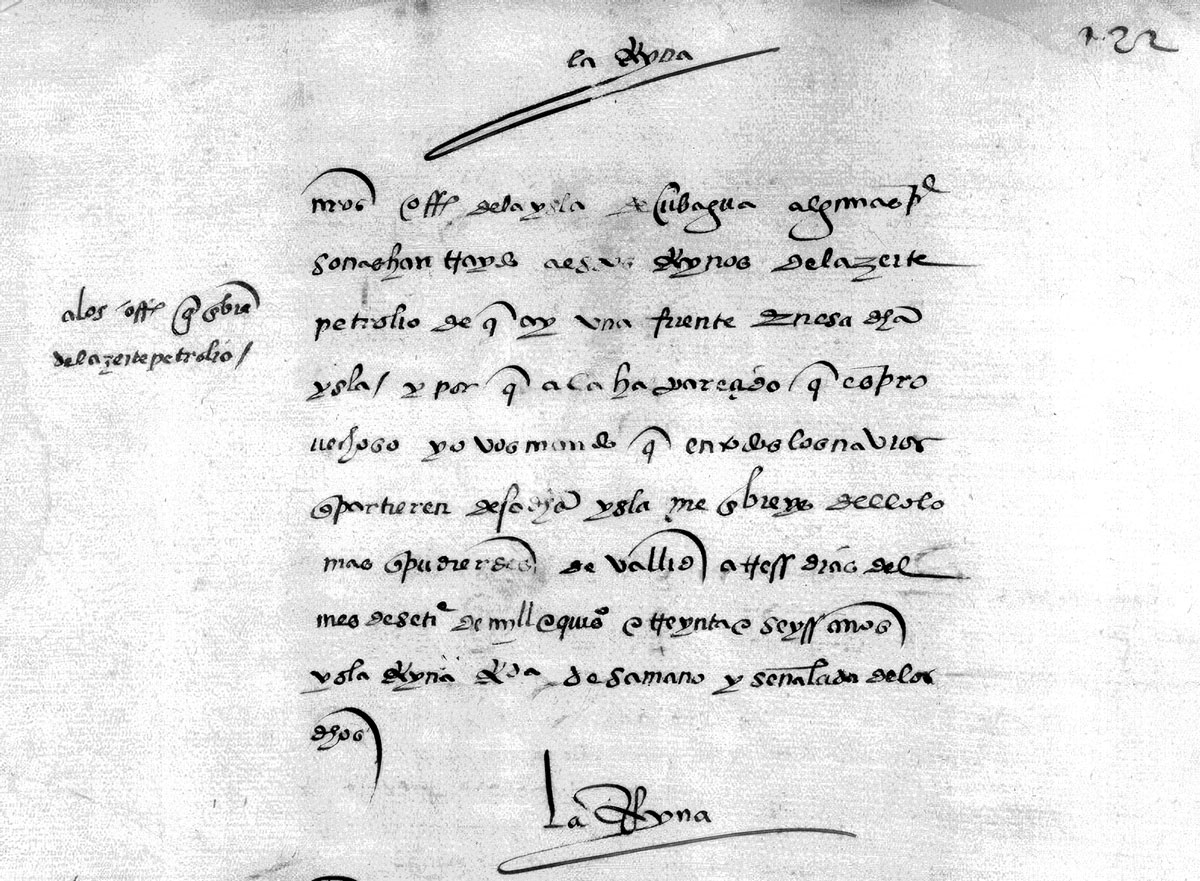
During her husband’s prolonged absences from the Iberian Peninsula, occupied with military campaigns and governance across his vast European territories, Isabella served as queen regent with remarkable diligence. Her deep concern for Charles’ health, evident in her frequent letters and personal involvement in his care, reflects the strong and affectionate bond that defined their marriage. Probably for this reason, on Sept. 3, 1536, the Queen issued a Royal Order from Valladolid, then the seat of the itinerant Royal Court.
Addressed to “our officials on the island of Cubagua,” the brief Royal Order by the Queen, preserved in the Archivo General de Indias, reads, “Some people have brought to these kingdoms the ‘azeite petrolio’ (petroleum oil) from a source on that island, and since it appears to be beneficial, I order you to send me as much of it as you can on every ship that departs from the said island.”
Although it cannot be stated with absolute certainty, the Queen’s request was most likely intended to help ease her husband’s gout, given that Emperor Charles, since he was 28 years old, was severely racked by that metabolic disorder caused by urate crystal accumulation in the joints of the extremities. Marked by severe inflammation and recurrent acute attacks, it was an illness that gradually impaired the Emperor’s mobility and writing ability.
Once the Royal Order was received in Cubagua, the officials began collecting the oil. However, due to the limited flow, they were only able to gather “half arroba” (5.75 kilograms), as reported in a letter dated Feb. 21, 1538, sent by the Cubagua officials to King Charles. The King answered on Oct. 25, 1538, ordering the Cubagua officials “to ship no more than three ‘arrobas’ (34.5 kg) of the collected ‘azeite petrolio,’ and to refrain from sending any additional shipments until further notice.”
First Documented Transatlantic Shipment of American Oil
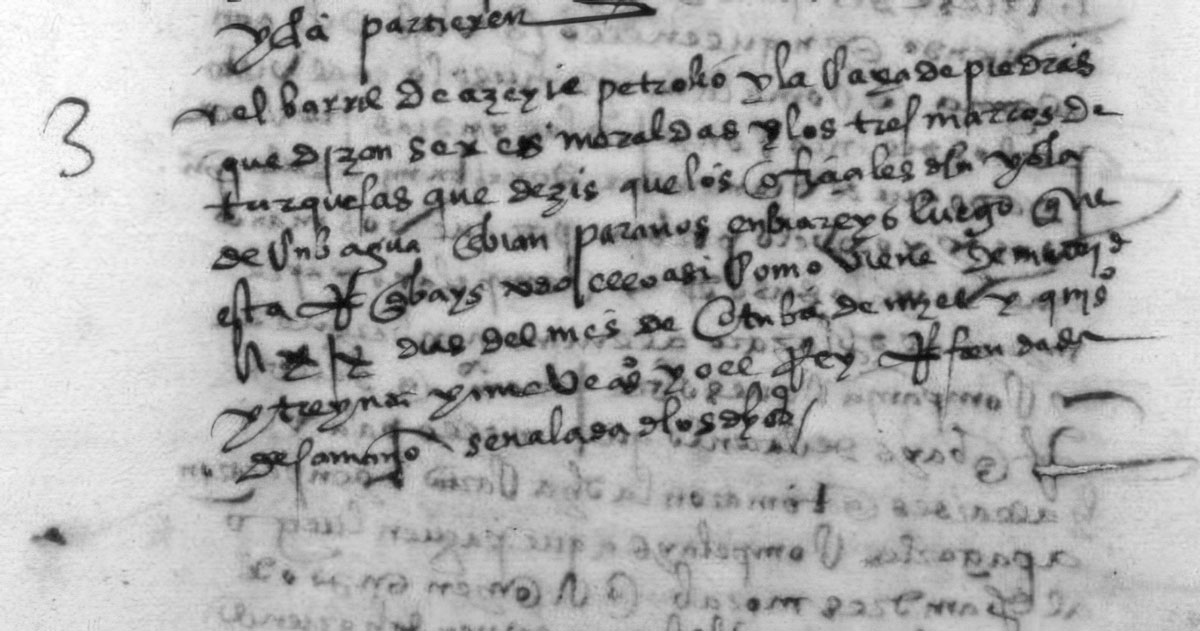
Following the Crown’s instructions, the treasurer of Cubagua informed King Charles in a letter dated April 30, 1539, that a ship was being dispatched carrying a barrel full of one arroba (11.5 kilograms) of clean, water-free “azeite petrolio.”
A Royal Order dated Oct. 19, 1539, confirms the arrival of Cubagua oil at the Casa de la Contratación de las Indias, the institution established in 1503 in Seville to oversee and regulate trade and navigation with the Americas. In the Royal Order, the King instructed that “the barrel of ‘azeite petrolio’ and a box with stones said to be emeralds, along with the three ‘marcos’ (690 grams) of turquoises sent by the officials of Cubagua Island be promptly forwarded to him, just as it arrived.”
A subsequent letter from the officials of the Casa de la Contratación to His Majesty, preserved in the Archivo General de Indias, reported that the oil barrel reached Seville aboard the ship Santa Cruz, routed through the officials of the Island of Hispaniola (present-day Dominican Republic and Haiti). The letter confirmed that, upon its arrival, the barrel had been promptly dispatched to the Royal Court, which was then located in Madrid.
While it is probable that earlier oil shipments had been made from Cubagua to Spain, this stands as the first known documented evidence of American oil crossing the Atlantic.
Tragically, Queen Isabella of Portugal, who had eagerly requested the Cubagua oil, hoping to ease her husband’s suffering, passed away in May 1539 at the age of 36. It was just five months before the oil shipment she had ordered finally reached Spain.
A Second Oil Shipment, the Fall of Nueva Cádiz and the Fate of Emperor Charles’s Gout
A second oil shipment is revealed in a Royal Order dated Nov. 29, 1540, in which the King requested confirmation of the arrival of “another barrel of ‘azeite petrolio’ dispatched from the Island of Cubagua.” The order reads: “Inform us whether it has been received, and if so, forward it to us with the first muleteer who comes to this court.” A letter from the officials of Casa de la Contratación to His Majesty dated Dec. 14, 1540, confirmed the arrival in Seville of this oil barrel and its rapid dispatch to Madrid.
This likely marked the last shipment of oil from Cubagua to Spain. Just over a year later, during Christmas of 1541, the city of Nueva Cádiz was partially destroyed by a hurricane-like storm, an event described in 1589 in the long poem “Elegías de varones ilustres de Indias” (“Elegies of illustrious men of the Indies”) by Juan de Castellanos, a chronicler and poet living on the island at that time. After the storm, the few remaining inhabitants gradually abandoned the island, relocating to the nearby Island of Margarita and Cabo de la Vela on La Guajira in present-day Colombia, some 1,000 kilometers to the west. In July 1543, French pirates raided Cubagua, burning and looting what little remained of the city of Nueva Cádiz, leaving it in ruins.
Not much is known about Emperor Charles’s use of the Cubagua oil and its effects on relieving his chronic gout. Nevertheless, it seems that the oil was ineffective, as he relied on bloodletting and purgatives until he died in 1558, at the age of 58, in the Monastery of Yuste, southwestern Spain. The man who had once been the most powerful ruler in the world did not die from gout, but from malaria caused by a mosquito bite, a disease endemic in certain regions of Europe at that time.
Cubagua Island: A Historical and Natural Heritage Site
The overseas transport of Cubagua oil in 1539 marked the historical first-documented American petroleum crossing the Atlantic. It also signals Venezuela’s initial association with oil exports, though it was indeed for medicinal purposes, not fuel.
Cubagua Island has only a small permanent population today, largely due to its harsh living conditions and limited infrastructure. Traditionally, fishing and pearl diving have been the island’s principal livelihoods. Nevertheless, it has recently become a modest tourist destination, now attracting day-visitors drawn by its pristine beaches and crystal-clear waters.
Nueva Cádiz was declared a National Historic Monument in 1979. Only a few scattered ruins remain of the once-thriving city that has been the focus of various archaeological investigations since the 1950s. Cubagua Island was designated a Site of Cultural Interest in 2000 and, years later, was proposed as an archaeological, paleontological and geological park, a project still awaiting execution.
Acknowledgement
I wish to express my gratitude to Hans H. Krause, former editor of Historical Highlights, who introduced me to this fascinating history and encouraged me to delve deeper and write this paper.