Philip Anschutz is one of the wealthiest men in the world, but he wasn’t always. In fact, he once needed help from Hollywood to save his bacon after a blowout.
He owns Anschutz Exploration Corp., a Denver oil and gas company active in the Rockies. Anschutz once owned all or part of the National Hockey League’s Los Angeles Kings and the National Basketball Association’s Los Angeles Lakers. He was the largest shareholder in Union Pacific Corp. and has controlled entertainment venues including Regal Cinemas, Crypto.com Arena (formerly the Staples Center) in Los Angeles and the O2 Arena in London. Through Anschutz Entertainment Group, he owned two major California music festivals, Coachella and Stagecoach. He chaired Qwest Communications, owns Sea Island Resort in Georgia and the Broadmoor Hotel in Colorado Springs, and he owns the company that publishes the Washington Examiner.
A Kansas native and longtime resident of Denver, Anschutz owns downtown real estate there and vast ranches and farms in Colorado, Utah, Wyoming and Kansas. He’s building a renewable energy project to move wind power from southern Wyoming to California. He has amassed one of the world’s greatest collections of art of the American West, much of which is open to the public at Denver’s American Museum of Western Art. An extraordinary philanthropist, Anschutz has donated hundreds of millions of dollars to the University of Colorado Anschutz Medical Campus. Forbes named him the 45th richest person in the United States last year, with an estimated net worth of nearly $17 billion.
But our story starts decades earlier, two years after he bought Circle A Drilling Co. from his father.
Wyoming’s ‘Ten-Day Volcano’
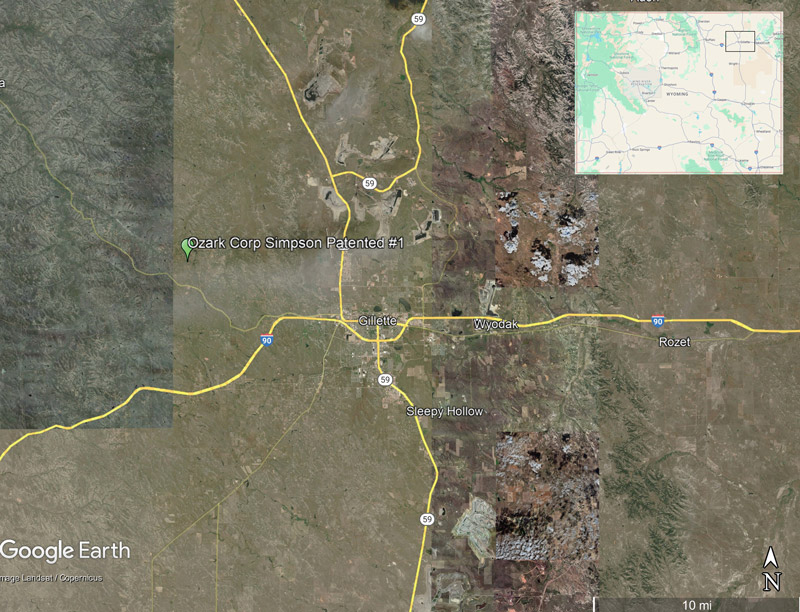
In 1967 Anschutz, then 28, made a pivotal deal in the bar of the Casper, Wyo. airport with a hard-drinking, tough-trading Wyoming wildcatter named Jeff Hawks. Circle A had been contract-drilling the Simpson Patented No. 1 for Hawks’s Ozark Corporation, in the Powder River Basin west of Gillette, Wyo. when it blew out. It was roughly three miles from the closest production.
The Simpson well was intended to test the Minnelusa Formation at about 12,000 feet but blew out in the Muddy Sandstone at about 9,200 feet on Oct. 7. Ozark had cut a core with oil saturation in a porous and permeable Muddy sandstone. The well encountered unexpectedly high pressure during preparation for a drillstem test to evaluate the shows. The drilling mud became highly gas-cut and the hole unloaded.
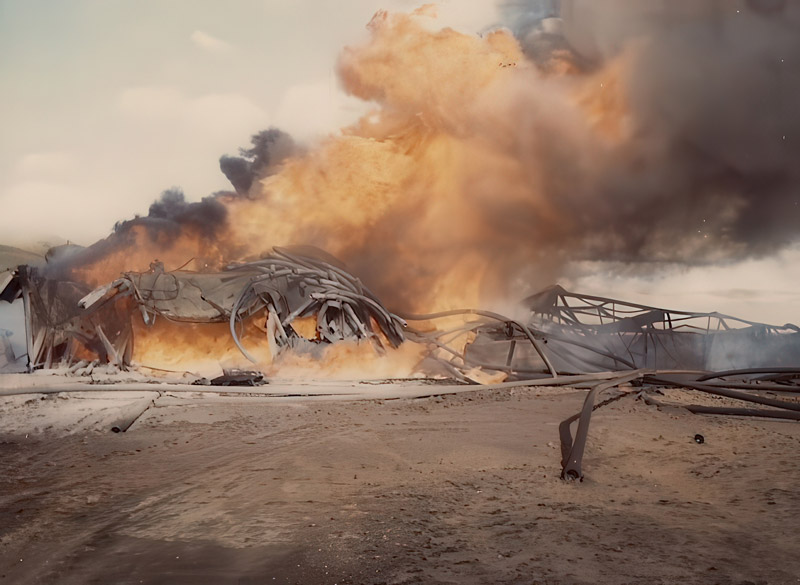
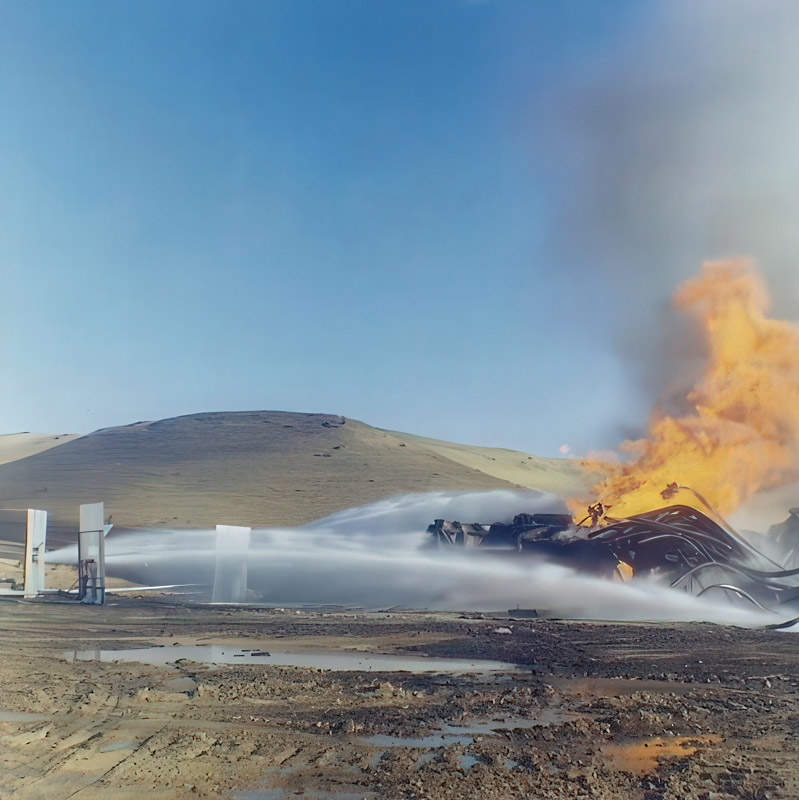
Local newspapers reported that the well blew out at the rate of 500 barrels of oil per hour. About 40 hours later, according to area journalists, it exploded into a “geyser of blazing gas” when a “chance spark” from a Halliburton truck engine ignited the associated gas following a wind shift. The “fiery gusher” produced a “heat-twisted tangle of metal” and a thin cloud of black smoke that trailed miles east toward South Dakota’s Black Hills. Jack Langan of the Sheridan Press said it “looked like Old Faithful in flames.” Oil erupted over the fields surrounding the wellsite, and the rig, trailers, tanks and reserve pits burned up. The driver of a mud pumper truck was injured but recovered.
In a rare interview with David McComb in 1974, Anschutz explained that he had just returned from a weekend in California with his fiancée when a 2 a.m. phone call alerted him to the blowout in Wyoming. What followed he described as “the most important single event in my business career so far.” His business was “having a very tough time” when the rank wildcat he was drilling (with a one-eighth working interest) blew out. He called his chief geologist, Brick Wakefield, to meet him at the airport and flew to Gillette in a cold, gusty snowstorm.
When he arrived, he saw oil blowing out over the derrick. After contacting his insurer, Lloyds of London, and other concerned parties, he recognized that the blowout indicated an oil discovery. Anschutz immediately sent lease crews into the field and started committing to buy offsetting unleased acreage from landowners and leases from other companies for several hundred thousand dollars.
At this point he “had no money to buy the leases.” Chevron was suing him, Ozark Corp., the operator, said that the blowout was his fault, offsetting lessors and lessees were threatening, and his rig was totally destroyed. Lloyds said they would not honor any claims, and his banks were unlikely to extend credit.
“It was a time bomb,” he said.
Anschutz met Hawks at the Casper airport, and they “argued – negotiated – from 6 p.m. to 1 a.m.” while Hawks drank “round after round of straight whiskey.” Finally, they agreed that Anschutz would assume full responsibility and liability for control of the well in return for an increased interest in the prospect.
When the plane left Casper to return to Denver, he noted, “The corner of the sky towards Gillette was a red flaming inferno. I thought that was the end of me in business.” He added, “I was worse than broke; I was bankrupt.”
Anyone Want to Buy an Oil-Well Fire?
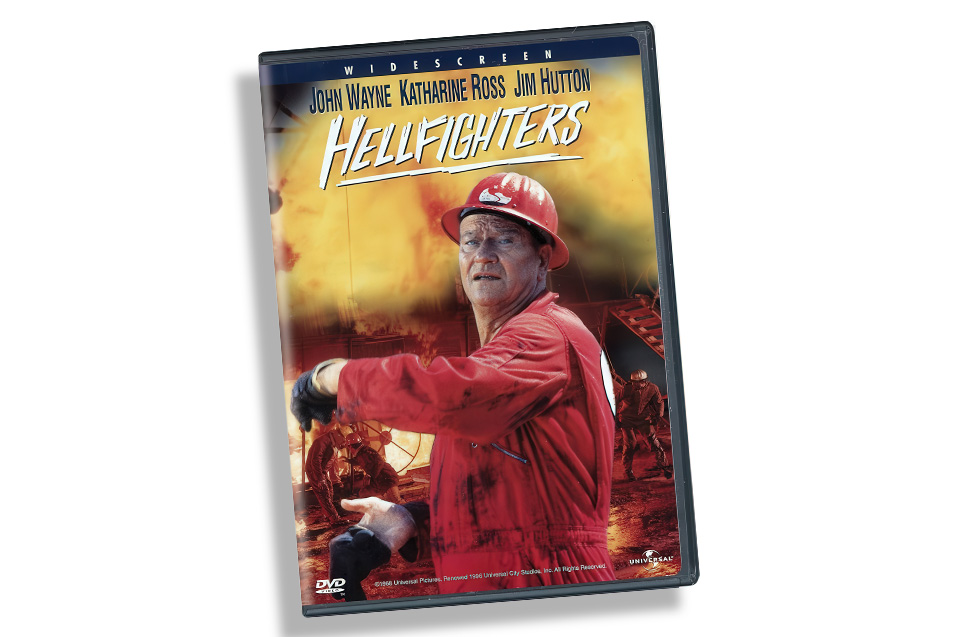
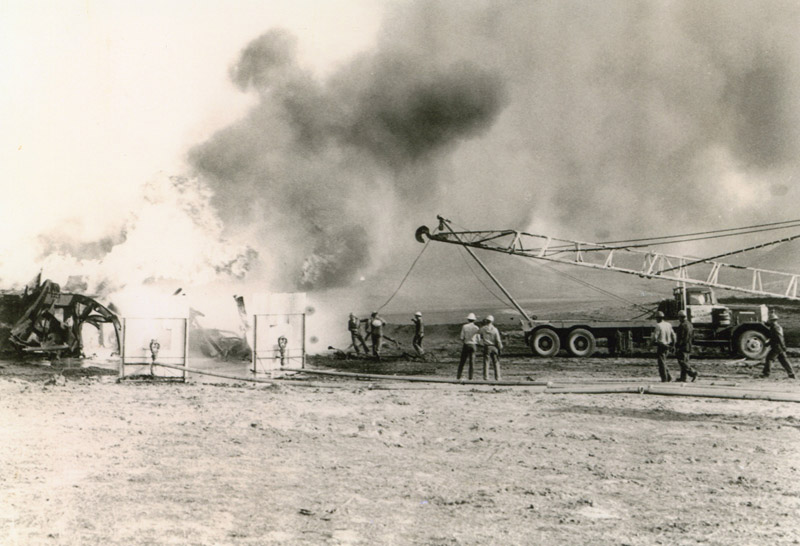
Circle A was in an existential crisis, but Anschutz had heard that Universal Studios was making a movie called “Hellfighters,” based loosely on the life of Paul N. “Red” Adair, the legendary oil-well firefighter. Anschutz secured $100,000 from Universal Studios for the exclusive rights to film the blaze. He then persuaded Adair to kill the fire despite Circle A’s shaky finances.
Red Adair was celebrated for extinguishing the world’s most challenging oil and gas well fires. Over the course of his long career, Red Adair Co. Inc. killed or helped control some 2,000 wild wells including a spectacular gas well fire known as the Devil’s Cigarette Lighter, which burned in the Algerian Sahara for months. (Astronaut John Glenn saw the towering flames from space.)
On Oct. 20, the Red Adair Company killed the Simpson inferno with equipment brought in from Texas. An explosion of 80 pounds of nitroglycerin in a barrel on the end of a long boom propelled by a large earthmover extinguished the fire. A blowout preventer was installed and the well was plugged and abandoned.

Having thought, “My God I’ll never be able to overcome all this,” Anschutz scrambled. He began to look for partners and sold an interest in part of the leasehold. The proceeds from Universal, plus the sales of acreage, were enough to pay Adair to put out the fire and leave Anschutz more than half the leasehold. The fire was under control, the bankers came around, and he eventually won the suit with Chevron and settled with Lloyds.
Anschutz said that in addition to the movie rights he “made a lot of money off the oil that I found plus the leases that I owned in that play. That was the basis of my company … everything that I’ve done of meaningful success has been done since that point.”
A replacement well, the Simpson Patented No. 1-A, was completed without much drama, but it wasn’t cored or drillstem tested. Still producing in early 2025, it has made more than 120,000 barrels of oil and 230 million cubic feet of gas. The No. 1 Simpson blowout/discovery extended the Kitty Oil Field which has now produced more than 23 million barrels of oil and 131 billion cubic feet of gas.
Hellfighters
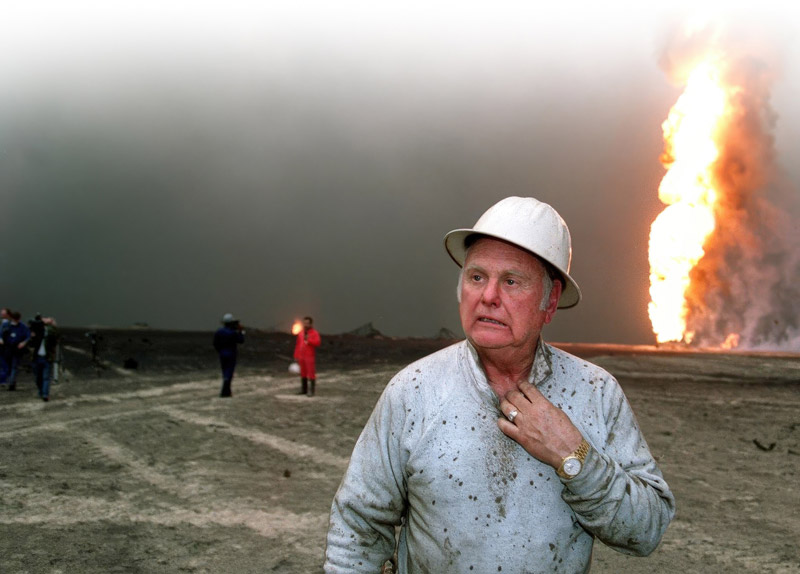
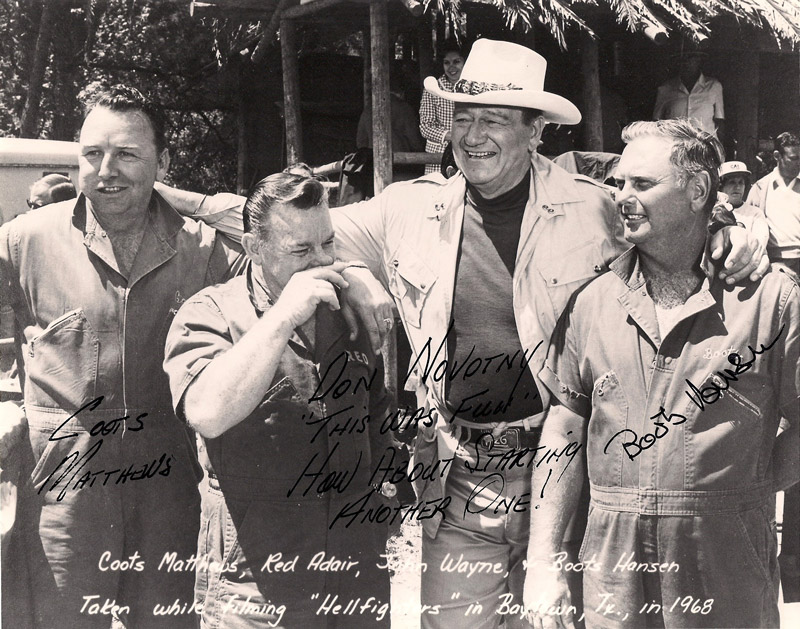
Red Adair apparently was never onsite during the Simpson blowout, though his colorful top hands, Asger “Boots” Hansen and Edward “Coots” Matthews, were. (Coots was in Casper for a meeting of AAPG’s Rocky Mountain Section when the fire started, so he was able to get there quickly.) All three were technical advisers for the film.
Adair was thrilled that John Wayne portrayed him, as Chance Buckman, in the movie. They were on location in Wyoming together, and celebrated Wayne’s 61st birthday there. “That’s one of the best honors in the world, to have The Duke play you in a movie,” boasted Adair.
Directed by Andrew McLaglen, who made several movies with John Wayne, “Hellfighters” contains intense firefighting scenes but received mostly poor reviews. Critic Roger Ebert called it a “slow-moving, talkative, badly plotted bore.” Wayne’s co-stars included Vera Miles as his (former and future) wife Madelyn, Katherine Ross as their headstrong daughter Tish and Jim Hutton as Tish’s husband, Greg, a brash, savvy member of the firefighting crew. For the first time in his career, The Duke earned $1 million for the film.
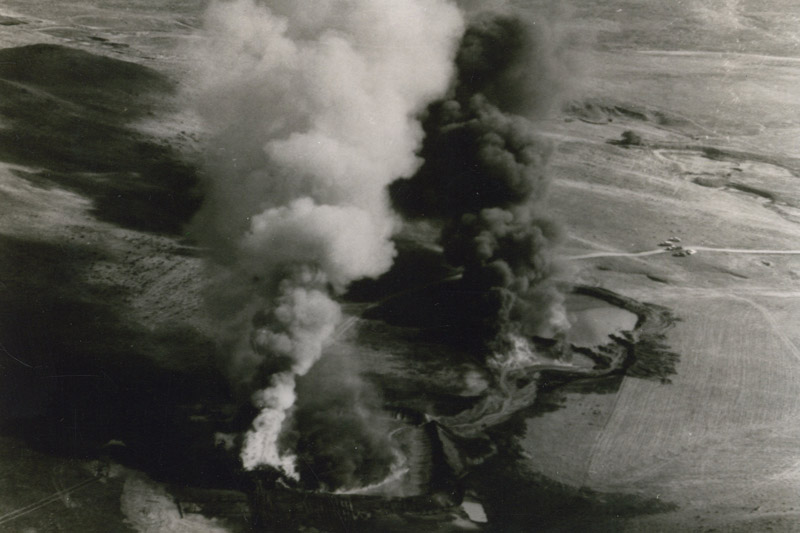
Some longtime residents of Gillette will claim that the rig fire in the opening credits for “Hellfighters” is the No.1 Simpson fire. That’s impossible, as the film crew did not arrive until the rig itself had already burned down.
With more than a hundred standing derricks, Goose Creek Field, near Baytown, Texas, was chosen to shoot many of the oilfield fire scenes. Hollywood magicians created an artificial oil gusher, which accidentally drenched the director and a cameraman when the wind shifted. The fictional Calhoun Oil Co.’s well No.5 was intentionally burned to the ground a few days after it was built.
Wyoming scenes shot at the Jackson Hole airport and the historic Bessemer Bend area along the Oregon Trail on the North Platte River west of Casper made the final cut. Probably no footage of the fire at Philip Anschutz’s blowout is actually in the movie.
Acknowledgments
Robert Henning and Justin Horn of the Campbell County Rockpile Museum in Gillette located and forwarded essential research information and historic images. Lisa Wolff and Jeff Spencer provided the map used here and details from the filming in Wyoming, respectively. Chuck Chandler shared the Goose Creek Field information and Bridget Crowther tracked down a name for vital fact-checking. Thanks to all of them.