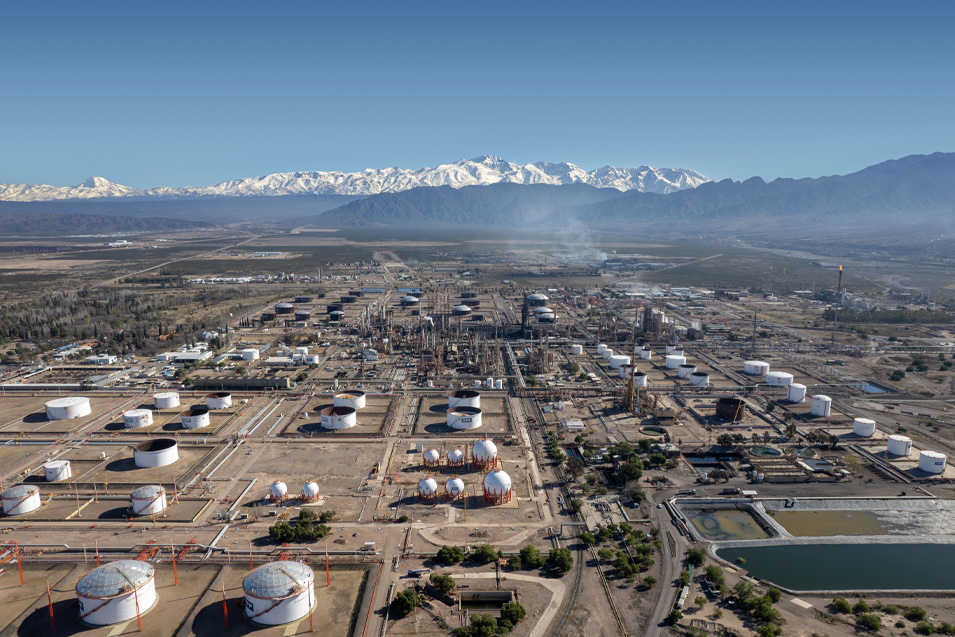
Argentina’s Vaca Muerta shale play keeps looking better and better. Producers hope it keeps getting bigger, too.
‘’Achieving further success also hinges on strategically expanding the productive boundaries of the play, with a strong emphasis on derisking and unlocking potential in emerging frontier areas,” said Cintia Ponce, geophysicist for Argentina’s state oil company YPF S.A. “Thanks to significant infrastructure development and ongoing frontier exploration in unconventional zones, Vaca Muerta is set to become a major player in Argentina’s energy sector.”
Analysts now predict the Late Jurassic-Early Cretaceous Vaca Muerta could reach production of more than a million barrels a day, making it one of the world’s most important unconventional resources.
Ponce and her colleagues will discuss exploration plans for the play at AAPG’s upcoming 2025 International Conference and Exhibition in Rio de Janeiro. Their study, “Expanding the Productive Limits of the Vaca Muerta Play in Frontier Exploration Areas. Southern Mendoza, Neuquén Basin, Argentina,” will be presented on Tuesday, Oct. 2.
The same session includes the presentation “Assessment of the Unconventional Resource Potential in the Vaca Muerta Basin, Southern Mendoza, Argentina,” developed by Mendoza province’s Dirección de Hidrocarburos.
Geology
Vaca Muerta lies within the Neuquén Basin, centered on Argentina’s picturesque Neuquén province in northwestern Patagonia. The basin extends into Mendoza province immediately to the north.
That’s where YPF and others are currently trying to extend the play. Evaluation and exploration of the shale in the province are still in their early days, but initial test wells have produced favorable results. More drilling is scheduled for later this year.
Nailing down the Vaca Muerta’s characteristics in frontier areas will be important, because readings vary widely across the play. Total organic carbon generally ranges from 2 to 8 percent – even higher in some places. Porosities vary from 4 to 14 percent. Over-pressured areas can improve flow rates and recovery.
Thermal maturities reflect the complex history and geology of the area, with both an oil window and gas window extending northward in the basin. YPF’s pilot wells in Mendoza reportedly have produced oil and associated gas, although test results remain preliminary at this point.
Development Strategy
YPF, the play’s largest producer, estimates Vaca Muerta’s overall footprint at more than 30,000 square kilometers (11,600 square miles). The company reported that advancements in drilling, seismic imaging and subsurface modelling technologies have incorporated new productive zones, possibly integrating future expansion areas in both Mendoza and Río Negro provinces.
A number of independents have joined YPF in the play, including Pluspetrol, Pan American Energy and Tecpetrol. Also, Shell operates in four license blocks in the basin and TotalEnergies recently approved an expanded phase of Vaca Muerta operations.
“It can’t be overstated how crucial Vaca Muerta is to Argentina’s energy independence and efforts to reduce imports. Alongside state-owned players, independent producers have a growing influence in the play, contributing 35 percent of oil production and 23 percent of gas production.
“There is every reason to view Vaca Muerta as a central pillar of Argentina’s long-term energy strategy and economic resilience, with a real possibility of reaching the 1-million-barrels-per-day mark by 2030,” said Radhika Bansal, vice president of upstream research for Rystad Energy.
Noted as an oil play, the Neuquén Basin shale formations also contain significant natural gas reserves. Argentina has introduced a multi-stage gas development strategy, including the Southern Energy joint-venture LNG project.
Southern Energy plans to operate two floating LNG facilities in Río Negro’s San Matías Gulf, providing a combined capacity of 6 million metric tons per year. First production is scheduled for late 2027, with the second facility online by the end of 2028. Venture partners are Pan American Energy, YPF, Pampa Energía, Harbour Energy and Norway’s Golar LNG.
“Vaca Muerta’s strong oil gains are no surprise anymore as its track record speaks for itself. However, what we’re seeing now is that gas is stealing the spotlight. Dry gas production hit 2.1 billion cubic feet per day in the first quarter of 2025, rising 13 percent quarter-on-quarter and 16 percent year-on-year,” Bansal said.
“To leverage this momentum, the country is actively pursuing a bold, multi-phase national LNG export strategy, meaning Argentina could soon become a pivotal player in global gas supply, significantly reshaping markets and energy geopolitics,” she added.
Additional pipeline capacity also will increase shipments and help monetize Vaca Muerta’s natural gas production, including capacity expansion of the Moreno (formerly Kirchner) line. That link moves gas to urbanized areas in the country’s north.
But the biggest news in transportation growth is the Vaca Muerta South oil pipeline, being developed by Argentina’s Vaca Muerta Oleoducto Sur midstream joint venture. In July, VMOS announced a $2 billion loan agreement to finance construction of the new line, which will ship oil to an export facility on the Atlantic coast.
Scheduled to enter service by 2027, the 270-mile pipeline will have an initial capacity of 180,000 barrels/day, with a planned expansion to 550,000 barrels/day, according to YPF. Other expected partners in VMOS include Shell and Chevron, along with Pluspetrol, Vista Energy, Pampa Energia and Pan American.
Challenges
Vaca Muerta does face development hurdles. Two of the biggest are legal challenges and industry economics. In 2012, Argentina took over Repsol’s ownership stake in YPF without making a tender offer to minority shareholders, according to legal filings. That eventually led to a $16.1 billion judgment against the country by a U.S. court, in favor of two investment-company plaintiffs.
Argentina was ordered to relinquish 51 percent of its YPF shares in partial settlement, but that order was temporarily suspended by an appeals court in July. Many legal experts expect the Argentine government to work out a compromise with the former YPF stakeholders.
A $15-per-barrel decline in world oil prices over the past year and a half has slowed Vaca Muerta drilling, a situation made worse by pipeline capacity constraints. However, with low breakeven limits in the $40-$45-per-barrel range and scheduled pipeline expansion, production growth should continue.
Operators and other investors have had an on-again, off-again affair with the play, sometimes pouring in risk capital, sometimes holding back. In a positive sign, Argentina’s Large Investment Incentive Regime – a government initiative to attract and provide security for major investment – has prioritized Vaca Muerta development.
Overall, play operating costs have declined significantly, partly because of a shift toward polyacrylamide-based friction reducers in fracturing fluids and the industry’s trend to longer laterals. YPF said reservoir development is being optimized through refined well spacing and advanced hydraulic fracturing designs.
With production levels now comparable to the best U.S. plays and oil and gas infrastructure additions on the way, the Vaca Muerta seems likely to keep getting better. With projected expansion into frontier areas, it should go on getting bigger, as well.