
The February installment of Jonathan Rotzien’s The Explorer’s Mindset column, “The Discipline of Changing Paradigms with New Evidence,” piqued my curiosity about turbidite/contourite systems.
I know that a turbidite is a sedimentary rock deposited by a turbidity current, and I know that turbidites are important to the industry as reservoirs, but I could not recall much about contourites or contour currents, or deepwater sedimentation in general. After watching flume-tank experiments posted online by Joris Eggenhuisen, I decided it would be a good opportunity to highlight the value of the Datapages Archives combined publications while benefiting from the knowledge.
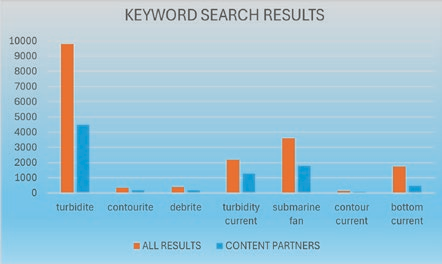
The Archives has tens of thousands of articles concerning deep-water sedimentation, including articles by Arnold H. Bouma, as well as articles by Rotzien, Postma, Tinterri, Shanmugam, Eggenhuisen, Hernández-Molina and others.
A bit of background science is in order:
- Turbidites are deposited by fluid-supported density/gravity flows (downslope).
- Other types of gravity flows include mass-transport deposits like slides, slumps, and debris flows.
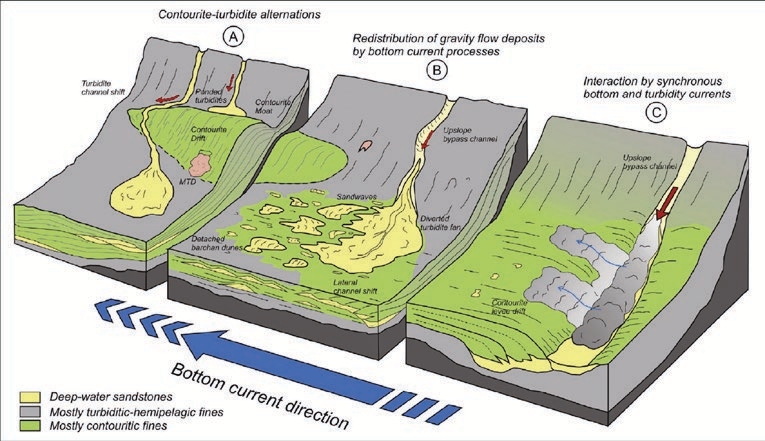
- Non-gravity flows include bottom currents or contour currents that flow parallel to the shore. The drivers of non-gravity flows are geostrophy (Coriolis effects) and thermohaline circulation, which in turn is controlled by temperature and salinity.
Significance
The interactions between the contour currents and turbidity currents and their deposits can cause the reworking and sorting of the sands, stripping of the fine particles (which can be deposited in a perpendicular direction to downslope movement), and improving the overall reservoir characteristics (that is, net-to-gross ratio). The giant gas discovery of the Coral field offshore Mozambique is a mixed/hybrid turbiditic-contouritic system. These hybrid systems are being recognized in major discoveries around the world, including the Jubilee Field, offshore Ghana, and the Barra complex in the Sergipe Basin, Brazil.
Why Only Recently Recognized?
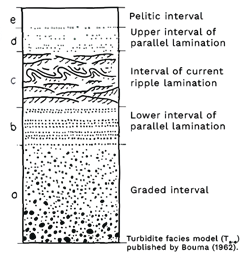
Turbidites (T) are identifiable in outcrops using the Bouma sequence of graded bedding (a-e):
• Ta = a graded interval
• Tb = a parallel lamination interval
• Tc = current ripple lamination interval
• Td = an upper interval of parallel lamination
• Te = a pelitic interval
Contourites, however, lack distinctive structures in outcrop. They have a massive appearance, often with intense bioturbation (destroying primary sedimentary structures), plus the deposits overlap with hemipelagites and turbidites. Contourites are more easily seen in seismic data because the deposits form very large, regional-scale drifts. With the current advances in seismic data collection, processing and interpretation, contourites are more easily identifiable, and have become a new exploration target.