We’ve all got one: an Estwing rock hammer!
The Estwing hammer (or pick), a trademark of the Estwing Manufacturing Company, Inc., is the favorite tool for geologists, rockhounds and others to bust, sample and gather rocks, minerals, crystals, metallic ores, industrial minerals, fossils and archeological artifacts.
The company was founded in 1923 by Ernest O. Estwing in Rockford, Ill.
Originally focused on carpenter hammers, Estwing Manufacturing branched out into geology picks in 1934 and still produces a large variety of hammers and other hand tools.
A Boy and His Rocks
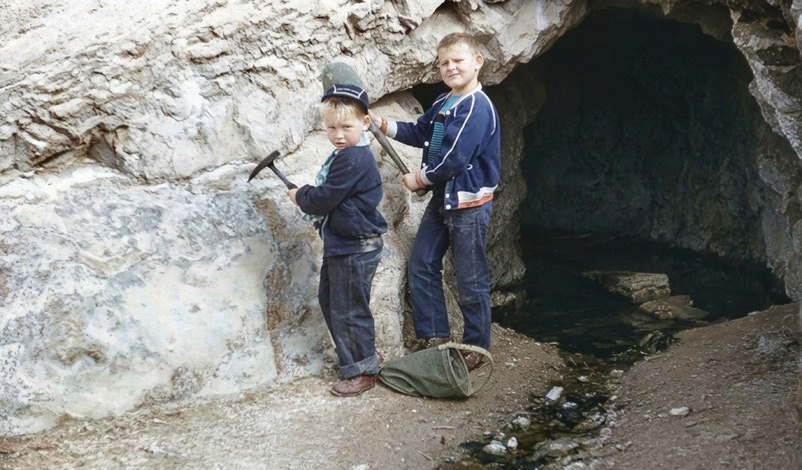
Ernest Otto Estwing, the founder of Estwing Manufacturing Co., was born on the island of Öland, Sweden, on Dec. 24, 1884. His original name was Ernest O. Johnson. Young Ernest had a curiosity about rocks and minerals from his early childhood. During the 1890s, little Ernest collected beach pebbles while walking on Öland’s shores along the Baltic Sea, immediately east of the southern tip of Sweden. It is not known what types of rocks he collected, but they were probably beach-rounded agates and other varieties of multicolored minerals. He was known as “Rock Boy” by the local island residents, because of his trouser pockets, bulging full of colorful, rounded beach stones.
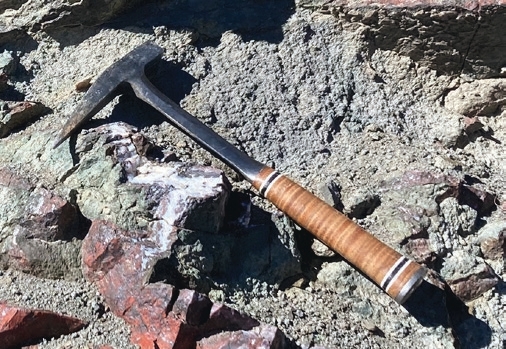
field. Photo by Ned Sterne.
As a 16-year-old in 1901, he immigrated by himself to the United States through Ellis Island on the Hudson River in New York Harbor. After settling in Rockford, he determined that his last name, Johnson, was very common in his community because of the large population of Swedes in the area. As a result, he officially changed his surname to “Estwing” which means “East Island” in his native language, referring to Öland along the Baltic Coast. Later in life, Estwing married and had a family of five children. He passed away at the age of 97 on June 3, 1982, after a long life and a successful career.
Twice the Value of Competitors
Estwing Manufacturing Co. was founded in 1923 when Mr. Estwing began designing and manufacturing hand tools. His first patent application involved a design for the ejection mechanism of a rear-loading shotgun, but his second patent application, filed in 1926, detailed the design of a one-piece carpenter claw hammer with inset wooden grips. This was granted in 1929 and issued as Patent No. 1,578,502 from the U.S. Patent Office. That was the beginning of the company’s unique designs in an extensive array of hand tools.
Estwing’s first tool, the one-piece steel carpenter claw hammer, was initially fabricated in the basement of his home in Rockford. The claw hammer was constructed of forged high-carbon steel with tapered wood grips that were inlayed into the steel shank and fastened with two inset rivets. When he was operating the drop forge in his basement, the neighbors on his block could feel the minor vibrations combined with rattles from their dishes and fine china. Legend has it that everyone knew immediately that “Ernest was at it again!”
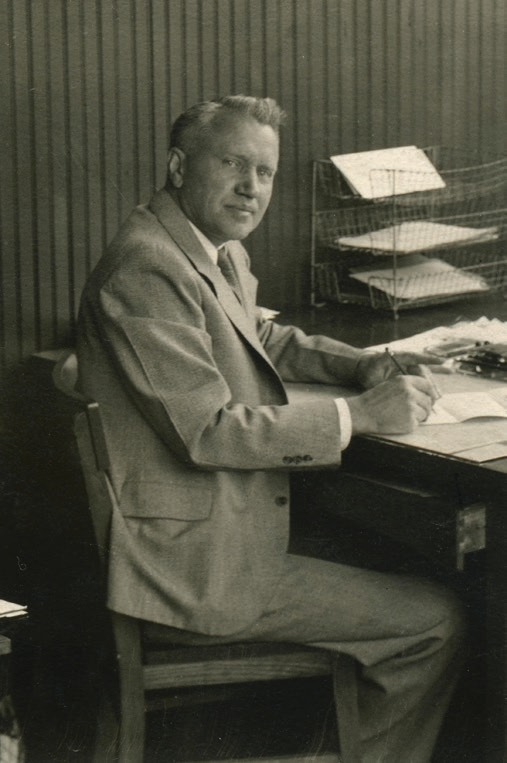
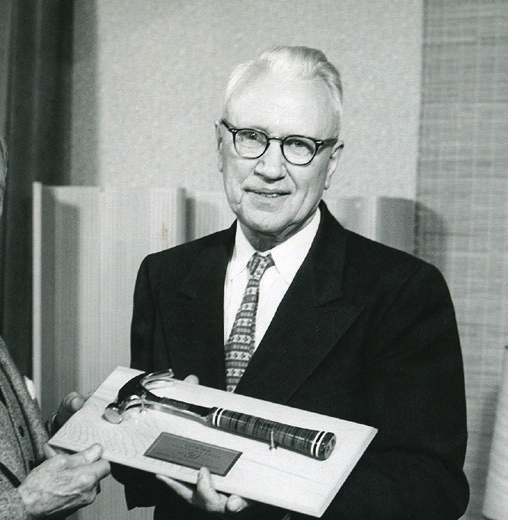
desk, 1950. Photos of Estwing
and Estwing Manufacturing Co.
courtesy of the company.
His carpenter hammer sold in the mid-1920s for $2.00 – twice the price of a commonly available hammer manufactured with a standard solid wood handle. This early design was superior to that of competitors, but not enough to make the product a huge success at the higher price.
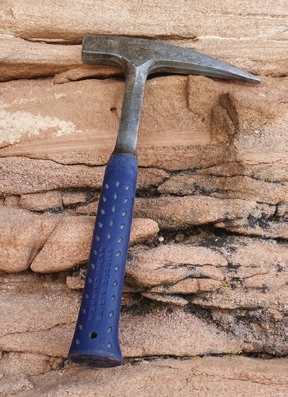
with the blue shock-reduction
grip in an outcrop of the upper
Paleozoic west of Masonville,
Colo. Photo by Astrid Makowitz.
That is, until 1925 when Estwing advertised his hammer by placing a full-page ad in July issue of The Carpenter Magazine. The immediate response was overwhelming, and he was unable to keep pace with demand while continuing to manufacture the hammers by himself in his basement.
Estwing saw the need to expand his operations, to hire employees and to build a machine shop. The early shop was constructed on property he purchased during the 1920s and it is still owned and operated by Estwing Manufacturing Co. in Rockford. He equipped the machine shop with drop-forge presses, grinding machines, polishing machines and high-temperature furnaces.
As Estwing began hiring employees, he trained his machinists with special attention to fabricating a quality product. Estwing realized that he was only able to compete in the striking tool market with products that were superior to those of other suppliers. Sales of his hammers declined drastically due to the Depression of the 1930s, but he was able to keep the machine shop from going under during this challenging time.
Birth of a Legend
In 1934, Estwing received a note attached to an order for carpenter hammers sent by a mining engineer from Arizona:
“My blacksmith has been welding pick points to the claws of your hammers, but that still doesn’t do the job where busting rocks is concerned. Have you ever considered manufacturing a special hammer-pick for prospectors and mining men? There might be a market for such a product.”
It didn’t take very long for Estwing to see the opportunity for an entirely new line of tools. He immediately began designing the new product, experimenting with manufacturing methods, and the legendary Estwing Geology Pick was born that year.
His initial design featured the familiar short, blunt, square head; the long, sharp, four-sided pick end; the thin, one-piece forged steel shank between the head and the handle; and the distinctive laminated-leather grip. After finalizing his design and manufacturing method for the geology pick, Estwing applied for a patent to protect his interests. The company’s design of the geology pick has not changed much since its early years in the mid-1930s.
A Golden Age for Rockhounding
To introduce his new product, Estwing sent complimentary rock hammers to the geology departments of several leading colleges and universities during the mid-1930s. Geology students armed with these new rock smashers demonstrated the tool’s abilities while in the field. Word of the tool’s well-balanced design, quality and durability began to spread.
By the mid-1940s, U.S. factories began switching from producing vehicles and weapons for World War II to manufacturing automobiles, pickup trucks and household appliances. War-time gasoline rationing was lifted on July 1, 1945. The post-war economic boom fueled the demand for vehicles and other manufactured products. With the Depression and the war over, the Golden Age of Rockhounding began to emerge around 1946, and the demand for Estwing geology hammers steadily increased.
As a direct result of these changes, people took to the great outdoors. Some began exploring for rocks and fossils. When rockhounds packed for a trip, they usually included at least one geology pick in each vehicle. Army surplus equipment became available in limited supply, including Jeeps, Dodge Power Wagons, small weapons carriers, cook stoves, pots and pans and small canvas tents.
The first mineral society had been formed as the New York Mineral Club in 1886. By 1900, the country had 24 mineral societies from coast to coast. During the late 1930s, there were 120 mineral groups. By 1947, the American Federation of Mineralogical Societies recognized more than 1,000 mineralogical societies. Word got out about the Estwing geology pick through magazines that were dedicated to the hobby of rockhounding.
In 1948, the Atomic Energy Commission announced a $10,000 reward to be given to any American citizen or company that discovered a significant uranium ore deposit. The objective was for the government to begin working toward stockpiling uranium ore and its processed commodities, including uranium oxides and the refined metal for use in warheads for national defense. Prospectors began purchasing Geiger counters or, by the early 1960s, scintillometers as their primary uranium exploration detectors. Sampling tools, including the geology pick, became essential instruments to be included in their field vehicles and carried on their belts or in their daypacks.
The sale of Estwing rock picks really took off during the Uranium Rush beginning in the early 1950s. Uranium prospectors throughout the country included Estwing geology picks in their list of essential prospecting equipment. The rock hammer was also a very important survival tool and could be relied upon for everything from digging holes and pounding tent stakes to splitting firewood. Some uranium prospectors even used their Estwing geology hammers for repairing field vehicles when minor bending of steel parts was necessary.
As geologic exploration was applied to the mining industry, petroleum industry and to the study of the earth sciences, the Estwing geology pick became essential for gathering representative rock samples along the paths of discovery. Paleontologists and archeologists recognized geology picks as essential tools for the extraction of fossils and artifacts.
Estwing Catches the Rockhound Bug
In 1959, Ernest Estwing announced his retirement from the company that he had founded in 1923. He composed a letter addressed to Eugene L. Conrotto, editor of Desert Magazine, requesting a recommendation for “someone to lead him to a good gem and mineral field.”
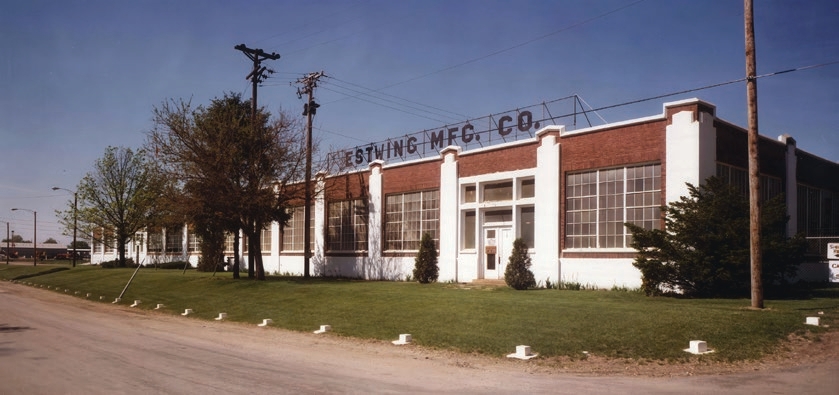
building, mid-1950s
Estwing concluded his letter with an intriguing note: “Although I have been manufacturing prospector’s picks since 1934, I have never had the opportunity to use one in the field.”
In response to this letter, Conrotto recommended a rockhound named Herb Ovits to lead Estwing on a field trip to the Hauser Geode Beds located southwest of Blythe, in a remote portion of the California desert west of Wiley’s Well in Riverside County, Calif.
Conrotto met Estwing in front of a resort hotel in Palm Springs, and they proceeded in the magazine’s overloaded jeep on their journey to pick up Ovits at his home near the north shore of the Salton Sea. Estwing came equipped with several of his geology picks.
As they made camp the first night, Estwing found time to slam one of his tools into a rock ledge that was outcropping near camp. Conrotto reported that Estwing, “took aim and drew back his hammer. Wham! Ernest sent a small piece of rock flying, but he looked first at the tip of his rock pick … then he grinned. We had a hard time dragging him from the diggings before darkness caught us.”
After dinner, a campfire was lit, and Estwing proceeded to tell his companions how his company began in 1923 and how his geology pick came to be in 1934. The following days were spent collecting geodes and agate nodules from numerous outcrops in this remote desert region. Naturally, Estwing had brought extra picks to give to those leading him on his first field trip. As geodes and nodules were extracted and collected, Estwing kept in mind that there would be a weight limit in his luggage for his return flight to Illinois. Some of the specimens of geodes and agate nodules exceeded the size of his fist.
Estwing proclaimed, “It may be that my hammers are too good. There won’t be many sales if they last forever.”
Ovits responded, “Don’t worry about that, they may be unbreakable, but they are not unlosable – I mislay one every now and then.”
Conrotto observed about Estwing, “Three days prospecting in the open desert can make changes in a man’s appearance.” He added. “The shoes were ruined, the slacks torn, the sweatshirt looked as if it had been used for a rock sack which, in truth, it had.”
Estwing had accumulated two mid-size cardboard boxes of rock material which he carried up to his hotel room. He concluded the field trip by declaring how grateful he was for the great opportunity he had while testing his geology pick in the field during the rockhounding expedition.
Estwing said, “I’m going to wash these and ship them back to Illinois.” He gave all the hammers that he had brought from his shop in Rockford to Conrotto and Ovits as gifts for their assistance in planning a trip that turned into a great adventure. Estwing felt that there was no sense in returning to Rockford with any of his rock picks.
The Estwing Rock-Hammer Recipe
Estwing’s steel, applied to the manufacturing of all the company’s hammers, axes, knives, chisels, pry bars and wood splitting tools, is supplied by Nucor Steel Production Co. and is delivered to Rockford from Nucor’s plant in Charlotte. The steel billets are composed of high-quality carbon steel with trace amounts of alloys to make the metal malleable during hot-forging operations as well as to enhance strength and durability. The steel is free of non-metallic inclusions, which ensures that the solid one-piece tool will be very hard, but not brittle. Recycled steel has never been applied in the manufacturing process for Estwing hand tools because of the possible introduction of undesirable impurities.
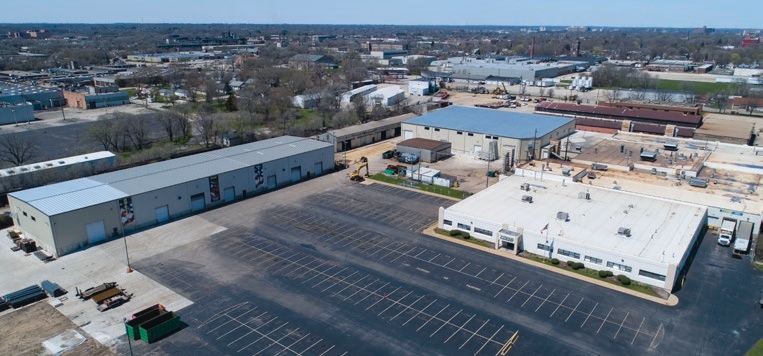
shipping building on the left.
When fabricating a hammer in Estwing’s machine shop, steel billets are heated in the furnaces to a high temperature and then subjected to several strokes on the drop-forge equipment, set with the proper dies (based on the tool’s general form and design). The forged steel is then annealed in the furnaces for a brief period and allowed to cool slowly. The steel is finally heat-treated for an extended length of time and quenched in oil. Some variations to this process are applied to certain tools, depending on the mass of steel being formed and the tools’ design applications. Details of the metallurgical chemistry, the manufacturing process and temperatures are proprietary.
After forging, annealing and heat-treating, the steel is allowed to finish cooling to room temperature. The tool is then machined into its final shape. For the manufacturing of hammers and axes, the leather or vinyl grip is formed, and the tool is then machined and polished for the removal of any burrs or upsets where the grip meets the steel. The Estwing insignia is then applied to the shank. The tool is given a final polish, coated with a clear finish and applied with an adhesive decal.
In 1960, after years of applying laminated leather for the hammer grips, Estwing introduced a blue molded nylon grip. More than 40 years later, the chemistry of the nylon grip was improved, allowing for the absorption of 50-percent more of the vibration shock generated from a blow of the hammer on a hard surface. The company continues to apply for patents as new products are designed and improved.
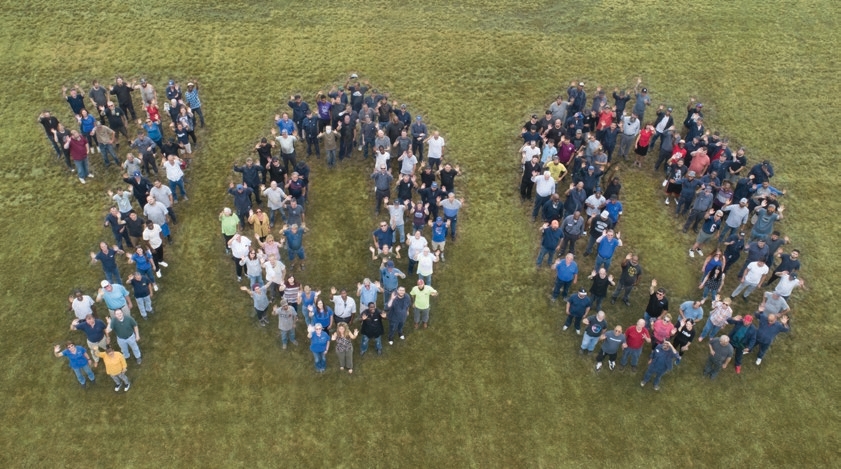
Estwing’s buildings in Rockford have expanded numerous times since those early years to address the increased demand for tools, to house new machinery, to upgrade new electric power requirements, to modernize the office space and to produce new product lines. It remains a family-owned business with more than 200 employees, some 50 of whom have been with the company for more than 25 years.
The Better Mousetrap
Estwing geological tools also include crack hammers, engineer’s hammers, drilling hammers, chisels, and treasure scoops. Popular due to their durable steel compositions and well-balanced designs, the tools are used extensively not just by geologists, but also by paleontologists, engineers, surveyors, miners, prospectors, archeologists, soil scientists and rockhounds. The company’s dominant product line continues to be the hammers made in Rockford, but their related equipment includes safety goggles, gloves, daypacks and sheaths.
Ernest O. Estwing had no idea that his legendary geology picks – still made to his exacting standards – would remain essential tools nearly a century later for so many scientists, engineers, students and hobbyists. As the company’s website states, “The history of Estwing Manufacturing Company reflects the promise of the free enterprise system, that success comes to anyone who can ‘build a better mousetrap.’”
Acknowledgements: A word of thanks goes to Stephanie Thrasher-Fisher of Estwing Manufacturing Co. for gathering photos from the company files and obtaining approval to publish the photos in this article. Details of the first inquiry about geology hammers and Ernest Estwing’s first field trip are found in Eugene Conrotto’s article in Desert Magazine, October 1959.