

A generative (or an effective) petroleum source rock is a clay-rich or carbonate sedimentary rock that has generated, or is generating, and has expelled, or is expelling, oil and/or gas.
Source rock with trap, seal, reservoir, and migration pathways is what constitutes the petroleum system. The source rock lies at a base of the system, deep in sedimentary basins. That is why source rock evaluation has historically been the last area of research and development in petroleum geoscience.
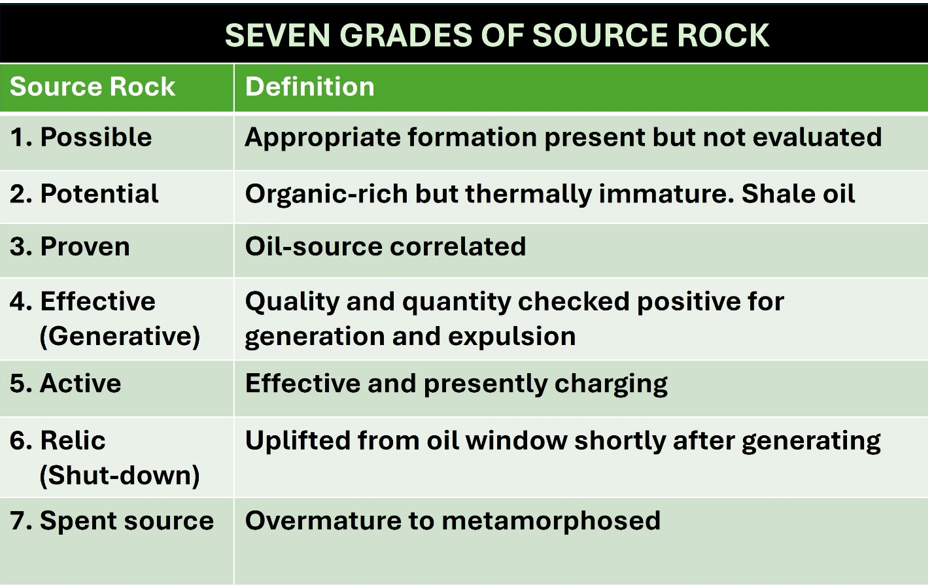
But source rock investigations are important, particularly for today’s shale play ventures, which deal with self-sourced reservoirs. It will also be key as the industry focuses more on little-charted ultradeep water basins.
I recently chatted with several experts and reviewed recent literature to discuss rock evaluation workflows and questions for further research. I thank Daniel Jarvie, Joseph Curiale, Andrew Pepper, Zhiyong He, Wayne Camp, and Matthias Greb for helpful discussions and correspondence. I have also benefited from the works of Bernard Tissot, Wallace Dow, Douglas Waple, Kenneth Peters, Barry Katz, and Harry Dembicki.
Let’s take a look.
Carbon Alone Will Not Do It
In quality checks on source rocks, a total organic carbon with threshold values of 1 or 2 percent is sometimes considered to be a fair or good source rock; however, relying on such numbers alone can be misleading. Aside from uncertainties in experimental measurements or pyrolysis calculations of TOC values, these numbers are dependent on the thermal maturity of the rock. Highly heated shale will have lower TOC values, and thermally stressed carbon alone would lead to graphite. Hydrocarbon yield in a source rock involves hydrogen, which is often measured as the hydrogen index (HI) derived from pyrolysis.
Two methodologies, both published in the AAPG Bulletin, offer templates for generative source rocks.
Researchers Gerard Demaison and Bradley Huizinga suggest using the Source Potential Index (SPI). This index combines rock thickness and density with potential yield (a sum of S1, free hydrocarbon, and S2, generated hydrocarbon in pyrolysis) and then calculates metric tons of hydrocarbon per square meter.
Another research team, Andrew Pepper and Elizabeth Roller, suggest using the Ultimate Expellable Potential (UEP) metric, which integrates rock thickness and density with TOC, HI, transformation ratio, and oil versus gas components to estimate generated and expelled oil volume.
Basin modeler Zhiyong He of ZetaWare considers both metrics useful in their own ways. SPI gives mass, and UEB gives the volume of source hydrocarbons. Both SPI and UEP help create generative maps laid over the depositional span of source rock formations.
A major challenge, though, is how to estimate the initial or original values of TOC and HI, usually used for basin modeling. Every proposed method has drawbacks. Geochemist Daniel Jarvie prefers maturity-based restorations combined with statistical analysis.
Oil mobility and expulsion efficiency from source rock and associated mechanisms are also critical parameters that deserve further research.
Kerogen Typification
Kerogen, or solid, insoluble organic matter dispersed in sediments, generates hydrocarbons via thermal cracking in a buried source rock. Kerogen type partly controls the kinetics of source rock maturity and whether the rock is oil-prone, gas-prone, hybrid, or inert.
The Van Krevelen diagram or cross-plot of atomic hydrogen-to-carbon and oxygen-to-carbon ratios was originally developed for coal ranking. It was later redesigned by scientist Bernard Tissot and others for categorizing kerogen by cross-plot of hydrogen index versus oxygen index. Both are derived from pyrolysis.
There are two important limitations of using the Van Krevelen diagram. Firstly, the modified Van Krevelen diagram is informative for thermally immature or early mature rock samples. With increasing maturity, hydrogen index decreases, and the kerogen trend lines on the diagram tend to converge. Secondly, as researchers Joseph Curiale and Wayne Camp emphasize, a source rock often contains different macerals and thus, more than one kerogen type.
To address these issues, geochemists suggest organo-facies (visual kerogen) analysis. Another technique is to analyze S2 peak materials from pyrolysis by gas chromatography.
Thermal Maturity
The standard industry practice to determine the thermal maturity of source rocks is vitrinite reflectance (Ro) measurements of whole rock or extracted kerogen samples. The top of the oil generation window is Ro 0.6 to 0.8 percent for different kerogen types. Although vitrinite reflectance data can have their own hurdles, they are routinely used along with Tmax data derived from pyrolysis and burial history modeling.
For rigorous basin modeling, Ro data can be supplemented by apatite fission track thermochronology (which also provides thermal history), thermal alteration index of palynomorphs, and conodont alteration index or graptolite reflectance data (both for Paleozoic rocks).
Problems and Prospects
Modern source rock science has come a long way from its beginnings when it was championed by a few scientists in the 1970s, but it still has a long way to go.
Two challenges in source rock evaluation and basin modeling are:
- Well data are location-specific. The deep hydrocarbon kitchen would be the last space to drill, or it may remain undrilled, even after a long production history from reservoirs.
- Validating the results of source rock evaluation applied to a basin is tricky. Reservoir oil to source rock fingerprinting using age-diagnostic or facies-diagnostic biomarkers obtained from gas chromatography-mass spectrometry can be helpful to some extent, but such data are usually scarce.
With further research and industry support, petroleum geochemists can elucidate many of the key questions in source rock evaluation and improve, calibrate, and standardize workflows for basin modeling, reporting, and cross-company comparison.