
Michael Sweet talked about the Deep Paleogene in the Gulf of Mexico (America) and began with its dubious reservoir quality.
Sweet is an expert on Gulf geology, program co-director for the Gulf Basin Depositional Synthesis Project at the University of Texas at Austin and a research scientist in the school’s Jackson School of Geosciences.
“In terms of reservoir quality, the Paleogene is really unique compared to the Miocene. It’s much finer grained, in the range of very fine grain to silt,” Sweet said.
Deposits in the Paleogene Wilcox Formation came from Laramide uplift drainage and, secondarily, from the Appalachian Mountains. Very fine grain size and high feldspar and lithic fragment content, combined with quartz and calcite cementation, produced relatively poor reservoir quality. Sweet put permeability in the 1 to 10 millidarcy range.
“In order to get these (Deep Paleogene) wells to flow at a reasonable rate, they’ve gone to doing stacked frac jobs on them. Those can be expensive, a quarter of a billion dollar completion on one well,” Sweet said.
But wait. There’s more.
Deep burial, pressure sealing and other factors led to a high-temperature, high-pressure environment in the Deep Paleogene. Sweet characterized the play as “4,000 to 6,000 feet of water, 35,000-feet drill depth, 25,000 to 30,000 feet below the mud line.”
Pressures can reach a forbidding 20,000 pounds per square inch or higher, what operators call “a 20K environment.” Also, most of the Deep Paleogene lies below salt, where imaging is tricky. It’s typically not a direct hydrocarbon indicator-on-seismic area.
But wait.
Today, the Deep Paleogene play is re-emerging as a hot deepwater play in the Gulf. Prospects for the play will be discussed in the 2026 Offshore Technology Conference session “The Future of the Gulf of Mexico, Developing the Paleogene,” on May 6.
BP’s Paleogene Plans
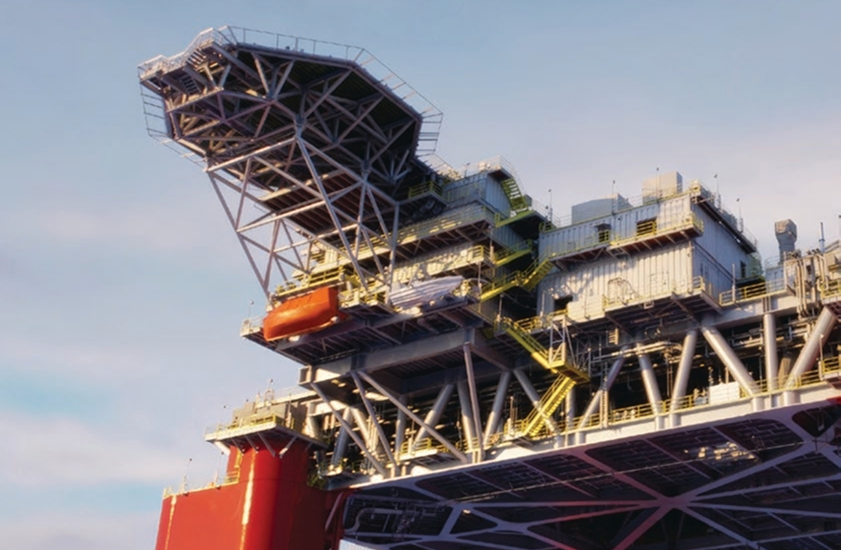
BP has launched two Paleogene-related production hub projects in the Gulf, each at an estimated cost of $5 billion: the Kaskida platform and the Tiber-Guadalupe platform, both in the Keathley Canyon area about 300 miles southwest of New Orleans. BP plans for Kaskida to begin production in 2029, Tiber the following year.
The company also is expected to drill a high-impact Gulf exploration and appraisal well this year targeting the Deep Paleogene, the Conifer-1.
So, this play clearly has something going for it. That includes potential hydrocarbon deposits estimated in the billions of barrels of oil equivalent, identified reservoir thicknesses of almost 8,000 feet and a better-than-average past success rate.
“Kaskida is a world-class project that reflects decades of technological innovation by BP and the offshore oil and gas industry. This $5 billion investment will safely bring online more American energy by helping to unlock 10 billion barrels of discovered BP resources in the Gulf of America’s Paleogene fields,” said a BP spokesperson.
In the deepwater Gulf, the play also is known as the Lower Tertiary, the Wilcox Formation trend, the Inboard Paleogene-Outboard Paleogene. It has a shallower extension to the west and a Perdido Fold Belt extension to the south, into the Gulf’s Mexican waters.
The Role of ‘20k Tech,’ Other Advances
Most – as in, almost all – Gulf production to date has come out of Neogene reservoirs, Miocene and Pliocene. The Paleogene looks like a different animal and a harder creature to tame. In revitalizing Paleogene exploration and production in the Gulf, improved technology has been key.
“Technologies have improved,” Sweet observed. “Companies seemed to have improved this frac’ing technology and are able to make it work.”
The ability to handle pressures of 20,000 psi, or “20K technology,” was pioneered by Chevron and a handful of other large companies pioneered the ability to handle pressures of 20,000 psi, or “20K technology,” and introduced it just a few years ago. Chevron began production from its Anchor platform in 2024, the deepwater Gulf’s first large-scale 20k production project. BP’s new production-hub projects also utilize 20K technology.
From a positive view, the play’s sedimentation through submarine fans spread over a vast extent. Sweet noted that “the Paleogene is a series of large submarine fans – giant. Exploration risk is quite low. You can’t drain a large area, but you have very high thickness.”
Mudstone and marl of the Queen City sequence create a top seal for Wilcox Group reservoirs – “It’s very thick and impermeable, and there’s often salt above it,” Sweet said.
Seismic imaging might be sketchy sometimes in the Deep Paleogene, but large structures can be – and have been –identified and imaged at significant depth, even below the salt canopy.
“People are drilling large structures, three- or four-way structures. That’s been very successful,” Sweet observed. Gulf Paleogene fields including Kaskida and Jack-St. Malo, “they’re all big four-way closures,” he said.
Organic-rich marine shales serve as source rock for the play. Tithonian and Smackover source rocks “are very widespread in the Gulf. At the prospect scale, the issue isn’t source rock presence, but rather the timing of migration versus timing of structure formation,” Sweet noted.
The Lower Tertiary Paleogene play first opened up 25 years ago with the success of the Trident prospect in 2001 and Shell’s Great White in 2002. Today’s interest in the Deep Paleogene is a second go-round, aided by advances in deepwater drilling and high-pressure technology.
“This (Deep Paleogene) play has kind of been a long time in coming. It really wasn’t until the early 2000s with the drilling of the Unocal Trident well that somebody drilled these thick formations. I think people have been surprised at their extent and thickness,” Sweet said.
The Next Big Test
Right now, attention is focused on BP’s upcoming test in the Deep Paleogene. Gordon Birrell, BP executive vice president of production and operations, discussed the well during a recent company earnings call.
“The next exploration well in the Paleogene will be Conifer, which we’ll spud later this year, which could be quite an exciting tie back to Kaskida eventually. So again, (it) creates longevity on that Paleogene opportunity that we have. So there’s lots of running room in the Gulf of America and a lot in the Paleogene,” he said.
Past Paleogene drilling in the Gulf extends over an area 400-miles wide. It began in the Alaminos Canyon and Walker Ridge areas and extended to Keathley Canyon, Green Canyon, Garden Banks, and beyond. Much of the initial drilling was offshore Louisiana.
“Shell, on the other hand, has developed a strong portfolio in the western Gulf, and there the Wilcox is much less deeply buried, about 6,000 to 8,000 feet below the mud line,” Sweet said.
“It’s like a different play,” he noted. That play area is anchored by Shell’s Perdido platform, about 160 miles off the Texas coast. Paleogene production extends further to the south, into the Gulf’s Mexican waters, where wells are tightly held and logs are not publicly available.
“We really don’t have much data on those, but there is a field (offshore Mexico) called Trion that’s being developed by Woodside and Pemex,” Sweet said.
“Companies have started to explore this trend updip and I think that’s going to be very challenging. It will be interesting to see how far people can push this play to the north and still be successful,” he said.
As the play moves north, reservoirs become less continuous and Paleogene prospects are more deeply buried in places, Sweet noted. In the Deep Paleogene, “there’s a lot of undiscovered and undeveloped resources, so that’s good,” Sweet said.
“I’m less optimistic about the exploration possibilities outside of the established fairway,” he added. “We’ll see how far people can push this north, where I expect the reservoirs become more channelized.”