
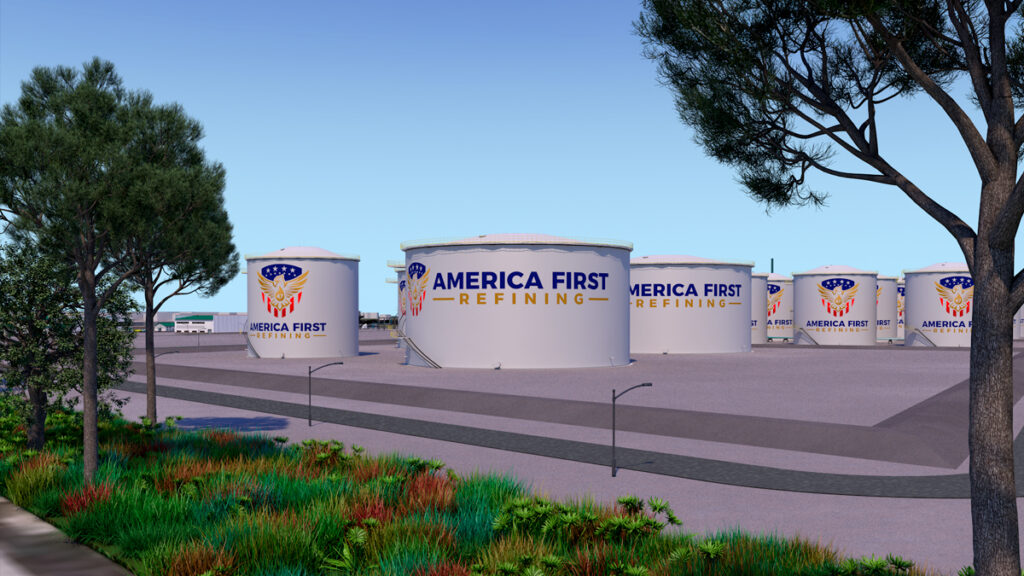
Plans for a major new crude oil refinery in Texas, announced in March, have boosted hopes for improved U.S. downstream capacity. The story is every bit as much about U.S. upstream capacity.
Almost overlooked in the hype and media chatter was the reality of one major California refinery being idled, and another scheduled for shutdown. At least in part, that’s also an upstream story.
America First Refining reported its new refining plant will be built in Brownsville,
Tex., with an input capacity of about 165,000 barrels per day. John Calce, AFR chairman, left no doubt about the project’s rationale.
“This project represents a historic step forward for American energy production. For the first time in half a century, the United States will build a new refinery designed specifically for American shale oil,” he said.
Through a social media post, President Donald Trump said the proposed refinery would “strengthen our national security, boost American energy production, deliver billions of dollars in economic impact and will be the cleanest refinery in the world.”
Light Oil in a Heavy-Oil Infrastructure
Proposals for an American refinery to process light, unconventional oil have circulated for more than a decade. Those plans reflect a complete turnaround in the country’s domestic oil production during the past 20 years.
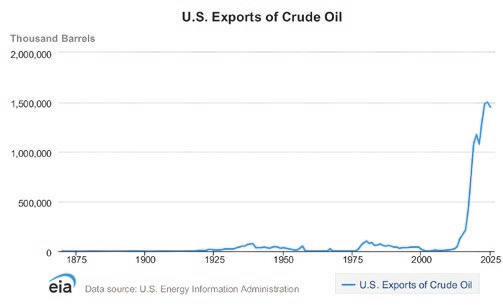
In 2007, declining U.S. crude oil production had fallen to about 5 million barrels per day. But producers were already applying horizontal drilling and multi-stage hydraulic fracturing to low-porosity shale and sandstone reservoirs.
New unconventional development techniques, first used in natural gas shale plays, soon spread to shale oil and tight sands oil plays. By late 2023, domestic oil production had reached 13 million barrels/day and was still climbing. That unconventional oil production was mostly light, sweet crude – oil with low density, low viscosity and high API gravity.
By contrast, American refiners for decades had moved toward processing heavier oil, which traded at a price discount to light oil and was readily available for import from “secure” sources like Venezuela and Russia, as well as Canada. U.S. production was steadily declining, so the switch made sense.
Roughly 70 percent of domestic refining capacity was optimized for processing heavier crude. U.S. refineries seemingly were well prepared for a future that didn’t happen. As America’s light crude output increased dramatically, proposals for new refineries circulated.
‘The First in 50 Years!’ … Sorta’
AFR announced its new refinery would be built at the Port of Brownsville on the Texas Gulf Coast. The Port issued its own news release, noting that plans for a light-crude refinery project dated back more than a decade.
“The refinery, to be built on more than 240 acres within the port, will process 100 percent domestic shale oil using advanced, hydrogen-powered systems to produce ultra-low-carbon fuels,” the release stated.
Trump hailed the AFR project as “the first new U.S. oil refinery in 50 years” and many news reports repeated the claim. More accurately, it would be the first large U.S. crude oil refinery in almost 50 years of a specific type: heated vertical distillation for fractionation, or atmospheric distillation.
According to the U.S. Energy Information Administration, “The newest refinery with significant downstream unit capacity is Marathon’s facility in Garyville, Louisiana. That facility came online in 1977 with an initial atmospheric distillation unit capacity of 200,000 (barrels per calendar day).” It currently has a capacity of 606,000 b/cd, Marathon reported.
Instead of taking on the expense and permitting challenges of building large new plants, American crude oil refiners chose to increase capacity at existing locations. Several smaller refining and condensate processing facilities have been built in the U.S. in the past decades – the EIA lists a dozen locations that have opened since 1980. The largest of those projects was a condensate-splitter refinery built by Kinder Morgan near Galena Park, Tex., in the Houston area, with a reported capacity around 100,000 b/cd.
Also, liquefied natural gas production expanded significantly as the U.S. grew into the world’s largest LNG exporter. LNG and midstream growth reflects the impact of shale development on domestic production in the past 20 years. U.S. marketed natural gas production ballooned from about 18.9 trillion cubic feet per day in 2005 to more than 43.2 tcf per day in 2025.
California Dreaming
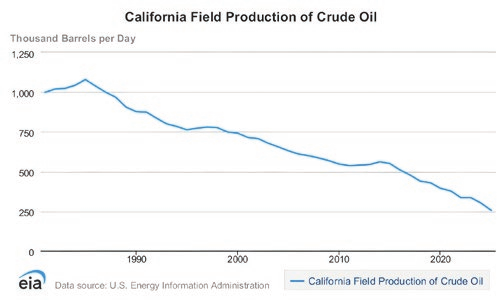
While U.S. oil production was increasing, the story looked very different in California. The state’s total field production of crude oil went through a long decline, dropping from almost 1.1 million barrels per day in 1985 to 257,000 barrels a day in 2025. California began losing refineries to shutdown, especially in the Los Angeles area.
According to the California Energy Commission, only nine refineries in the state were producing transportation fuels as of January 2026. One of those, Valero Energy’s 145,000 barrel a day refinery in Benecia is scheduled for closure in April. Phillips 66 shuttered its 139,000-barrel-a-day Wilmington refinery complex at the end of 2025.
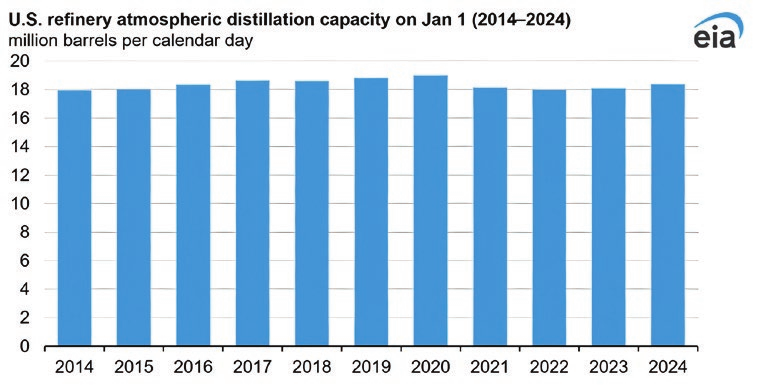
Several factors have influenced the decline in California refining, including strict environmental rules and the state’s policies opposing hydrocarbon-based energy. Operating restrictions and permitting hurdles also have affected American refineries in general, but overall U.S. capacity has remained fairly steady at around 18 million b/cd for a dozen years.
How ‘Historic’?
In announcing its new refinery, AFR did not give an initial full-cost estimate. Reported starting-costs estimates have varied from $1.2 billion to $3 billion, with full construction, equipment, and opening cost estimates ranging up to $5 billion to $10 billion.
Trump touted the refinery as an “historic $300 billion deal.” In its news release, AFR reported “the U.S. trade imbalance will improve by $300 billion.” Some media reports also included that figure, which apparently came from the combination of two numbers: shale oil purchases valued by AFR at $125 billion and refined products output it valued at $175 billion.
The company reported a “global supermajor” had signed a binding 20-year offtake agreement for refinery output and had pledged “a nine-figure investment.” Trump thanked “our partners in India, and their largest privately-held energy company, Reliance (Industries),” for financial commitments. A conglomerate active in several business areas, Reliance operates the world’s largest refining complex in India.
Calce, AFR’s chairman, said refinery construction would start in the first half of 2026. He added, “in 2028, we should have all of our large units on the ground and being assembled in Brownsville with our first full year of operations in 2029.”
The U.S. West Coast lost refineries as California oil production declined and restrictions tightened. American refiners chose to add capacity at existing locations instead of opening new plants. And shale development reshaped the refining and processing picture in the United States.
Welcome to unconventional refining. AFR President Trey Griggs commented that, right now “the United States has a surplus of light shale oil, but a shortage of refining capacity designed to process it.”
It’s a downstream story that’s also all about upstream. At the beginning of this century, domestic crude oil production in the United States faced a grim future. Then petroleum geologists and petroleum engineers created a new one.