

Author Alvin Toffler emphasized the emergence of digital information technologies and how they would reshape the world in his bestsellers “Future Shock,” “The Third Wave,” and “Powershift,” during the 1970s and ‘80s.
His vision has come true.
Since 2000, the term “emerging technology,” or “ET” has been increasingly used to introduce, forecast, or publicize, cutting-edge revolutionary, or rising technologies. But how can we objectively spot a successfully emerging technology from one that only appears it might gain traction?
A Template for Emerging Technologies
In 2000, George Day and Paul Schoemaker defined “emerging technologies” as “science-based innovations that have the potential to create a new industry or transform an existing one” in their pioneering paper in California Management Reviews. Since then, various definitions have been suggested. Raji Srinivasan in Industrial Marketing Management, Mohanad Halaweh in Journal of Technology Management & Innovation, and Daniele Rotolo and colleagues in Research Policy have compiled and analyzed these concepts, identifying these defining attributes for emerging technologies:
- Novelty and radical innovation
- Fast clock-speed or rapid growth
- Convergence, or fusing together, of previous technologies in the new application domain
- Benefits to a wide range of users or a positive network effect among users
- Dominant design, meaning: how a particular emerging technology becomes dominant among competing designs
- Evolving cost: Emerging technologies have initially high cost or low performance- price ratio, but over time, costs should decrease and performance should increase.
- Uncertainties: Because ET impacts lie in the future, ETs are associated with various forms of uncertainties in business models, standards and specifications, job disruptions, societal impacts, and so forth.
Rotolo and colleagues suggest that the intensity of these attributes of an emerging technology change over time.
These researchers consider three stages: Pre- emergence, Emergence, and Post-emergence.
During the pre-emergence stage, novelty, cost, and uncertainties are at their highest levels, and they reach their lowest levels during post-emergence and maturity times. Attributes such as fast growth, convergence, and dominant design have lowest intensity during pre-emergence, become increasingly intense during emergence, and reach a plateau during the post-emergence stage.
The Gartner Hype Cycle
In 1995, Jackie Fenn, an analyst working for Gartner Inc., developed a graphical cycle for the development of emerging technologies. Fenn and her co-author Mark Rosinko detail the Gartner Hype Cycle in a 2008 book, Mastering the Hype Cycle: How to Choose the Right Innovation at the Right Time.
The Gartner Hype Cycle is divided into five phases:
- Technology trigger: A potential technological breakthrough attracts wide interest.
- Peak of inflated expectations: Mass media and some success stories create lots of enthusiasm and expectations for technology.
- Trough of disillusionment: As experiments and implementations fail to deliver the expected results, interest and investment wane.
- Slope of enlightenment: Some benefits of the technology materialize as some companies continue to invest and develop. These benefits become better understood.
- Plateau of productivity: Mainstream adoption of technology takes place.
Future Technologies in Geoscience
Si Woong Bae and Jae-Wook Lee from South Korea’s Future GeoStrategy Research Center have published an interesting report in Frontiers in Earth Science. Based on a bibliometric analysis of policy reports and research papers published between 2023 and 2025 from six countries – Australia, China, Germany, Japan, the United Kingdom, and the United States – Bae and Lee identified five research and development trends and priorities in geoscience:
- Digital and intelligence geoscience: The advancement of AI and integration of AI agents to enhance scientific efficiency and innovation
- Frontier/hostile operating conditions: Resource exploration and development technologies in extreme environments such as the Arctic, deep seabed, and outer space for future resource security
- Sustainable resource innovation: Advancing eco-friendly and high-efficiency technologies across the resource development lifecycle
- Earth system monitoring and prediction: Building unified data systems and AI-based early warning capabilities to detect and respond to geo-environmental hazards
- Public value and data-driven services: Developing open-standardized platforms and service modes to enhance national safety and societal impact
Bae and Lee state that these geoscience trends have important impacts on a macro-framework they call STEEP: society, technology, economy, environment, and politics. These geoscience R&D priorities should also be analyzed in the context of each country’s environmental framework called SWOT: strengths, weaknesses, opportunities, and threats (or risks and securities).
Emerging Technology Leaders
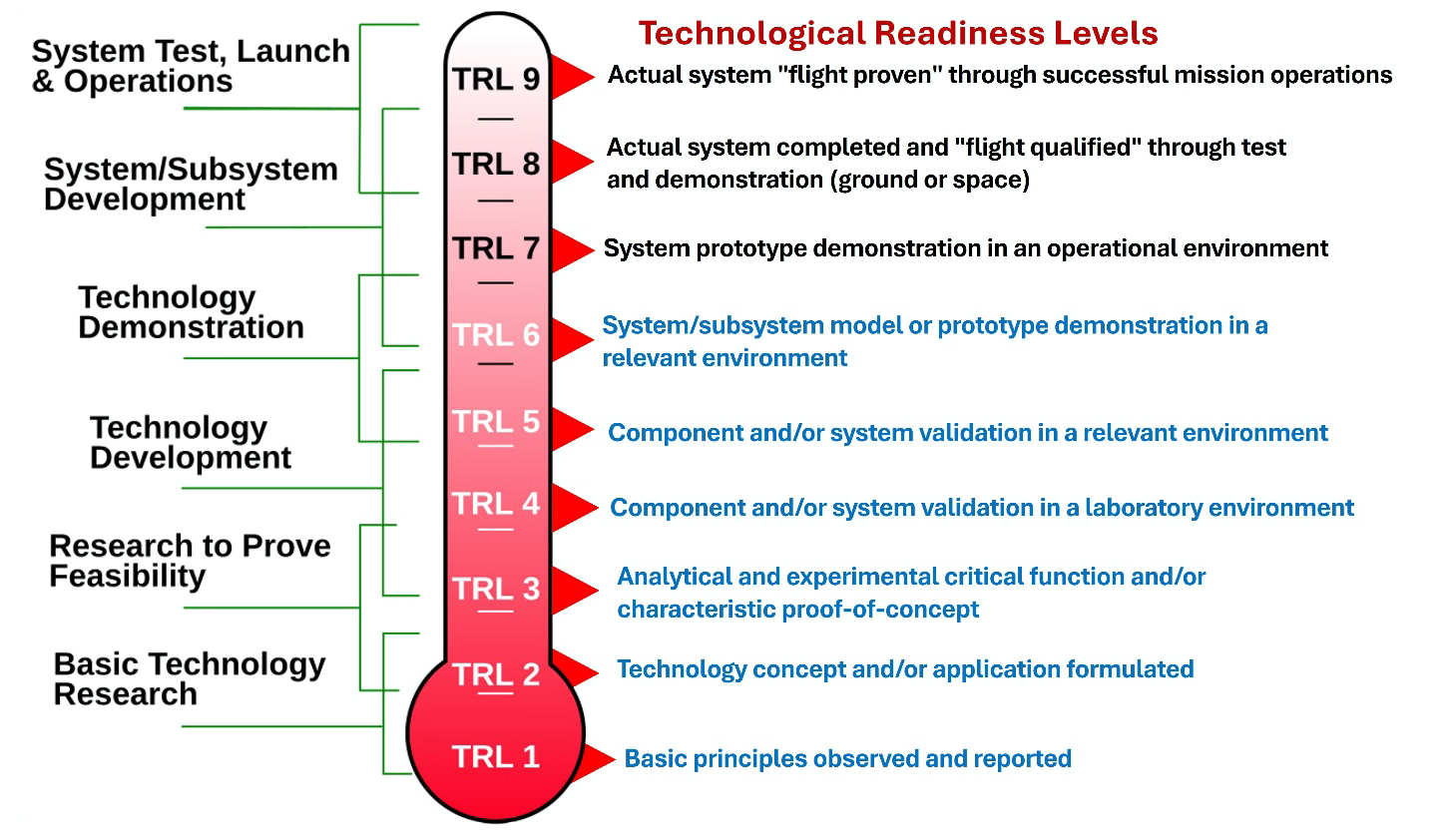
Emerging technologies in the modern world arise from investments in R&D. Moreover, emerging technologies are developed by leading countries or companies, and as a result, they control that emerging technology’s diffusion and market.
It is important to study how emerging technologies develop, and how to identify successful emerging technologies in a particular field, as they can provide advantages but also be disruptive of a given market or workplace.