
Recently, I was asked what information the Datapages Archives has about Libyan oil and gas extraction. My first thought was “challenge accepted.” My searches found 257 articles using the term “Libya” in a title search, with dates ranging from 1960 to 2025, and 1,381 results from the same term in a keyword search. Additionally, there were 303 results from a keyword search using “Sirte Basin” and 183 results using “Sirt”
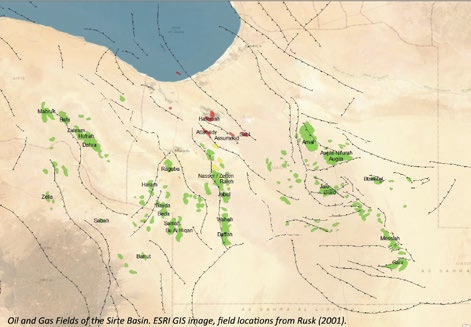
Libya holds the largest reserves in Africa. Its petroleum basins include the Sirte, Murzuq, Ghadames, Al Kufra, Al Bottnan, and Tripolitania Basins. The current proven oil reserves, according to OilPrice.com, are 48 billion barrels with 1.4 million barrels per day in oil production, and about 53 trillion cubic feet of gas reserves. Of the Libyan basins, the Sirte Basin (about 500,000 square miles) is the most prolific, holding 89 percent of the reserves and 22 giant oil fields, and 25 large fields (see Sirte Basin fields map).
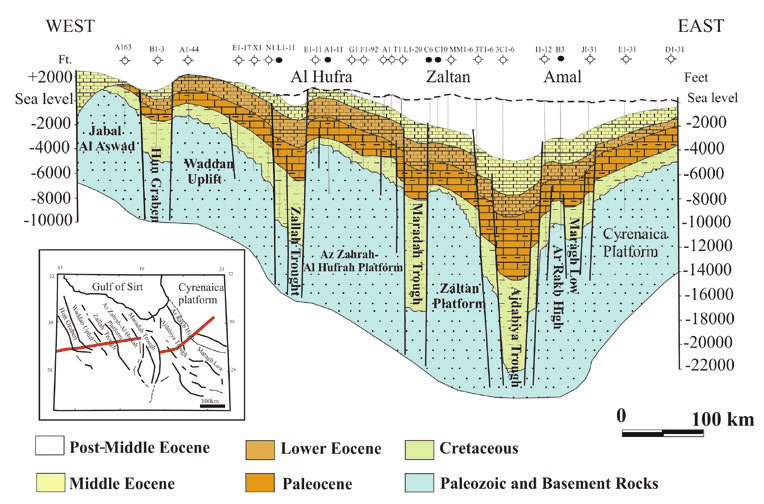
The Sirte Basin is classified as a cratonic sag on an earlier rifted basin. The major oil pools are related to a horst and graben system with normal faulting. The area is dominated by rift structures that are aligned in northwest-southeast-trending embayments, leading to hydrocarbons within fault-associated structural traps. The ages of the reservoir rocks range from Precambrian (highly fractured basement charged by overlying shales) to the Eocene. The major source rocks in the basin are the Upper Cretaceous Sirte Shale and Rachmat Formation (see the Sirte Basin Cross Section).
Bahi Giant Oil Field
According to a 1959 AAPG Bulletin (the earliest document in the Archives), in 1958 the first Sirte Basin commercial oil was discovered. Well A1-32, owned by Oasis Oil Company, produced oil from the Late Cretaceous (Cenomanian) Bahi Sandstone overlying the Hercynian unconformity. It tested 704 barrels of oil per day of 40-degrees API oil. This discovery was the start of the Bahi Field, which has an estimated 600 million barrels of oil in ultimate recovery. Classified as a giant oil field.
Dahra Giant Oil Field
Also in 1958, well B1-32 was drilled south-east of the Bahi Field, culminating in a giant discovery, the Dahra Field. The reservoir is in the Paleocene carbonates of the Dahra Formation consisting of limestones, shales and dolomites. The reserves in place are estimated to be approximately 7 billion barrels of oil and 2 trillion cubic feet of gas.
Zelten (Nasser) Giant Oil Field
In 1959 another giant discovery, the Zelten Field, was found. The discovery well, C1-6, produces oil from Upper Paleocene Limestone, testing 17,500 bopd. The primary trap is an anticlinal structural trap. The pay zone is at depths of 1,500 to 1,600 meters below sea level from the Zelten member of the Paleocene and Lower Eocene Ruaga Limestone, consisting of