
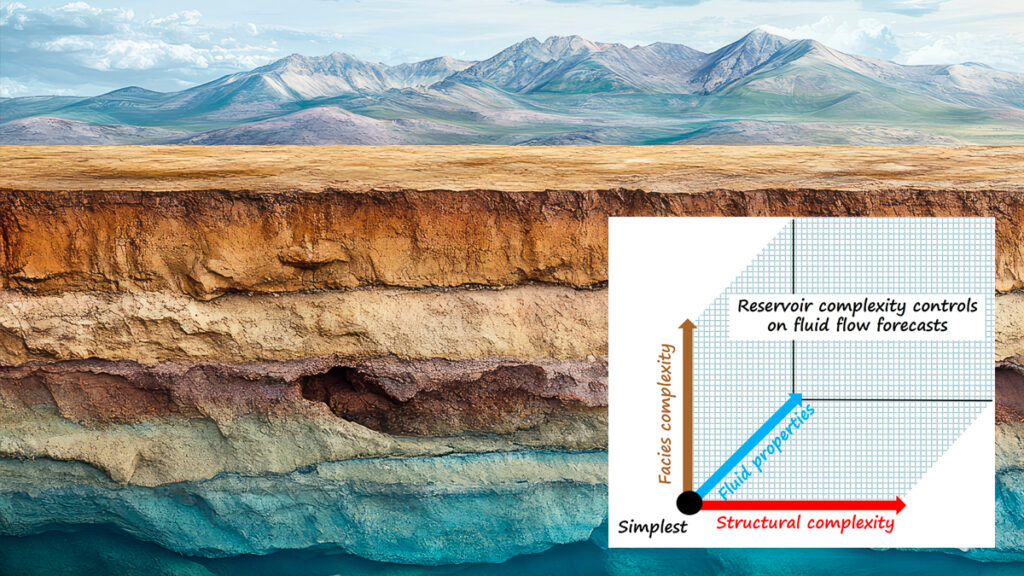
At the opening session of the 2025 IMAGE in Houston there was a panel discussion on “Dealing with Complex Reservoirs.” Impressed by the discussion, I thought the topic has huge significance for petroleum geoscience, exploration, and production, especially as the issue of complex reservoirs is rarely covered in petroleum geology textbooks.
I explored the existing literature on the subject and also posted a LinkedIn query, “What is a complex reservoir?” to which several petroleum geologists responded, and their opinions have been incorporated here.
Reservoir Definitions
A petroleum reservoir rock stores oil and gas on a geological timescale and yields oil or gas upon drilling wells. These properties are quantified respectively as porosity and permeability. According to A. J. Levorsen’s widely cited ranking, an excellent reservoir has porosity of 20 to 25 percent and permeability of 100 to 1000 millidarcy. A tight reservoir has porosity of less than 10 percent and permeability of less than 1 millidarcy. Petroleum reservoirs are usually classified into siliciclastic (sandstone), carbonate (calcite-dolomite) and fractured basement (igneous) rocks.
Structural Complexity
Faults and rock fractures control fluid flow in a variety of ways that pose challenges to reservoir simulations, production management, and fluid flow forecasts. Reservoirs intensely faulted and fractured exhibit structural complexity. Major faults can compartmentalize reservoir formations if they are sealing faults or alternatively breach the cap rock and create leakage conduits for oil and gas. On the other hand, in tight reservoirs, fracture networks can significantly contribute to permeability.
The Geological Society of London’s Special Publication 292 offers several case studies of structurally complex reservoirs. To characterize these reservoirs, it is imperative to collect the population, direction, dimensions, and geometry of faults and fractures, perform fault sealing analysis, and construct 3-D fracture models.
Sedimentary Facies Complexity
Several geoscientists who responded to my query – Wayne Camp, Matt Williams, Angel Perdomo, Evan Allred, and David Williamson – all highlighted inherent heterogeneity in sedimentary facies as important parameters, including:
- Lithology reflected in various types of clastic or carbonate rocks
- Mineralogy; for example, percentage and type of clay or volcanic input
- Porosity type and distribution; For example, carbonate vuggy or moldic porosity is heterogenous compared to clean sandstone porosity.
- Depositional environment; For example, deltaic sandstone versus turbidite sandstone
- Diagenetic processes such as dolomitization, dissolution, cementation, recrystallization, etc.
- Vertical rock heterogeneity, including lamination and grain size gradation
- Lateral discontinuity due to facies changes
- Thickness changes
“All geology is complex at some level,” said Williams. Reservoir complexity can thus be relative. A quartz-rich, well-sorted, highly porous and permeable, thick and laterally continuous sandstone (technically called “quart arenite,” such as beach sandstone) is perhaps the simplest and best reservoir and can be a yardstick for comparison of reservoir complexity.
Where Numbers Do Not Match
Reservoir complexity affects modeling of porosity, permeability, reservoir pressure, flow rate, and production. For instance, multimodal porosities are often encountered in complex reservoirs.
“A complex reservoir,” said Wiliams, “is one where the engineering equations and assumptions used no longer accurately predict outcomes.”
This is also echoed by Allred: “A complex reservoir is one that is hard to predict.”
Why? Because as David Williamson commented, “Complexity implies that the flow will vary in different parts of the reservoir.” Complex reservoirs exhibit different flow rates from well to well.
Aside from rock properties, well production and flow rates also depend on fluid properties including oil viscosity, API gravity, and gas-to-oil ratio. Fluid properties also need to be considered in reservoir characterization.
Complex vs. Difficult Reservoirs
A distinction should perhaps be made between complex (not simple) reservoirs and difficult (not easy) reservoirs. The latter poses production challenges because of a dominant limiting factor. For example, heavy oil reservoirs have very low API gravity and thus require thermal stimulation and diluents, or tight oil reservoirs can be produced only using fracture stimulation of horizontal wells. Such reservoirs are difficult to produce but not necessarily complex. Difficult reservoirs may be complex if they also have inherently structural or sedimentary heterogeneities.
Complexity characterization is different from scarcity of data. Camp commented, “I had a boss who did not like it when geologists said something was complex. He thought it was a cop-out that meant we had not done enough work to understand what we were working on.”
Complex reservoirs require abundant data and a comprehensive integration of sedimentary, structural, and petrophysical templates using core description, well logs, seismic facies analysis, and production history matching.
Future research
I made a survey of AAPG Bulletin articles, the titles of which contained the terms “complex reservoirs” or “reservoir complexity.” There were seven articles published since the 1990s. The alternative term, reservoir “heterogeneity,” is older and more widely used, with 36 articles published since the 1980s. One of the few books on this topic is Comprehensive Practice of Exploration and Evaluation Techniques in Complex Reservoirs by Cheng, Fan and Gu.
Future research using empirical and numerical methods and publication of various case studies will be critical for detailed understanding of complex reservoirs, which are important not only for oil and gas production but also for carbon dioxide sequestration.