

Gas
chimney and fault volumes extracted from 3-D seismic data are rapidly
becoming valuable tools for exploration and field development. Various
seismic anomalies such as chimneys, faults, fractures, salt and
sand bodies can be highlighted using a new technique that analyzes
data with combinations of seismic attributes.
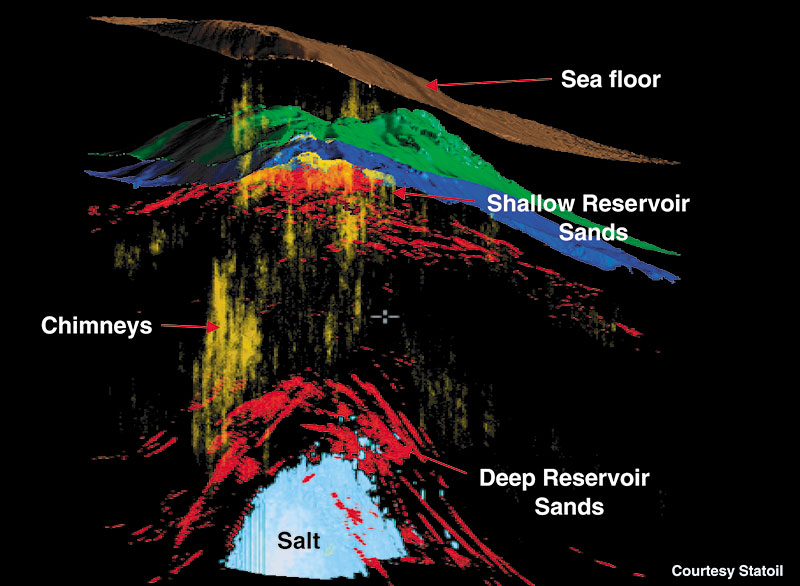
Gas chimney (in yellow) overlaid on reservoir structure.
This article
focuses on the mapping of gas chimneys and faults; a forthcoming
column will illustrate the detection of salt bodies and channel
sands.
New Type
of Seismic Volumes
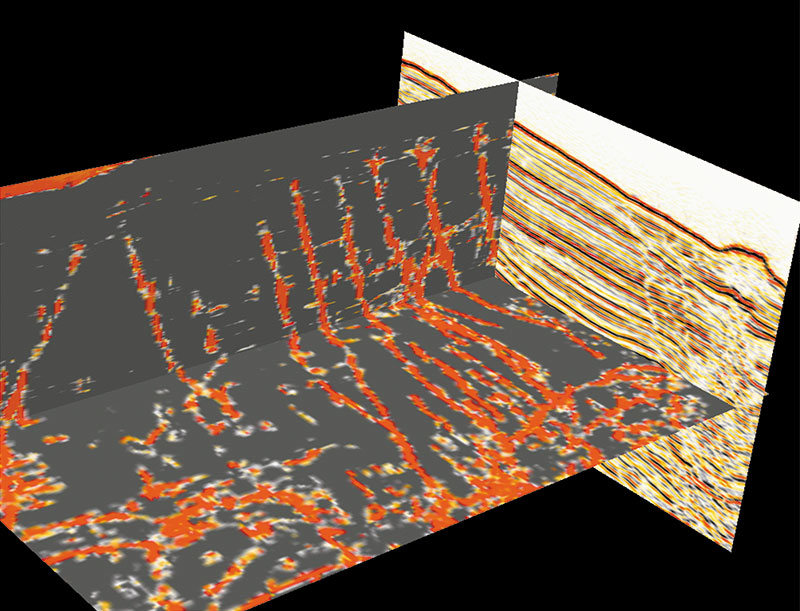
An example of a fault cube with the horizontaland vertical slices tied to an original seismic section.
Chimney
cubes (figure 1) and fault cubes (figure
2) are used to map areas where the seismic detects anomalous
patterns of amplitude and similarity in combination with other attributes
like dip variance and curvature. They help determine where hydrocarbons
originated, how they migrated into a prospect and where they leaked,
creating shallow gas (and sometimes mud volcanoes, or pockmarks)
at the sea floor.
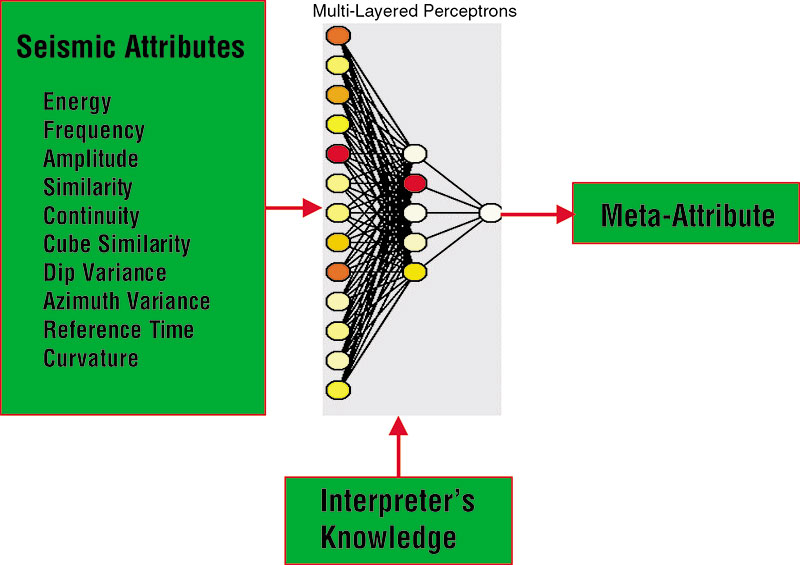
Creation of a meta-attribute.
Current
applications of chimney and fault cubes include:
- Unraveling a basin’s
migration history. - Distinguishing between
charged and non-charged prospects. - Distinguishing between
sealing versus non-sealing faults. - Determining vertical
migration of gas. - Identifying potential
for over-pressure. - Detecting shallow
hazards. - Predicting hydrocarbon
phase and charge efficiency, especially in multiphase petroleum
systems.
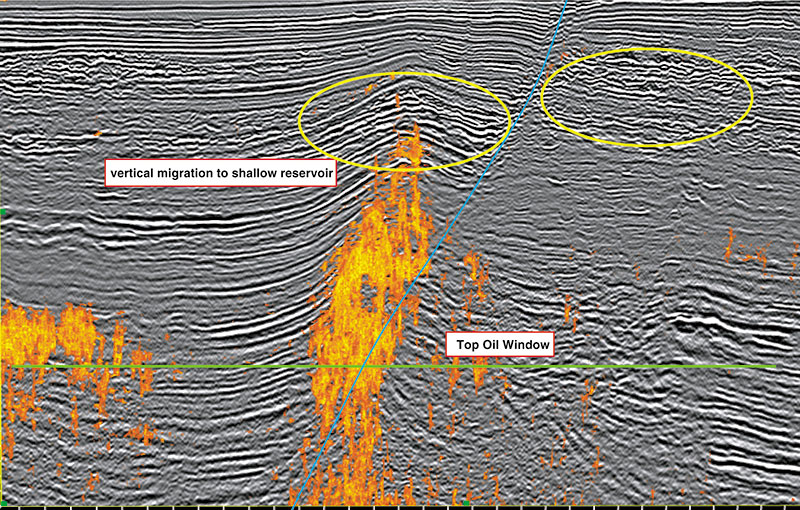
Distinguishing gas-charged versus non-charged fault segments.
Computers
can be trained to search through data volumes looking for seismic
objects using carefully designed criteria “meta-attributes,” which
are an aggregation of a number of seismic attributes where the interpreter’s
insight is combined with the power of a trained neural network to
detect a particular seismic anomaly.
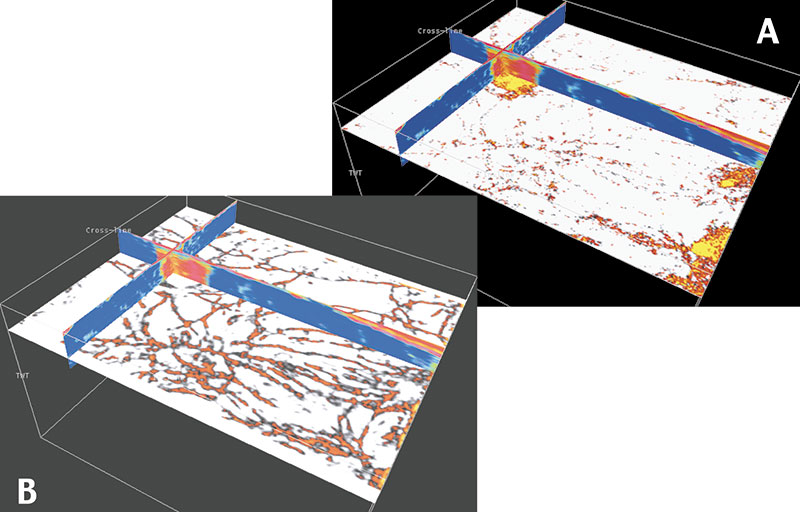
Comparison of a horizontal slice of a chimney cube (A) and fault cube (B).
As shown
in figure 3, a multitude of attributes
from known or suspected chimneys (or faults) are used as input to
a neural network.
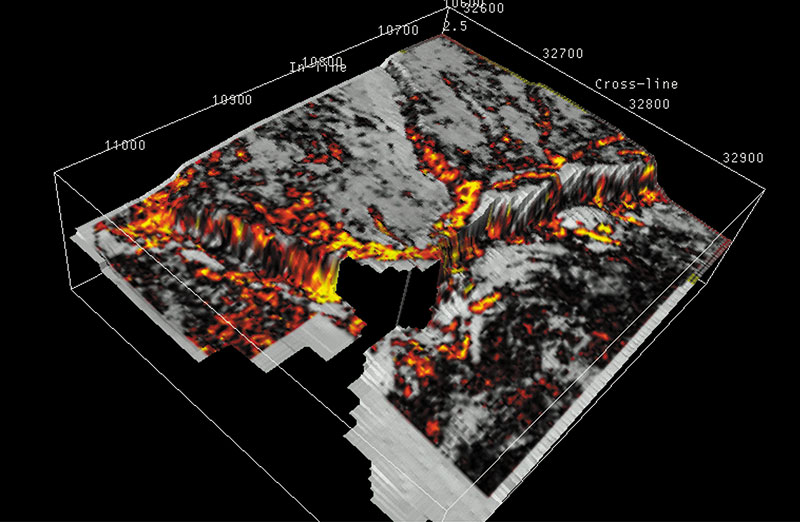
Active chimneys (in yellow) along faults thatform the trapping mechanism of the gas reservoir.
Training
of the neural network using interpreter’s insight renders the “meta-attribute”
suitable for detection of a given seismic body, like gas chimneys
or fault patterns.
Gas Chimney
Figure
1 shows a typical gas chimney in yellow overlaid on a deep salt
structure with deep and shallow reservoir units. It highlights the
migration pathway of hydrocarbon from deep structures into shallower
reservoirs and into near surface gas pockets.
Gas clouds
and gas chimneys have often been considered as a source of seismic
noise that degrades the quality of seismic reflection events. Much
effort has been devoted to filter out the impact of gas clouds and
provide interpretable sections by imaging through them.
Our main
focus, however, is to highlight such events and establish a link
between chimney characteristics (occurrence, type and extent) and
geologic concepts critical for successful exploration.
For example,
mapping the location and origination/termination points of gas chimneys
helps the:
- Understanding of
deep petroleum migration processes. - Distinguishing between
charged and non-charged fault segments. - Detecting sealing
versus leaking faults. - Distinguishing oil-prone
versus gas-prone prospects.
Sometimes
it is difficult to pinpoint deep migration pathways on a conventional
seismic line — but chimney cubes can highlight subtle features
like vertical gas migration in the geo-pressured sections of the
Gulf of Mexico. This helps substantiate predictions of geochemists
and geologists that vertical migration is an important process in
charging Tertiary reservoirs in the Gulf of Mexico and in other
similar basins around the world.
Chimney
and fault volumes improve the understanding of the petroleum system
and identify the role faults play in the migration of hydrocarbons
into the reservoir.
Distinguishing
Charged Fault Segments
In figure
4 we have overlaid the chimney halo (in orange) on top of the
seismic section.
Note that
the two structures on opposite sides of the fault have similar seismic
response but very different charge probability.
The structure
on the right side of the fault has no chimney halo associated with
it, and thus is less likely to be charged. In general, structures
with some associated strain possess preferential charging potential.
Of course,
we have to keep in mind that excessive strain would be a major leak
risk, so chimney analysis should be used in conjunction with other
tools which predict stress/strain regimes.
Sealing
vs. Leaking Faults
Combining
fault and gas chimney data can be a powerful tool in detecting hydrocarbon
migration pathways. Figure 5 shows their
use in determining sealing versus leaking faults.
While all
the mapped faults are highlighted in Figure
5b, the subset of the faults that are likely to be leaking show
up in the chimney volume of Figure 5a.
This information can then be integrated with other regional information
to assess probability for hydrocarbon charge and seal.
Many fields
in the Gulf of Mexico and other basins demonstrate that the fault
systems associated with gas chimneys have been major charging pathways
for the reservoirs. Figure 6 shows active
chimneys (in yellow), both large (e.g. one at the intersection of
the two lines) and small (along selected fault blocks) that are
considered to be leaking.
Presence
of chimney-like behavior along faults can indicate evidence of vertical
hydrocarbon movement.
Oil-Prone
vs. Gas-Prone Prospects
In multi-phase
petroleum systems, where both oil and gas are migrating into a trap,
the structures that vent the gas (either through faulting or fractures)
will be more oil-prone. Processing can detect the weak signal associated
with venting.
This approach
has been used to successfully predict hydrocarbon phase in a number
of basins in West Africa, the North Sea, GOM and the Far East.
Based on
worldwide case histories from gas prone basins, chimney and fault
cube analysis is a proven tool to make geologic predictions. This
includes:
- Relating surface
seeps to subsurface structures and reservoirs. - Understanding the
hydrocarbon history model. - Ranking prospects.
- Detecting reservoir
leakage and spill points. - Assisting in identifying
potential over-pressured zones and shallow gas drilling hazards. - Assessing the sea
floor stability for platform design and drilling.