


Even optimally processed seismic data can be affected by noise, which could be either random or coherent. When such noisy data are used for seismic attribute computation, the resulting attributes can lead to inaccurate interpretations. Therefore, preconditioning of seismic data to enhance the signal-to-noise ratio is a critical step prior to attribute extraction.
Over the years, various methods have been proposed and implemented for seismic data preconditioning, with several noteworthy contributions from the authors of this article. Among the most widely used techniques is structure-oriented filtering (SOF). SOF is a method available in most seismic interpretation software. This technique filters seismic data along reflection events, effectively suppressing random noise and enhancing the lateral continuity of reflections. Using a principal component or a variation of a median filter preserves discontinuities and avoids smearing critical structural or stratigraphic features.
Edge-preserving structure-oriented filtering further preserves and even enhances lateral discontinuities. This method involves computing a measure of continuity (such as variance or coherence) of the data within overlapping windows containing the point of interest. The (centered or non-centered) window that is most continuous is assumed to best represent the coherent signal. A smoothing filter is then applied within that window, and the result is assigned to the analysis point, thus maintaining edge integrity while reducing noise.
Unfortunately, not all “edges” in seismic amplitude are geological, with steeply dipping coherent noise associated with migration operator aliasing or acquisition footprint being preserved rather than suppressed. An earlier Geophysical Corner article (April 2021) showed that simply stacking (applying a mean filter) to a centered analysis window provided results similar to our edge-preservation algorithm. We investigated this issue more deeply in our April 2024 Geophysical Corner article and found that applying a suite of centered (non-edge-preserving) mean and median filters to the low-frequency components of the data provided superior results.
Moreover, post-stack processing steps, applied to pre-stack time-migrated data, often result in volumes with enhanced signal-to-noise ratio and broader bandwidth/higher vertical resolution than the input true amplitude data. Many of these post-stack enhancements can also serve as preconditioning steps for (near-, mid-, and far-) angle stacks as well as azimuthally-limited volumes that are used in simultaneous impedance inversion.
It is often observed that P-reflectivity or S-reflectivity volumes derived from AVO analysis appear noisier than the final migrated volumes obtained through conventional processing workflows – even when those workflows include amplitude-unfriendly steps. This raises an important consideration, which is, can certain post-stack processing techniques be repurposed as preconditioning steps for migrated seismic gathers, especially prior to applying processes like simultaneous impedance inversion?
A typical post-stack processing sequence, which can also be effectively applied to prestack time-migrated stacked data, might include steps such as FX deconvolution, multiband CDP-consistent scaling, Q-compensation, deconvolution, bandpass filtering and noise removal using a nonlinear adaptive process.
Each of these processes serves a targeted objective. For instance, for enhancing the signal-to-noise ratio as continuity of reflection events in prestack seismic data for AVO or AVAz analysis some neighboring gathers (3 by 3, or 5 by 5) are partially stacked. Within these supergathers, using FX deconvolution, a dipping, constant amplitude planar reflector is represented by a single kx-ky-omega component. Components that fall above a threshold are kept. Smaller components representing random noise are rejected. There is a small amount of smoothing in this process. Further insights into this method and its applications can be found in the July 2019 Geophysical Corner.
When preparing seismic data for AVO or AVAz analysis or simultaneous impedance inversion, preconditioning typically involves processing prestack time-migrated gathers. This might include bandpass filtering, generating supergathers, applying random noise attenuation and trim statics.
These steps are generally executed in migrated offset gathers, consistent with traditional seismic data processing approaches. Increasingly, these procedures are also carried out on migrated incident angle gathers (the input for prestack inversion), which has shown advantages in managing noise more effectively.
To further evaluate the impact of these techniques, we revisit this preconditioning workflow and demonstrate its application on a reprocessed seismic dataset from Denmark, highlighting how preconditioning can enhance prestack data quality for more reliable inversion and interpretation.
Preconditioning of Reprocessed Seismic Data from Denmark
Since 1989, natural gas has been injected and stored at the Stenlille facility in Denmark. The reservoir lies within a domal subsurface structure, sealed by the low-permeability Fjerritslev Formation caprock. The storage reservoir itself is the Upper Triassic Gassum Formation, which consists of interbedded sandstones and mudstones. Overlying the Gassum Formation is the Lower Jurassic Fjerritslev Formation, approximately 300 meters thick, composed primarily of marine mudstones and shales, acting as the regional caprock.
The Stenlille structure has an estimated gas storage capacity of three billion cubic meters. However, due to reservoir heterogeneity, gas is stored in several discrete zones. Beneath the Gassum Formation lie impermeable mudstones of the Vinding, Oddesund and older formations, including the Zechstein Formation at a depth of approximately 2,800 meters. Movements in the Zechstein salt led to the development of the Stenlille structural trap.
The natural gas is stored in an anticlinal structure, defined by six sandstone reservoir zones within the Gassum Formation. While the formation is about 140-meters thick, only the upper 40 meters are used for gas storage to avoid migration through the spill-point. These 40 meters are divided into five storage zones, separated by thin shale beds. The five zones operate as two distinct units, namely zones 1–3 function as an integrated storage unit, and zone 5, located below, operates independently.
The total estimated storage volume within this four-way structural closure, covering approximately 14 square kilometers, remains around 3 billion cubic meters. Further details about the Stenlille facility and its reservoir characteristics are available in the April 2022 Geophysical Corner.
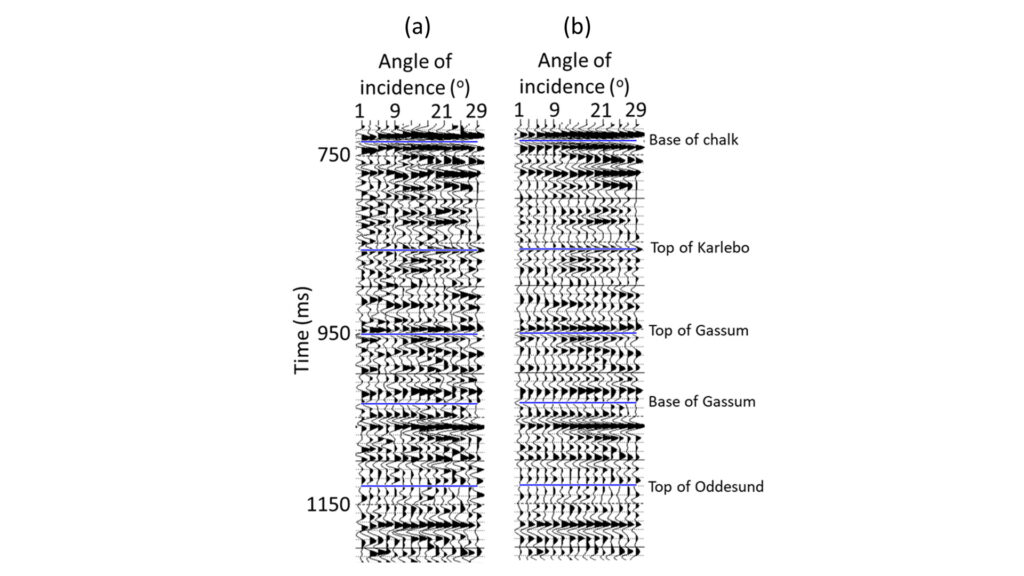
Figure 1a displays a representative angle gather derived from prestack time-migrated seismic data. This gather was processed using a sequence of SNR enhancement techniques, including bandpass filtering, supergather generation, random noise attenuation, and trim statics. The result of this preconditioning is seen in figure 1b, where signal continuity is enhanced, noise levels are reduced and reflection events appear flatter, indicating improved gather quality for subsequent analysis.
Impact on AVO attributes
Two of the most commonly used attributes in amplitude-versus-offset analysis are the intercept and gradient. The intercept attribute is calculated by applying a least-squares linear fit to a plot of reflection amplitudes versus the square of the sine of the angle of incidence. The zero-offset value of this best-fit line is referred to as the intercept amplitude. Unlike conventional CMP stacking, which tends to smear amplitude information across various incidence angles, the intercept attribute offers a more accurate estimate of P-wave reflectivity at normal incidence (zero-offset).
The slope of the best-fit line used in AVO analysis is known as the gradient. It quantifies the change in amplitude with offset. A large positive gradient indicates that the amplitude increases with offset; however, whether the magnitude actually increases or decreases depends on the intercept value. In non-hydrocarbon-bearing formations, the intercept and gradient are typically negatively correlated.
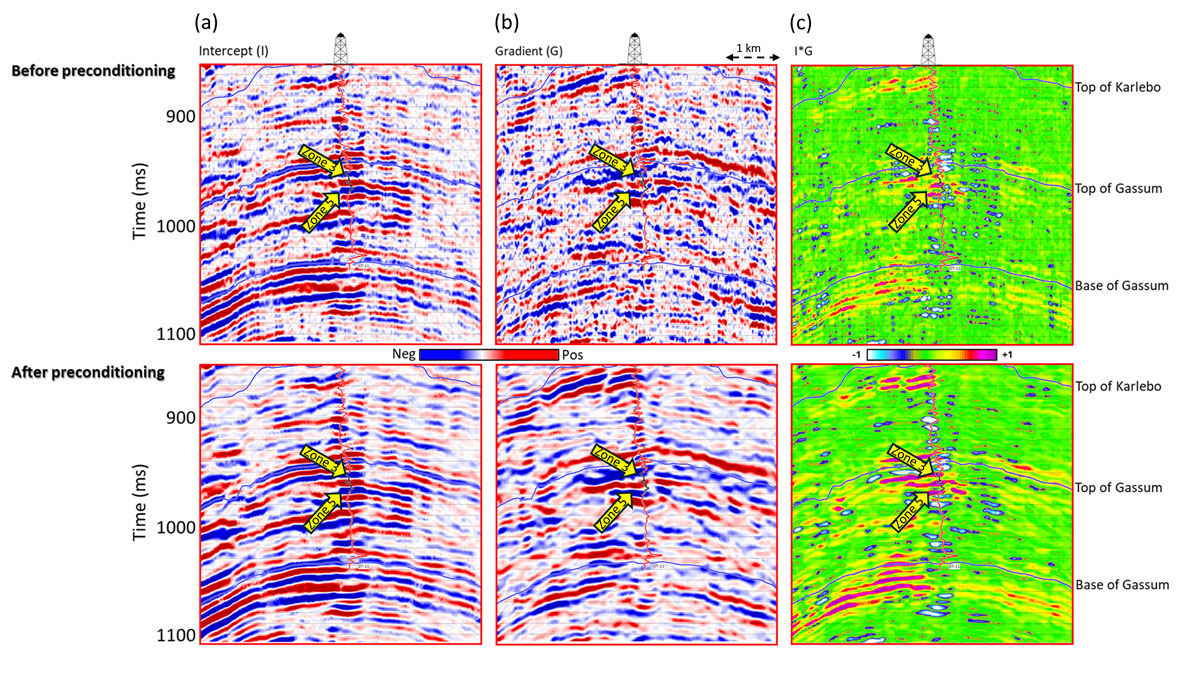
Figure 2 presents a comparison between segments of intercept and gradient sections, computed before (top) and after (bottom) seismic data preconditioning. The improvements are evident, namely, higher SNR, improved continuity of reflections, clearer definition of reservoir zones, particularly those highlighted with yellow block arrows. These enhancements lead directly to more accurate seismic interpretation.
In the Stenlille gas storage site, zones 3 and 5 are associated with gas accumulations and exhibit Class III AVO behavior. These anomalies are characterized by large negative (in blue) intercept, and large negative (also in blue) gradient. While such anomalies are generally distinguishable, noise can obscure their clarity. To counter this, an AVO indicator, computed as the product of the intercept and gradient attributes, is often used. This composite attribute helps enhance the visibility of potential gas zones (where the product of the two negative components gives a positive red result).
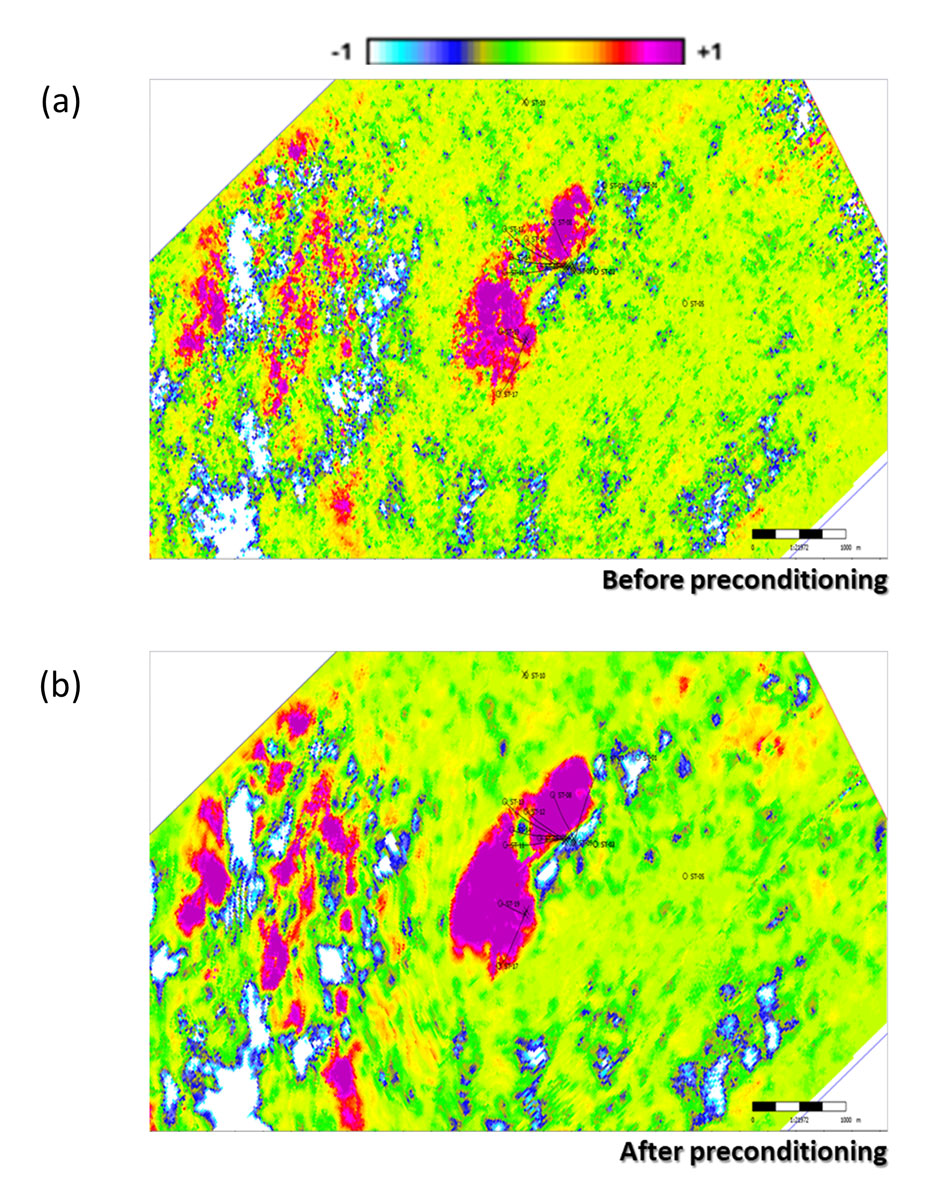
Figure 3 shows horizon slices extracted from the intercept × gradient (product) attribute along the top of zone 5. After preconditioning, the anomaly is much more clearly defined, standing out sharply against the background.
As demonstrated, applying preconditioning steps, such as bandpass filtering, supergather generation, random noise attenuation and trim statics, can lead to substantial improvements in the quality of AVO attributes.
The resulting AVO volumes display stronger, more continuous, and well-defined anomalies, making them more reliable indicators of potential hydrocarbon presence. This enhanced clarity significantly supports seismic interpreters in identifying, delineating, and de-risking subsurface prospects.