
We now have half an answer. Lots of eyes this year were on the pre-salt Bumerangue exploration well offshore Brazil, operated by BP in the Santos Basin. And lots of speculation centered on the chances of a major find in the area.
Bumerangue landed on all the main lists of high-impact exploration wells for 2025. It made most of the lists of the year’s important wells to watch.
Then Petrobras announced a high-quality oil discovery in the nearby Aram block earlier this year, spurring more conjecture. Would a major discovery at the Bumerangue site propel new interest in the Santos Basin pre-salt play?
The first part of the answer came in early August. By its own estimation, BP announced the Bumerangue wildcat as its biggest hydrocarbon discovery in 25 years.
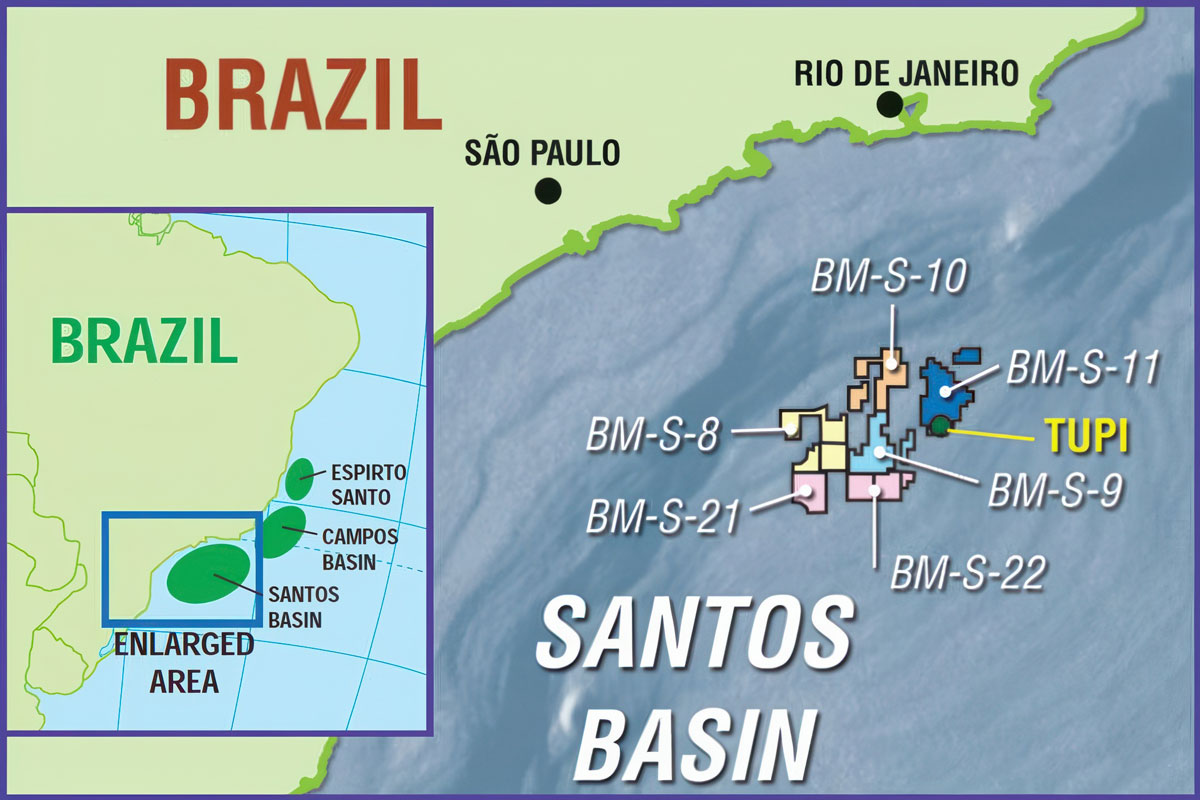
The company holds 100 percent of the block, with state-owned Pré-Sal Petróleo as the production-sharing contract manager. It drilled the Bumerangue wildcat, 1-BP-13-SPS, in a water depth of 2,372 meters some 400 kilometers (218 nautical miles) offshore Rio de Janeiro.
BP reported the discovery well intersected reservoir about 500 meters below the structural crest, then penetrated an estimated 500-meter hydrocarbon column. It described the reservoir as high-quality carbonate with an areal extent of more than 300 square kilometers.
Subsequent rig-site analysis showed elevated levels of carbon dioxide in the well, BP reported – a cause for concern. An earlier Petrobras discovery in the Jupiter field, apparently on-trend with Bumerangue, was declared non-commercial because of its high-CO2 content.
In this region of the Santos Basin, CO2 concentrations in associated gas can exceed 75 percent. The commercial Libra field has a 40-percent content, according to GeoExpro. Brazil hasn’t allowed venting of CO2, making production challenging, it noted.
“It’s early days and the discovery requires further testing, but it could prove (either) an outlier or a new sweet spot in a trend within the pre-salt play that so far delivered high-CO2, gas-condensate, sub-commercial finds,” said Luiz Hayum, principal analyst-upstream research Latin America for Wood Mackenzie.
“BP and Equinor own blocks with mature prospects nearby, and it could generate excitement for blocks available in the October licensing round, too,” Hayum observed.
The size and potential of recent discoveries in the Bumerangue and Aram blocks can’t be discounted, according to industry analysts. This year’s successes have brought new attention to the Santos basin and its pre-salt polygon.
“Proven commercial, they will provide relevant volumes to sustain Brazil oil supply and revenues in the next decade,” Hayum said.
The Polygon
A large geologically and geographically-defined area, Brazil’s offshore pre-salt polygon encompasses a productive play area of the Santos Basin and part of the neighboring Campos Basin. It’s roughly the shape of a polygonal crookneck squash stretching parallel to the Brazilian coast.
The term “pre-salt” designates formations older than a salt layer, regardless of their position. That’s in contrast to “sub-salt,” which refers to formations located beneath – deeper than – the salt layer.
Aram and Bumerangue stand out because they are separated from and distinct from Brazil’s most productive pre-salt offshore fields, including Buzios and Lula/Tupi, but they could also be considered in the same neighborhood. Recent discoveries, especially Bumerangue, may help define the limits of the play area.
“The pre-salt polygon line crosses the (Bumerangue) block. But the whole block was licensed under a profit-sharing contract,” Hayum noted.
Bumerangue’s Expected Return
BP secured the Bumerangue block in December 2022 through Brazil’s Permanent Production Sharing leasing cycle, under what it called “very good commercial terms.” Those reportedly include an 80-percent production allocation to cover costs of exploration and production.
In June, Brazil’s Agency of Petroleum, Natural Gas and Biofuels (ANP) announced that nine companies had acquired 34 exploration blocks under its 2025 Permanent Concession leasing cycle, drawing a record total signing bonus of about $188 million (R$989 million).
Those included blocks in the offshore Santos, Pelotas and Foz do Amazonas basins as well as the onshore Parecis Basin. Among the winning bid partners were ExxonMobil, Petrobras, Chevron, CNPC, Equinor, Shell and Australian independent Karoon Energy Ltd.
ANP also announced the third cycle of its Open Acreage of Production Sharing lease offering, with the public session scheduled this October. Up to 13 exploratory blocks in the Santos and Campos basins will be offered, including four frontier blocks.
Industry watchers think that BP’s success at Bumerangue, along with earlier Aram discoveries, could generate increased enthusiasm for the upcoming lease offer, especially in the Santos Basin pre-salt where interest was lighter in the previous round. Foz do Amazonas Basin blocks garnered most of the attention in that leasing.
Many analysts consider the Foz do Amazonas, part of the Equatorial Margin, as Brazil’s most promising area for frontier oil exploration – in part because of geological analogs with offshore Guyana. But the area along the Amazon coast, especially near the mouth of the Amazon River, is environmentally sensitive and drilling there is controversial.
Brazil now follows an Open Acreage leasing model, which allows for continuous offering of exploration blocks and areas with marginal accumulations. Companies are free to study technical data and submit bids at the time they deem most appropriate, without depending on strict deadlines or specific bidding cycles, according to ANP.
BP now plans to grow its global production to 2.3-2.5 million barrels of oil equivalent per day by 2030. Gordon Birrell, the company’s executive vice president for production and operations, called Bumerangue “another success in what has been an exceptional year so far for our exploration team.”
“Brazil is an important country for BP, and our ambition is to explore the potential of establishing a material and advantaged production hub in the country,” he said.
Among BP’s 10 claimed discoveries to date in 2025 are successful wells in Egypt, Libya. Trinidad, U.S. Gulf waters and also offshore Namibia and Angola through an ENI joint venture.
For the Bumerangue discovery, BP had not released reserves or production estimates by mid-August, but it reported that laboratory analysis has begun “to further characterize the reservoir and fluids discovered.” Further appraisal will be undertaken subject to regulatory approval, the company added.
At the moment, Bumerangue looks like a promising discovery, pending further analysis. But until more details about reserves, reservoir and production plans for the well are available, and until the future of Brazil’s pre-salt development becomes more clear, it will remain half an answer.