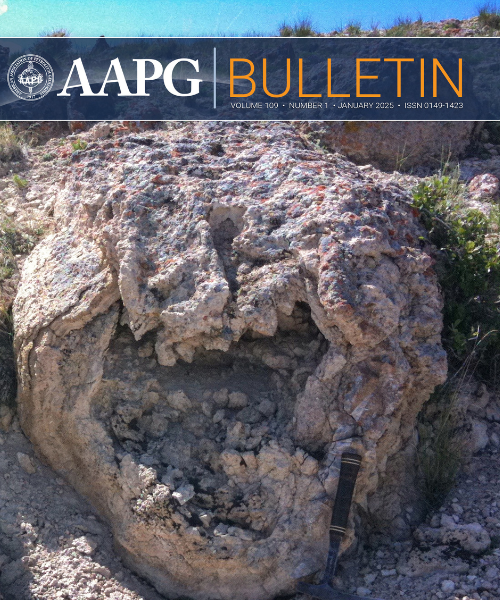
AAPG Bulletin: January 2025
Pro Tip: Log in to access special member pricing and exclusive benefits.
Description
Using δ of methyl aromatics and oils to trace the reservoir charging characteristics of complex petroleum systems in Tarim Basin, northwestern China, by Bin Cheng, Yiman Zhang, Zhiwei Wei, Hanyu Deng, Haozhe Wang, Yun Li, Liangliang Wu, Wenmin Jiang, Haizu Zhang, and Zewen Liao. Aromatization occurs steadily during the petroleum evolution stage of light oil/condensate (LOC) formation, for which the composition and δ of aromatics are of considerable geochemical significance. This paper presents a study on the composition and δ of monomethyl aromatic compounds (toluene, methylnaphthalene, methylphenanthrene, and methyldibenzo-thiophene) and related hydrocarbon compounds in LOCs from the Tazhong uplift area of the Tarim Basin in China.
Scaling laws of karst dissolution features: Evidence from three-dimensional unmanned aerial vehicle imaging and ground-penetrating radar analyses, by Juliana A. G. Lopes, Walter E. Medeiros, Renato R. S. Dantas, Josibel G. Oliveira, Jr., Flavio L. Santana, and Francisco H. R. Bezerra. The discovery of karst dissolution features in boreholes or well logs serves as a key indicator of the presence of significant karst porosity and high permeability zones in carbonate reservoirs. This insight is crucial for the development of such reservoirs. By applying the power law derived for the occurrence of volumes, the authors generated a statistically equivalent three-dimensional stochastic model for karst features that closely replicates the distribution of actual karst features.
Petroleum-charge history of Paleozoic carbonates in the Tahe oil field, Tarim Basin, northwestern China: Insights from oil geochemistry, fluid inclusion, and U-Pb dating, by Hao Xu, Xiaowen Guo, Zicheng Cao, Tiago M. Alves, Ze Tao, Bing Wang, Jiaxu Chen, Gaokun Zuo, Xuyou Zhang, and Tao Luo. The Tahe oil field is the largest Paleozoic petroleum accumulation in China, with a multistage petroleum-charge history. Ordovician carbonate reservoirs in this field are investigated in this paper based on oil geochemistry, fluid inclusion analyses, and in situ U-Pb dating of calcite cements. This work is important because it suggests that fault reactivation during the main tectonic episodes generated the main pathways for oil in the Ordovician carbonate reservoirs of northwestern China.
Hydraulic fracture networks bypassing thick sealing sequences as fluid conduits in deep overpressured strata, by Qingfeng Meng, Baibing Yang, Zhifeng Guo, and Fang Hao. The authors used new ocean-bottom-node seismic data to obtain high-resolution images of a gas-bearing structure that holds one of China’s largest offshore gas reservoirs in the South China Sea. The Dongfang 1-1 comprises clustered high-angle fractures in Miocene source rock intervals, with minimal disruption to stratigraphic layering. Their results provide new insights into the formation mechanism of the Dongfang 1-1 structure and an exciting opportunity for further exploration of subsurface fluid migration in deep overpressured strata.
Geochemistry of aromatic hydrocarbons in source rocks of the Cretaceous Orange Basin, by Solomon Adeniyi Adekola, Kai Mangelsdorf, and Akinsehinwa Akinlua. The distribution pattern and occurrence of aromatic hydrocarbons as influenced by thermal maturity and the nature of Aptian to Campanian source rocks from the Orange Basin were investigated to gain more understanding of the petroleum generation and accumulation potential of the basin. The effect of burial depth on thermal maturity of the source rocks appears to be more significant than the age of the rocks.
A fracture-related deep Archean crystalline basement reservoir facilitated by thrusting and mineralogy: Newly discovered Bozhong 19-6 large gas field, offshore Bohai Bay Basin, China, by Tao Ye, Anqing Chen, Chengming Niu, Jian Luo, and Mingcai Hou. Crystalline rocks underlying basins, with their lack of primary porosity, are unconventional traps for hydrocarbon exploration. The Bozhong 19-6 large gas field in the Bohai Bay Basin, China, is a rare, newly discovered, deep-buried crystalline basement play with a productive zone of more than 1000 m, which provides an excellent opportunity to investigate the formation mechanisms for this large-scale reservoir.