AAPG Bulletin: September 2026
Pro Tip: Log in to access special member pricing and exclusive benefits.
Description
GEOLOGIC NOTE
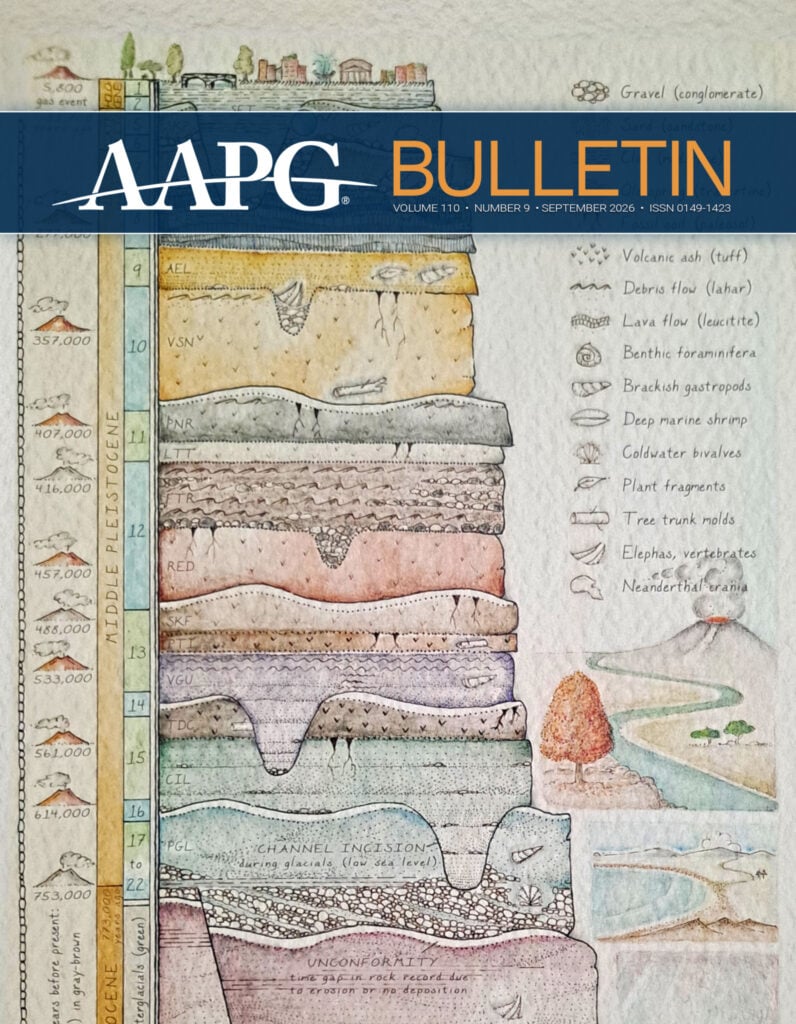
Documenting stratigraphy
Quaternary sequence stratigraphy, supported by an exceptional abundance of proxy data and well-constrained boundary conditions, provides an unprecedented opportunity to bridge the gap between quantified modern processes and the interpretation of the ancient sedimentary record. The author shows that documenting how stratigraphy is constructed over centennial- to millennial-scale timescales, where controls on stratigraphic architecture are well constrained, provides insights into the interpretation of older stratigraphic successions, for which driving mechanisms can only be inferred.
ARTICLES
Evaluating shales
Porosity serves as a critical parameter in shale oil reservoir evaluation and resource quantification. Limitations in evaluation principles and shale heterogeneity lead to varying effectiveness among different methods. Moreover, solvent extraction may cause fluid retention, toxicity risks, and data distortion, compromising the accuracy of assessment. This study proposes the Shale-ΦT1/T2 porosity evaluation methodology for conventional core shales as an innovative approach, using sealed core samples from the fourth member of the Shahejie Formation, Dongying sag as the study object.
Introducing GEOPARD
The authors introduce a new rule-based algorithm called GEOPARD, which models shoreface deposits by following geological principles. The outcomes of geological processes are represented as rules that are integrated into the core of a standard geostatistical modeling framework. It builds on the stochastic object-based facies modeling technique and incorporates a Bayesian framework for conditioning to data and reducing uncertainty. This paper outlines the geological prior model of the algorithm, which generates facies geometries and controls object placement using geological rules.
Exploring cycles
Astronomically forced climate cycles and hyperpycnal flow deposits are the forefront of contemporary geological research. Climate significantly influences the formation of hyperpycnal flows, with these changes being driven by astronomical cycles. However, the relationship between astronomical cycles and hyperpycnal flows has not been sufficiently explored. The authors’ findings underscore the significant role of astronomical cycles in governing the development of hyperpycnal flows and highlight their positive influence on organic matter enrichment.