AAPG Bulletin: September 2025
Pro Tip: Log in to access special member pricing and exclusive benefits.
Description
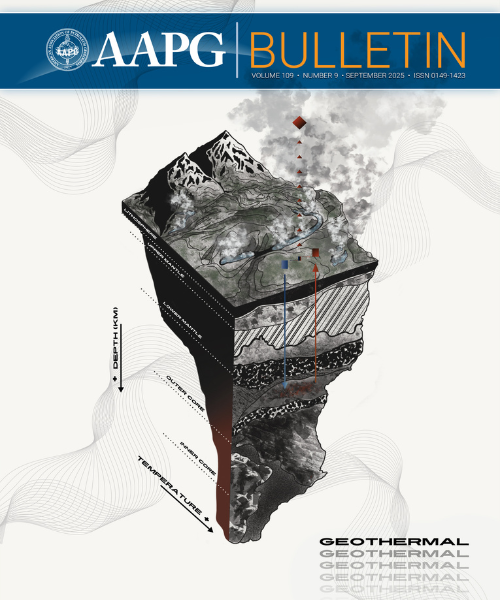
SPECIAL ISSUE: Geothermal Exploration, by Kellen L. Gunderson and Evan J. Earnest.
Rethinking power density for geothermal resource estimation, by R. Chadwick Holmes and Laura Huebner. Two approaches are commonly used when calculating the power potential of new geothermal opportunities: the US Geological Survey heat-in-place method and the power density method. This study evaluates how the power density method performs as an estimator given its minimalistic approach. The authors’ findings suggest a need to reevaluate the use of map-based methods like power density for power estimation, particularly when the complexities of the subsurface take three dimensions to fully describe.
Preliminary resource conceptual model and power capacity estimates for the Northern Granite Springs Valley blind geothermal prospect, Pershing County, Nevada, by Kurt O. Kraal, Bridget F. Ayling, Nicole Hart-Wagoner, James E. Faulds, Jonathan M. G. Glen, Drew L. Siler, and Tait Earney. Northern Granite Springs Valley (also known as Adobe Flat) in the Basin and Range province of Nevada in the western United States hosts a thermal anomaly and has been explored as a blind geothermal prospect since the late 1970s. The authors develop conceptual models that aim to represent the uncertainty in the hypothesized location of the hydrothermal upflow. Their integrated analysis indicates that there is likely a power-capable geothermal resource in northern Granite Springs Valley with a power capacity estimation of between 3.7 and 35.6 MWe, with a P50 estimate of 11.5 MWe.
Detailed reservoir characterization of Mesozoic siliciclastic strata for sedimentary geothermal exploration, Colorado Plateau to Basin and Range transition zone, Utah, by Ted Morgan, Samuel M. Hudson, Kellen L. Gunderson, Brad Taylor, Cassidy Grover, Levi DeCrescenzo, Derek Ashliman, and Madison Ramos. The Basin and Range provides excellent opportunities for geothermal resource development. Based on porosity and permeability measurements from 164 samples and thin sections from key stratigraphic intervals, three siliciclastic units were identified as prospective reservoir targets. Statistical analysis shows a strong linear relationship between porosity and permeability that is primarily related to textural and compositional maturity, but burial history and diagenetic alteration have a large effect on current reservoir properties.
An integrated geothermal resource assessment and techno-economic analysis in Presidio County of the Trans-Pecos region of Texas, by Shuvajit Bhattacharya, Ken Wisian, Bissett Young, Malcolm Ross, Mohamed Khaled, Rama Chandrudu Arasada, Qiqi Wang, David Chapman, and Aysegul Turan. Presidio County of the Trans-Pecos region of Texas has substantial, undeveloped geothermal resources. The authors conduct a thorough, multiscale characterization of geothermal resources and assess comparative techno-economics for power generation and direct use facilities. They integrate surface geology, high-resolution gravity, borehole geophysical logs, and core data for subsurface characterization and carry out detailed techno-economics, considering enhanced geothermal systems and closed-loop geothermal systems technologies.