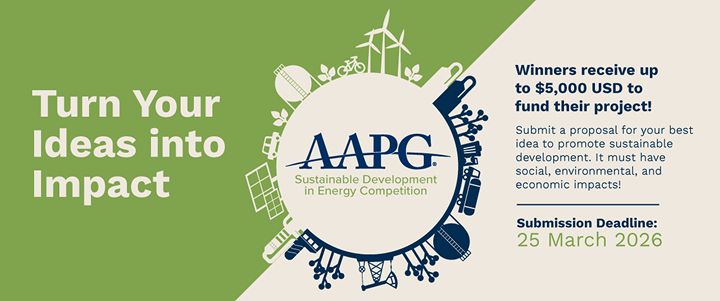
Sustainable Development
Harness your creativity to develop innovative, sustainable projects across the energy spectrum — with real social, environmental, and economic impact.
Mission & Goals
AAPG’s Sustainable Development in Energy Competition for students and young professionals is intended to raise awareness of the need to encourage sustainable development in energy industries. The objective is to harness the creativity of students and young professionals in developing innovative and sustainable development projects across the energy spectrum.
The goal is to generate practical and achievable ideas that can be implemented to promote science and technology relevant to energy issues with a positive social, environmental, and economic impact. In addition, the competition will be an opportunity for students and young professionals to learn about sustainable development as we undergo the energy transition.
Our Sponsors
Program Expectations
What we expect from your project.
Scope
Projects should cover extraction, processing, consumption, or disposal of components across the energy chain — including oil, gas, solar, wind, hydroelectric, biomass, nuclear, or critical energy minerals — with clear impact on sustainable development objectives.
Context
Projects may be part of any academic training activity, research, lectures, or graduate work. Proposals may be presented with or without support from faculty or private-sector representatives.
Use of Funds
Any money awarded must be fully destined to developing the proposed project and may cover all or part of the cost. Winning projects must be implementable within one year of the award.
Winner Deliverables
- Three-minute video showcasing their project – due 30 days after the competition award funds are received.
- Team photo, preferably in the field.
- Six-month follow-up summary of how the funds benefited the project.
Program Eligibility
The competition is open to all undergraduate and postgraduate students, and to young professionals with less than two years of experience in the energy sector.
Individuals or teams
Proposals may be submitted by individuals or by teams of up to six members.
English submissions
All proposals must be submitted in English.
AAPG membership encouraged
All participants are encouraged to join AAPG.
Effective Proposal Writing: For Emerging STEM Professionals
A presentation from OSU Research College of Arts and Sciences
Key dates for 2026.
For More Info
2026 Contest Winners:
1st Place, $5,000
TwinStream Nexus:
TwinWaste to GreenFuel
2nd Place, $3,000
Graphene:
StrawToShield
3rd Place, $2,000
AquaVolt:
Geo-Hydraulic Electrification: Harnessing Confined Aquifer Pressure for Sustainable Energy and Salinity Control
Project Proposal Guidelines
- Executive Summary (1 page)
- Project Description (5 pages max)
- General description of the area in which the project will be implemented and the population that will be impacted.
- Technical description of the project including a full description of the contribution to sustainable development goals (SDG).
- Timeline and Budget (including details of any additional funding obtained or sought).
Award Schedule
Each awardee will be required to sign an “Intended Use of Funds” form prior to receiving any award.
Evaluation Criteria (100 Points)
Originality (25 pts)
Innovation & Impact (20 Points): how innovative the proposal is, either by presenting initiatives that are different from traditional approaches or by implementing traditional measures having a greater impact than those generated previously.
Multidisciplinary Focus (5 Points): the extent to which the project involves different professional and/or technical fields.
Sustainability (50 pts)
Relevance (15 Points): the project relates to the sustainable development goals (SDG) and considers the environmental, social, and economic needs and realities of the area where it will be implemented, as well as the participants in the project.
Social Contribution (10 Points): the positive impact that the project has on the social development of the communities in the project’s area of influence, on the applicant’s academic community, and/or on the organization that may apply the proposed project.
Environmental Contribution (10 Points): the positive impact the project has on the environmental development of the project’s area of influence.
Economic Contribution (10 Points): the positive impact that the project has on the economic development of the communities in the area of influence of the project, and/or on the organizations that may apply the proposed project.
Integration (5 Points): the level of integration proposed by the project, contributing to the three components of sustainable development (environmental, social, and economic) together with a multidisciplinary focus.
Applicability (25 pts)
Methods/Timeline (15 Points): the possibility of applying the proposed project considering the methods and schedule presented.
Budget (10 Points): the possibility of applying the proposed project considering the budget presented.