


Elastic properties derived from seismic data are widely used for lithology prediction, multi-attribute analysis, and geomechanical applications. Conventional workflows estimate elastic properties independently of lithofacies and interpret facies in a subsequent step, often leading to smoothed responses and ambiguity across facies boundaries. In this study, we present a one-step Bayesian lithofacies inversion framework in which facies and elastic properties are inferred jointly. The method integrates prestack seismic data, facies-dependent rock-physics models, and geological continuity within a unified probabilistic workflow. We first show a synthetic example which demonstrates that even with identical seismic data, the one-step approach produces facies-consistent impedance, whereas conventional inversion yields smooth impedance estimates that mix responses across facies boundaries. Thereafter, we show a field example where seismic amplitude alone can lead to ambiguous impedance interpretation, while the proposed method resolves this ambiguity by incorporating geological constraints. The resulting impedance estimate is more consistent with well observations and provides a more reliable basis for reservoir characterization and geomechanical analysis.
Introduction
Seismic-derived elastic properties, such as acoustic impedance and VP/VS, form the foundation of quantitative interpretation workflows. These properties are routinely used to infer lithology, fluid content, and rock mechanical behavior, and are subsequently integrated into multi-attribute analysis, reservoir characterization, and geomechanical modeling. Despite their central role, elastic properties are commonly estimated without explicit consideration of lithofacies.
In conventional two-step workflows, seismic data are first inverted to obtain elastic properties using smooth priors, and lithofacies are inferred through post-inversion classification. This separation implicitly assumes that elastic properties can be estimated independently ofgeological context. In practice, this leads to a fundamental limitation: the inverted elastic model often represents an average of multiple plausible geological scenarios, particularly in thinly layered or heterogeneous intervals. As a result, facies boundaries appear smeared, and elastic trends might not correspond to any single facies population.
One-step Bayesian lithofacies inversion addresses this limitation by integrating facies and elastic properties within a single probabilistic framework. Instead of estimating elastic properties independently, the method evaluates how facies-dependent elastic models explain the observed seismic data. Elastic properties are therefore estimated conditional on facies during inversion, ensuring consistency between geological interpretation and elastic response.
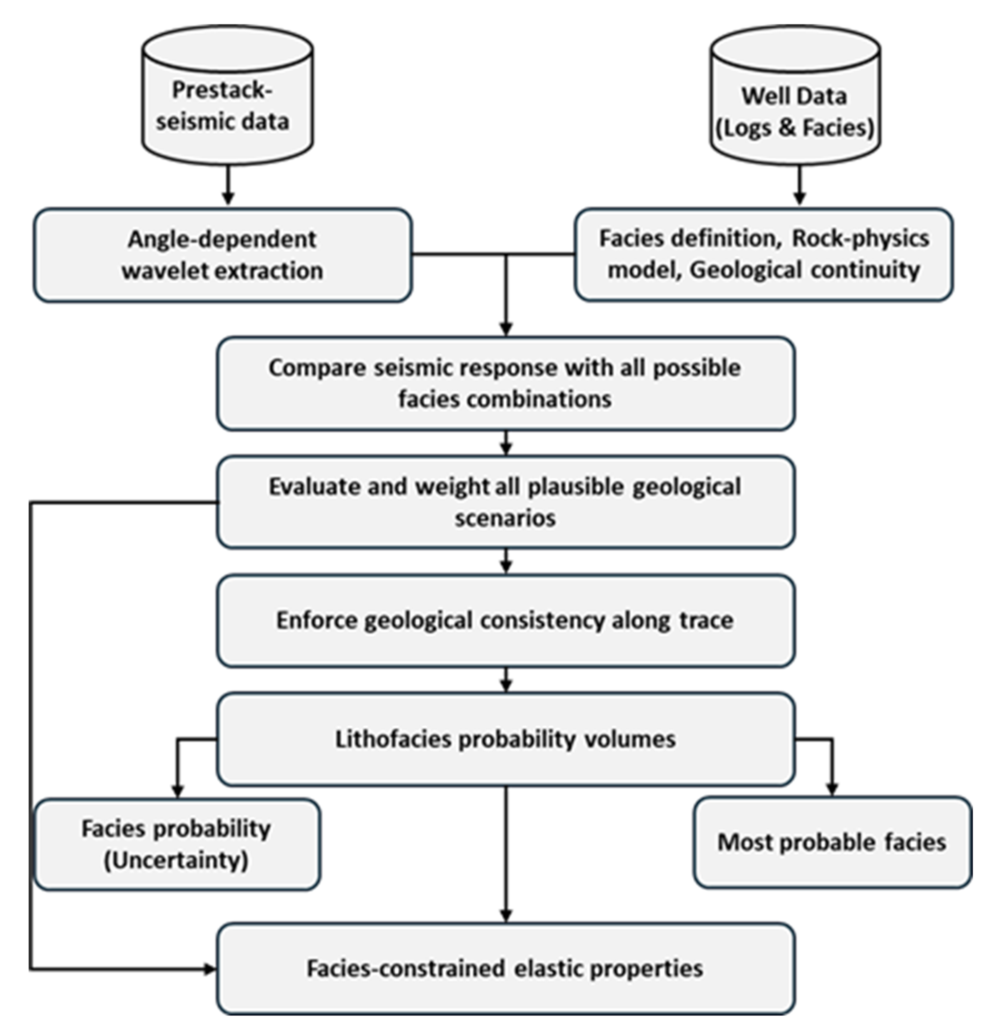
Here, we present a practical workflow for one-step Bayesian lithofacies inversion (figure 1) and demonstrate its impact using both synthetic and field examples. The objective is to show that the key advantage of the method lies in the integration of geological information within the inversion process.
Methodology Overview
The practical implementation of the one-step Bayesian lithofacies inversion workflow is summarized in figure 1. The method integrates prestack seismic data with well-derived facies definitions, rock-physics relationships, and geological continuity within a unified probabilistic framework. The workflow can be described in two main steps: local facies evaluation and trace-wide geological consistency assessment.
In the first step, the inversion evaluates how different combinations of lithofacies can explain the observed seismic response. Because seismic data are band-limited, individual samples cannot be interpreted independently. Instead, the analysis is performed over small vertical windows (typically a few samples thick), within which multiple facies combinations are considered simultaneously. This allows the method to account for the fact that seismic reflections arise from contrasts over a finite vertical interval rather than from a single depth point. Within each window, all plausible facies combinations are evaluated by comparing their expected seismic response derived from facies-dependent rock-physics relationships, with the observed seismic data. Rather than selecting a single “best” solution at this stage, the method retains and evaluates multiple geological scenarios that are consistent with the seismic response. This step captures the inherent non-uniqueness of seismic data and preserves the range of possible subsurface interpretations.
In the second step, these local evaluations are combined along the trace to ensure that the final facies distribution is geologically realistic. In practice, this means favoring solutions in which facies show reasonable vertical continuity, as expected in natural depositional systems, and reducing rapid, sample-to-sample variations that are unlikely to occur in reality. Importantly, this step does not smooth the results but instead promotes facies sequences that are consistent with both the seismic response and the vertical patterns observed in well data.
By integrating seismic data, facies-dependent rock-physics models, and geological continuity within a single workflow, the method jointly estimates lithofacies probabilities and corresponding elastic properties. As a result, the derived elastic properties are consistent not only with the seismic response but also with the underlying geological framework, providing a more reliable basis for reservoir characterization and geomechanical analysis.
Synthetic Example
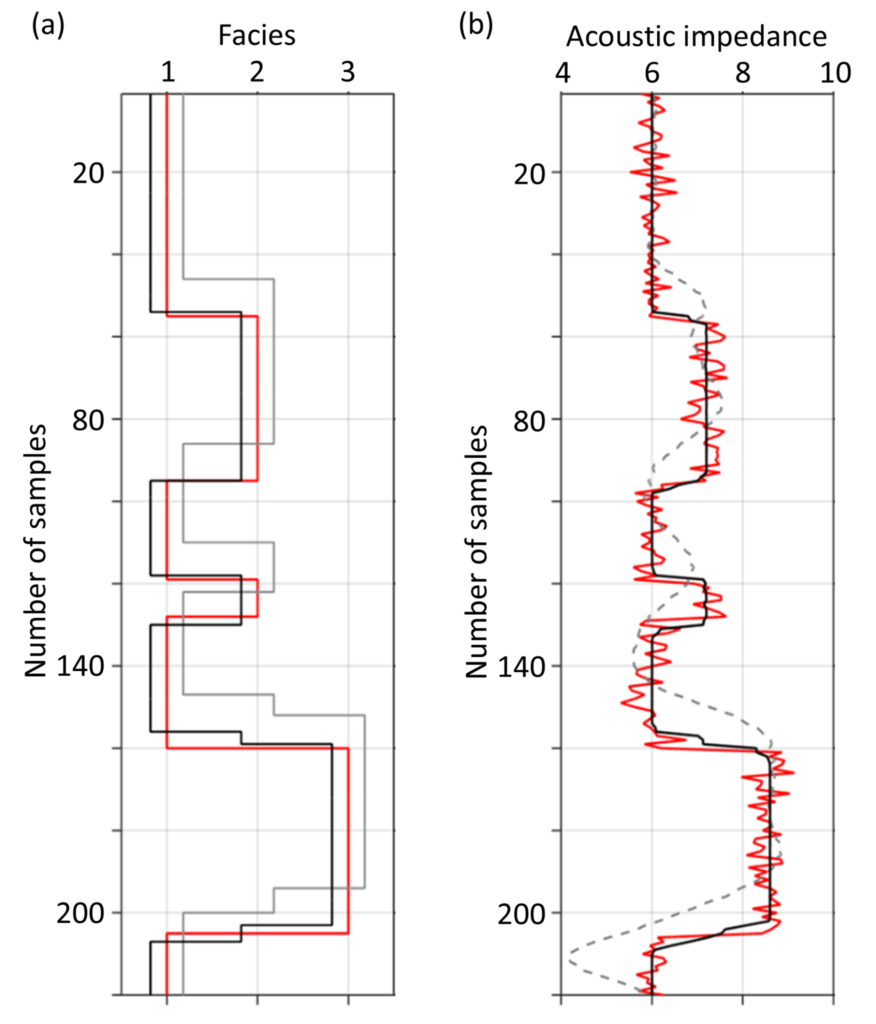
To assess the impact of the inversion strategy, we consider a 1-D synthetic example (figure 2) in which the input conditions are kept identical for both deterministic and one-step workflows. Specifically, the same band-limited seismic data and the same facies-dependent rock-physics relationships derived from well logs are used in both cases. The synthetic model is constructed using a known sequence of lithofacies, where each facies is assigned a range of elastic properties (for example, acoustic impedance) based on well-log observations. This allows us to generate a seismic response that mimics realistic subsurface conditions while retaining full control over the underlying geology. In this sense, the example provides a controlled setting in which the true facies and elastic properties are known. Because both workflows use exactly the same seismic data and rock-physics relationships, any differences in the results arise solely from how the inversion method incorporates geological information. This makes it possible to directly evaluate the impact of the inversion strategy on the resulting facies and elastic property estimates.
The deterministic inversion produces smooth impedance profiles that blend responses across facies boundaries, reflecting the stabilizing effect of a global prior and the limited vertical resolution of seismic data. As a result, thin layers are not resolved, and the inverted elastic properties represent an average response that does not correspond uniquely to any single facies.
In contrast, the one-step Bayesian lithofacies inversion evaluates multiple plausible facies configurations within local analysis windows and integrates geological continuity to obtain geologically consistent facies probabilities. Elastic properties are then estimated as facies-conditioned expectations, allowing the inversion to retain facies-specific impedance trends while remaining consistent with seismic data. Consequently, layer contrasts are better preserved, and the resulting impedance profiles align more closely with the underlying facies distribution, within the limits imposed by seismic bandwidth.
This comparison highlights that elastic property estimation is not determined solely by seismic data quality, but also by the structure of the inversion framework. Incorporating facies-dependent rock-physics models directly within the inversion process enables a more faithful representation of subsurface heterogeneity compared to workflows in which facies are introduced only after elastic inversion.
Field Example
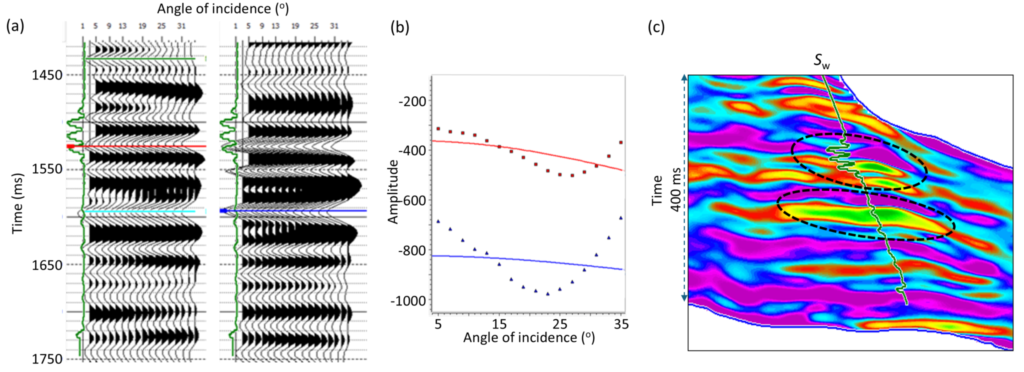
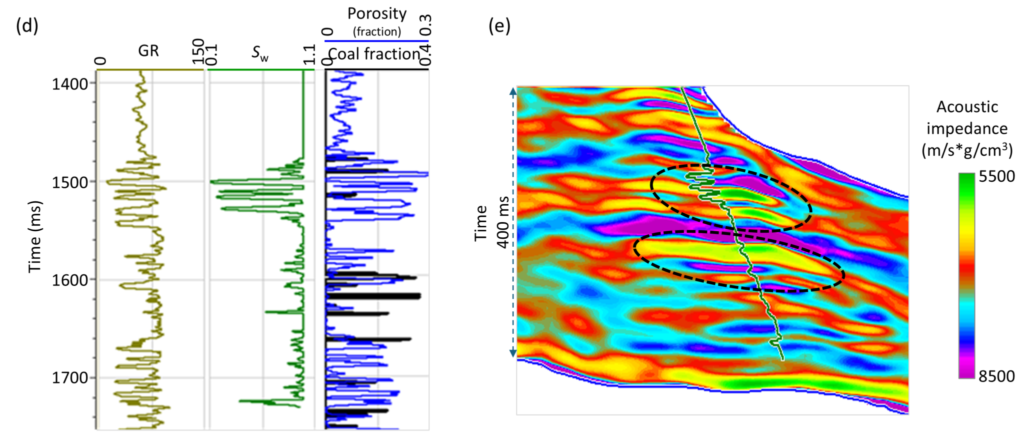
The advantage of the proposed approach is further demonstrated using a field example involving two Class III AVO anomalies (figure 3a and b). The lower anomaly exhibits stronger negative amplitudes than the upper anomaly, and deterministic inversion translates this response into lower impedance (figure 3c), consistent with the seismic data.
However, well information reveals that the upper anomaly corresponds to a hydrocarbon-bearing sand, whereas the lower anomaly is a high-porosity water-bearing sand associated with adjacent coal layers. The combined effect of coal and high-porosity sand produces a seismic response similar to that of gas-bearing sand, leading to ambiguity when interpretation is based on elastic properties alone.
A comparison of the deterministic and one-step inversion results (figure 3c and e) provides further insight. The low-impedance signature associated with the gas-bearing sand remains consistent between the two approaches. In contrast, the lower anomaly, despite exhibiting stronger negative amplitudes, undergoes a significant shift in impedance in the one-step inversion, increasing toward slightly higher (less green) impedance than the gas-bearing interval. This adjustment reflects the incorporation of facies-dependent rock-physics behavior, allowing the water-bearing sand to be distinguished from the gas-bearing sand.
Our example highlights that the limitation is not in deterministic inversion itself, but in the non-uniqueness of the seismic response. By incorporating geological information directly within the inversion process, the one-step Bayesian lithofacies inversion resolves this ambiguity and produces elastic properties that are consistent with both seismic data and underlying geology.
Implications for Interpretation and Geomechanics
Facies-consistent elastic properties have important implications for successive applications, for example, in terms of multi-attribute analysis, where they reduce ambiguity and improve classification reliability by avoiding mixed responses. In rock-physics interpretation, elastic trends align more clearly with lithological classes, improving interpretability.
In seismic geomechanics, where mechanical properties are derived from elastic parameters, facies-constrained estimates provide a more realistic representation of subsurface variability. This is particularly important in unconventional reservoirs, where thin layering and complex lithologies strongly influence reservoir behavior. By preserving facies-dependent elastic responses while remaining consistent with seismic data, the proposed approach provides a more reliable foundation for both exploration and development workflows.
Conclusions
One-step Bayesian lithofacies inversion provides a framework for estimating facies and acoustic impedance directly from seismic data. By integrating rock-physics relationships, seismic response, and geological continuity within a single workflow, the method produces facies probabilities and impedance estimates that are conditioned on lithofacies. The synthetic and field examples demonstrate that the resulting impedance estimates are better aligned with well observations compared to conventional deterministic workflows. In particular, the method helps distinguish between geological scenarios that produce similar seismic responses, such as gas-bearing sand and high-porosity water-bearing sand associated with coal. These results highlight that impedance should not be treated as an independent intermediate product, but as a quantity linked to lithofacies. Incorporating this relationship directly within the inversion process leads to more reliable inputs for reservoir characterization, multi-attribute analysis, and seismic geomechanics.
Acknowledgements: We would like to thank Sharp Reflections, CMG, for access to their software, which has been used for Bayesian lithofacies Inversion.