Fossil hominin footprints offer a unique and immediate snapshot of our ancestors' lives, capturing their ecological, environmental, and behavioral contexts over remarkably short time scales. This presentation delves into the discovery and analysis of over 400 human footprints from Engare Sero, Tanzania, located on the southern shore of Lake Natron. This site boasts the largest known collection of human footprints in Africa's fossil record. Our investigation reveals that these footprints were created from volcanic material initially deposited on the flanks of the nearby active volcano, Oldoinyo L'engai. The volcanic sediment was then reworked and fluvially transported to the footprint site, which presented several unique challenges. Using advanced dating techniques, such as 40Ar/39Ar and 14C methods, along with stable isotope analysis (d18O and d13C), we determined that the footprints date back to the Late Pleistocene-Holocene. Studies of modern footprints suggest that these ancient prints were made, buried, and preserved within days to months. By analyzing the size, shape, and patterns of the footprints, we gain insights into the individuals who made them, including their sex, age, and social behavior. The trackways tell the story of two groups of humans who crossed this landscape at different times, exhibiting both walking and running behaviors. The evidence suggests a mixed group of individuals, primarily adult females, moving together. One group of 14 adult females walked together at the same pace, accompanied by only two adult males and one juvenile. These findings, when compared to modern ethnographic data, provide a fascinating glimpse into the cooperative behavior of Late Pleistocene humans and how they interacted with their environment tens of thousands of years ago.
Reconstructing a Late Pleistocene East African Paleolandscape using the Footprints of our Ancestors 67623
 Cynthia Liutkus-Pierce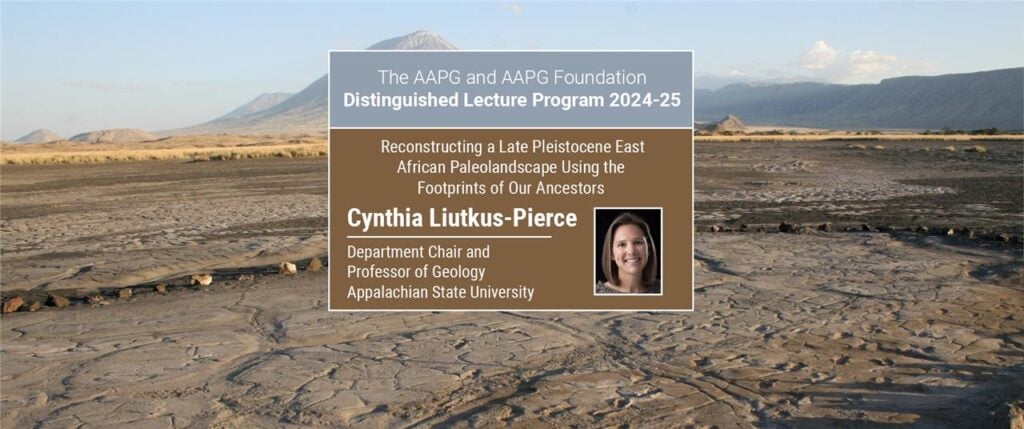
Cynthia Liutkus-Pierce
Cynthia M. Liutkus-Pierce is department chair and full professor in the Department of Geological and Environmental Sciences, Appalachian State University, Boone, NC, and served as the director of the Environmental Science Program from 2018-21.
Liutkus-Pierce is a geologist and paleoenvironmental scientist who has conducted research in Kenya, Tanzania, South Africa, Namibia, Bermuda, Canada and throughout the United States. Her recent research with the Turkana Miocene Project, an NSF-funded interdisciplinary collaboration involving scientists and students from more than 25 institutions/universities across the globe, focuses on reconstructing paleoenvironmental conditions in eastern Africa during the Neogene to understand the roles of climate and environmental change in the evolution of primates and our early human ancestors.
She also is lead scientist of the Engare Sero footprint project—a collaborative team of geologists, paleoanthropologists, geochronologists and volcanologists working to understand the dynamics of a group of early Homo sapiens who made over 400 footprints in a volcanic mudflow deposit in northern Tanzania about 20,000 years ago. Her work on the Engare Sero footprint site has been published in Nature's Scientific Reports and showcased by a number of news outlets including the Washington Post, National Geographic and many others. She is a committed advocate for equity and inclusion of undergraduates in research, is a National Geographic Explorer and was named a Fellow of the Explorers Club in 2017.
Liutkus-Pierce was inducted into Appalachian's Academy of Outstanding Teachers in 2016, was named Outstanding Teacher of the Year in the College of Arts and Sciences in 2017 and was awarded the UNC Board of Governors Appalachian State University Excellence in Teaching Award that same year. Her commitment to service was celebrated in 2017 when she was awarded the Jimmy Smith Outstanding Service Award. She was selected to participate in Appalachian State University’s Academic Leadership Development Program (ALDP) in 2016-17 as well as the BRIDGES Academic Leadership for Women program (UNC system) in 2018.
She holds a bachelor’s degree in both geology and philosophy from Bucknell University, and a master’s and a doctorate in geological sciences from Rutgers University.