
For decades, the Nile Delta Basin has dominated East Mediterranean oil and gas plays and production; however, recent discoveries, ventures, and developments offshore Israel, Cyprus, Lebanon, and Turkey have transformed the entire region into an exploration hot spot of global significance.
Part of the region’s potential is due to its unique gas plays. The Oligocene-Neogene plays in the East Mediterranean contain huge biogenic gas (such as the Tamar, Leviathan, and Zohr fields) and thermogenic gas fields (such as Raven and Temash in the Nile Delta). The region provides a field-scale laboratory to study how these two gas systems form in the same basin.
Let’s break down the region and examine its current hotbeds.
Nile Delta Basin
The Nile Delta still surprises explorers. Since ConocoPhillips drilled the Abu Qir gas field – Egypt’s first offshore discovery – in 1969, more than 180 fields of various sizes have been discovered. Fields range in age from Oligocene to Pliocene and span the Nile Delta Basin’s fan-shaped area of 250,000 square kilometers.
In 2025, BP partnered with Harbour Energy to drill two offshore wells in the West Nile Delta: the El King-2 well in the North King Marious concession and the Fayoum-5 well in the North Alexandria concession. Both wells encountered gas in Messinian-age sand reservoirs at measured depths of 2,400–2,900 meters. In September, BP brought the Fayoum well online with a production of 80 million standard cubic feet per day.
Egypt: An LNG Leader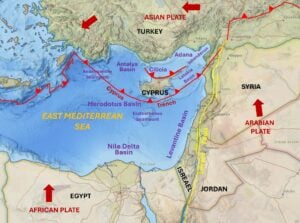
With modern production reaching 3.7 billion cubic feet of gas per day, Egypt is the second largest natural gas producer (after Algeria) and exporter in Africa and the only country in the East Mediterranean with liquified natural gas export facilities.
Eni discovered Egypt’s Zohr gas field in 2015 at a water depth of 1,459 meters in the Shorouk block within the northeastern portion of the Nile Delta. The field is an isolated carbonate atoll of Miocene age with a hydrocarbon column of 455–630 meters. Zohr’s production began in 2017 during a decline in Egypt’s gas production. Zohr’s recoverable reserves have been cited as 30 trillion cubic feet, although C&C Reservoirs considers 10 TCF to be a practical estimate.
Israel and the Levantine Basin: Gaining Energy Independence
For decades, Israel depended on energy imports. This changed in 2009 when Noble Energy (later bought by Chevron) discovered the Tamar gas field with reserves of about 7 TCF, as well as the much smaller Dalit gas field in the deepwater Levantine basin. Tamar began production in 2013. The Noble Energy-led consortium also discovered three other gas fields in the same basin: Leviathan in 2009 with 17 TCF reserves (producing since 2019), Tanin in 2012, and Karish in 2013. The Tanin and Karish fields came on stream in 2022 and together contain roughly 2 TCF.
Greek company Energean took over operations of Tanin and Karish North in 2016 and went on to discover the Athena, Zeus, and Katlan gas fields in Block 12 in 2022. These fields are currently in the development stage.
Israel now generates 70 percent of its electricity from natural gas. In 2024, Israel exported 13.2 bcf of natural gas, or about 49 percent of its production. Israeli gas goes to Jordan and Egypt via pipelines and to Europe via an Egyptian LNG plant.
In July, Israel launched its Fifth Offshore Bid Round with a bid submission deadline of January 2027.
The roughly 83,000-square-kilometer Levantine Basin is home to Israel’s gas fields and extends to offshore Lebanon and Syria. Lebanon and Syria have not made any discoveries, but Lebanon awarded its offshore blocks 4, 8, and 9 to TotalEnergies, Eni, and QatarEnergy. Drilling in Block 4 in 2020 found no gas. Recently arising from Civil War, Syria has opened for exploration and awarded its offshore block 3 to TotalEnergies, QatarEnergy, and ConocoPhillips.
Cyprus: Gas Potential Galore
Like Israel, Cyprus has benefited greatly from the recent gas discoveries in its Mediterranean territorial waters. These include:
- Chevron, Shell, and NewMed Energy’s 2011 discovery of the Aphrodite field in Block 12
- Eni and TotalEnergies’ discovery of the Calypso (2018), Cronos (2022), Cypriot (2022), and Zeus (2022) fields in Block 6
- ExxonMobil and QatarEnergy’s discoveries of the Glaucus (2019) and Pegasus (2026) fields in Block 10.
These six gas fields contain about 17 TCF total, but it will take a few years for them to start producing.
Turkey: Signing New Deals
Turkey has four offshore basins – the Iskenderun, Adana, Cilicia, and Antalya fields – for frontier exploration in the East Mediterranean Sea. In January 2026, state-owned Turkish Petroleum Corporation signed a Memorandum of Understanding with ExxonMobil for collaborative exploration in the Black Sea and Mediterranean Sea. Chevron signed a similar deal with Turkish Petroleum Corporation in September.
Regional Potential Abounds: What to Watch
So far, discoveries in the East Mediterranean have been limited mainly to Oligocene-Pliocene reservoirs and have only scratched the surface. Seismic images, outcrop geology, and onshore wells indicate presence of untapped deeper oil and gas plays in the East Mediterranean. However, structural and depositional complexities characterize these deeper plays and require detailed studies.
A 2020 U.S. Geological Survey assessment estimated that the East Mediterranean basins hold about 286 TCF of undiscovered conventional gas and 879 million barrels of oil. Except for Egypt and Turkey, the other countries in the region do not have large populations, so they will have significant export capacity if they discover giant oil and gas fields. With more discoveries underway, the planned EastMed and LNG plants will be necessary to transport natural gas to Europe, the nearby major market.