
Two of the biggest names in upstream oil and gas will get together for a few hours in Houston this August. The plan partly includes a discussion about the energy industry today, partly a glimpse at strategic planning. And partly, a casual mix-and-mingle.
Wood Mackenzie is a leading energy consulting, data and analytics company. Starting as a small stockbroker firm in Edinburgh in 1923, Woodmac began analyzing and issuing reports on the oil industry more than 50 years ago.
Over the past five years, the annual International Meeting for Applied Geoscience and Energy has become the world’s leading scientific and technical event for energy geosciences. The event is co-hosted by AAPG and the Society of Exploration Geophysicists in conjunction with the Society for Sedimentary Geology.
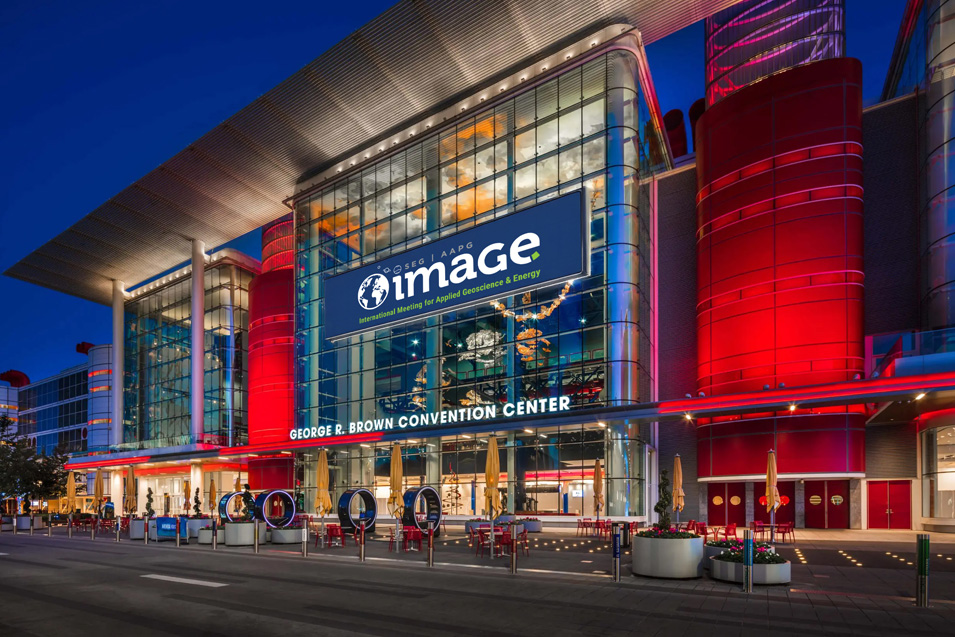
IMAGE ’25 convenes Aug. 25-28 at Houston’s George R. Brown Convention Center. That’s where Wood Mackenzie will present an executive discussion of today’s energy business landscape, followed by a sponsored one-hour reception, on Monday, Aug. 25.
A first-of-its-kind for IMAGE, the special session will be nontechnical by design, said Andrew Latham, Wood Mackenzie’s senior vice president of energy research.
“Our goal is to bring some economics and some broader strategic perspective to add to the great technical content at IMAGE,” he said.
Still in development at the time of writing, the discussion session is being billed as the Inaugural C-Suite Strategic Panel. “C-suite” is industry-speak for an organization’s executives – CEO, COO, CFO, CIO and so on.
A High-Level Look at the Future of Upstream
“We’re bringing a blend of senior industry folks who have mostly an economic and strategic point of view. We’ll have representatives from banking and finance, as well,” Latham said.
“We’ve got a couple of hours (so) we may have a fireside chat followed by a panel,” he added.
Woodmac’s sponsored events will be open to all IMAGE attendees as a separate ticketed option at no additional charge, with conference goers asked to indicate their interest during the registration process.
Presentation and discussion are scheduled for 1:30-3:30 p.m., followed by the reception from 3:30-4:30 p.m. Latham said the sponsored reception will be held in a designated space at the conference center, not on the exhibit floor.
For the panel discussion, Woodmac expects a broad look at business models, energy technologies, what kinds of companies might succeed, what strategies might work best, according to Latham. He called it “more of a helicopter view.”
“Our role will be primarily one of facilitation. We’ll organize the panel and lead off with thoughts of our own,” Latham explained.
“One thing we will try to do is to keep the conversations within the upstream world,” he said.
Overall, Latham said, Wood Mackenzie is “looking for deeper conversations with a wider view of the landscape” in the panel discussion, including perspective on the sector’s biggest strategic opportunities and challenges.
“What are the implications for people in technical roles from the trends that are unfolding now? Are enough people choosing petroleum engineering and geoscience as a career? We’d like people to come away with some perspective on that,” he said.
As a central theme, presentations and discussions will be built around the long-term outlook for oil and gas, according to Latham.
“I think that will be fun to discuss. A lot of younger people, younger than I, are wondering, ‘What are the long-term implications for my career?’” he noted.
Integration, Advantaged Resources
Latham identified integration and advantaged resources as two of the key concepts Wood Mackenzie wants to examine in its session.
“I think if there’s one word we would highlight, it’s ‘integration,’” he said.
He used the natural gas market as example, where a 360-degree view of the market would include an understanding of coal, renewables and other energy sources “so you can know what’s going on in adjacent sectors that won’t catch you unawares.”
“If you want to understand the market for gas, you kind of need to know what the demand is for natural gas,” he said.
Wood Mackenzie looks at the cost of production to identify the lowest-cost energy resources, and the amount of potential carbon emissions to determine the lowest-carbon resources. Those with a combination of relatively low cost and low carbon it considers advantaged resources.
Evaluating resources, “as a geologist, that’s my natural comfort zone,” Latham said.
In addition to all those topics, Latham said the discussion also will “probably touch at least a little bit on supply and demand scenarios” in the oil and gas industry.
“You won’t hear anyone at Woodmac talking about peak oil. You will hear us talk about the shortage, the significant shortage, of advantaged resources,” he said.
Key considerations for the Wood Mackenzie executive session are:
- What is the long-term outlook for oil and gas within the overall energy landscape?
- How should different oil and gas players position themselves to thrive through the 2030s?
- What will be the right portfolio balance and characteristics for optimal resilience and sustainability?
- How can organic and inorganic growth routes best support these ambitions?
- How can domestic players best return to international upstream or even debut overseas?
While the oil majors have long had an international focus, other energy companies are now considering more international involvement. Wood Mackenzie is looking at the best strategies for large U.S. independents, “companies in the tens of billions of dollars (in market value) range – many of those today are totally North America focused,” Latham said.
“Do I stick in the basins I know and love back home, even if those may be more mature? Or do I take more risk?” he said.
Woodmac analysis has found that growth through investment in exploration showed better returns recently than growth through acquisition: “The average numbers are encouraging. They’re better than (mergers and acquisitions),” he noted.
Questions from the audience will be taken in the discussion session, Latham said, adding that Wood Mackenzie doesn’t want a session that’s been too scripted in advance.
“Given the seniority of our panel participants, I think they’ll be comfortable with sort of riding the tiger and seeing what comes,” he said.