

Meeting global climate goals will require not only rapid emissions reductions but also the large-scale deployment of carbon capture and storage. Recent studies indicate that this effort depends on having mature, proven carbon storage sites ready to operate at an industrial scale. Global emissions remain high (about 40 gigatonnes per year of CO2 in 2025), but still only 50 megatonnes per year of it (the equivalent of 0.05 Gtpa) are captured globally, as indicated by the Global CCS Institute’s 2025 status report. To close this gap, the world must accelerate the development and validation of geologically secure storage sites – depleted hydrocarbon reservoirs and saline aquifers – capable of safely and permanently containing CO₂. Mature storage infrastructure is therefore not optional if the world is going to meet these goals; it is a foundational requirement for achieving net-zero emissions this century.
A crucial part of the development plan for a CO2 storage site is the formulation of the measurement, monitoring, and verification plan. A risk-based approach to the MMV plan is recommended, while ensuring the regulatory and societal requirements are met to enable verification of containment of the CO2 and conformance of the storage site to expected behavior – that is, to ensure that the actual spatio-temporal evolution of the CO2 plume is consistent with model predictions. As carbon capture and storage moves from pilot projects to large-scale deployment, MMV has become the cornerstone of trust in the entire value chain: regulators require it, investors depend on it, and society ultimately measures CCS success by it.
MMV provides the evidence that injected CO₂ behaves as predicted, remains contained within the storage complex, and poses no unacceptable risk to people or the environment. In practice, this means combining robust subsurface characterization, fit-for-purpose monitoring technologies, and transparent data management over decades of operation and post-closure stewardship. For TGS, MMV is not a single technology or survey. It is a life-of-field data challenge – one that demands integration across geoscience, engineering, and digital domains.
From Characterization to Conformance
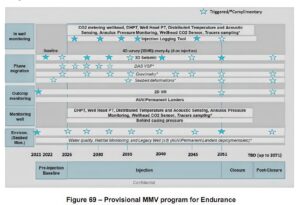
Figure 2 (right). The MMV plan of Endurance in UK is an example of the integration of multiple tools to gain optimal insight of the life-span of the carbon storage site. (Source: BEIS)
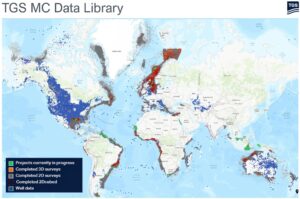
Every successful carbon storage project to date demonstrates that an effective MMV program begins well before the first ton of CO₂ is injected, making a robust baseline understanding non-negotiable. Effective, but practical and economic, monitoring of CO2 storage sites is a critical part of ensuring that CO2 is safely stored, legislative requirements are met and public confidence in CCS is gained and maintained. A defensible MMV plan relies on deep knowledge of storage site architecture and capacity, seal integrity and fault behavior, the condition of legacy wells and potential leakage pathways, and the expected geomechanical response to pressure and stress changes within both the storage complex and its seals. TGS addresses this challenge by leveraging the world’s largest multiclient subsurface data library (figure 1), integrating seismic, well, geological, and production data to support screening, site selection, and risk assessment at both regional (storage complex) and prospect scale.
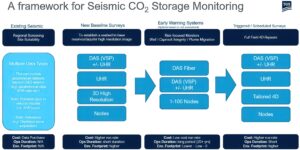
Establishing a strong regional context is essential because carbon storage sites do not function as isolated subsurface features, unlike many oil or gas accumulations. Understanding structural connectivity, potential plume migration pathways, and the geometry of the broader containment system significantly reduces uncertainty prior to injection. This holistic characterization enables operators to progress confidently from initial site appraisal to development of risk-focused monitoring planning for long-term conformance monitoring, ensuring that the storage complex behaves predictably and remains secure throughout the project lifecycle.
Designing Risk-Based MMV Programs
Modern CCS regulations emphasize risk-based, site-specific MMV programs rather than one-size-fits-all monitoring, ensuring that effort is concentrated where it delivers the most value over time. From a TGS perspective, this approach includes identifying credible containment and conformance risks, using a robust high- resolution baseline seismic survey, mapping those risks to the appropriate monitoring domains, and selecting technologies that can evolve as the project progresses. This philosophy, exemplified by figure 2 from the Endurance site in the UK, enables MMV planning to stay adaptive and scalable, allowing monitoring intensity to adjust as subsurface understanding improves and operational phases change, according to a recent report by the UK Department for Business, Energy and Industrial Strategy. The Northern Endurance Partnership has carried out detailed 3-D baseline surveys prior to injection as part of their project development MMV plan (figure 3). Another well-documented example in the industry is the monitoring of the Sleipner CO2 injection.
Seismic at the Core of Subsurface Monitoring
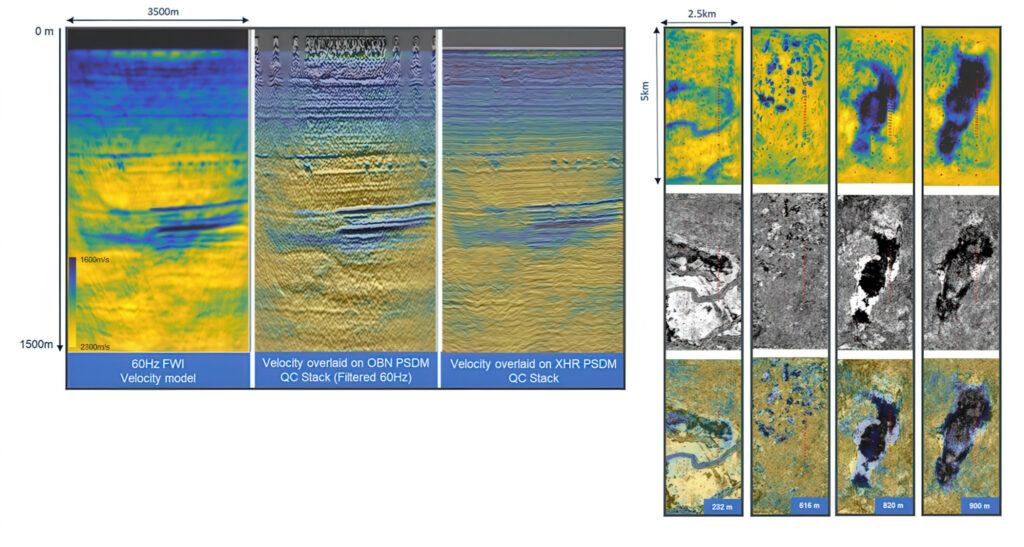
Time-lapse (4-D) seismic remains the most effective method for tracking plume migration and pressure evolution at reservoir scale over time. Recent advances in acquisition and imaging – especially broadband acquisition and elastic full waveform inversion – have markedly increased sensitivity to CO₂-related changes, enabling clearer, more reliable monitoring of subsurface behavior.
Beyond Seismic: A Multi-Domain View
Effective MMV extends well beyond the storage formation and requires a multi-domain approach to fully understand storage performance and environmental assurance over time. Key monitoring domains typically include the deep geosphere, where plume conformance and potential fault activation are evaluated; the shallow subsurface, where gas migration pathways and pressure anomalies can be detected; the seabed and water column, where monitoring focuses on identifying any potential seepage; and both active and legacy wells, where integrity must be continuously assessed.
Digital Enablement and Data Transparency
MMV programs generate enormous volumes of data over long project lifecycles. Transforming that data into actionable insight and auditable evidence requires more than interpretation expertise alone. TGS is developing digital solutions that seamlessly link subsurface monitoring data with operational and reporting workflows to support near-real-time decision-making, ensure full traceability across the CCS value chain, and streamline regulatory reporting and verification. Through initiatives such as carbon tracking and integrated data platforms, CO₂ can be traced from its emission source to its final permanent storage location, strengthening confidence in reported sequestration volumes. The Prediktor Data Gateway software is a cornerstone of the Northern Lights project in Norway, enabling continuous performance tracking of CO₂ from transport vessels through the Øygarden terminal and pipeline to permanent storage in the saline aquifer.
The TGS Perspective
Some see MMV as a regulatory obligation. TGS sees it as a value-creation opportunity. This is well supported by the technological innovations implemented on Sleipner (figure 6).
A properly designed MMV program includes:
- Reduction in subsurface uncertainty of CO2 movement and storage
- Enabling optimized injection strategies for operational efficiency and safety
- Lower long-term monitoring costs
- Build public and stakeholder trust from pre-injection through closure and transfer
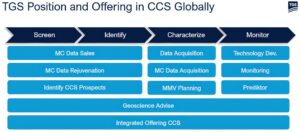
By combining global subsurface data coverage, advanced seismic technologies, and digital integration, TGS positions MMV as a strategic enabler for scalable CCS, not just a compliance exercise.
As CCS accelerates toward gigaton-scale deployment, confidence in storage permanence will define success. A proper MMV plan is how confidence is earned – measured, monitored, and verified. TGS provides advanced data and intelligence to companies and organizations involved in energy exploration, production, and carbon storage. With the industry’s largest subsurface data library and decades of geoscience expertise, TGS supports informed decision-making across the CCS lifecycle.