While many universities are experiencing upticks in undergraduate enrollment in geoscience, some are experiencing quite the opposite. Particularly in the southern United States, declining enrollment has prompted many schools to try and pinpoint the cause while developing creative plans to reverse the trend. Whether the reason is a shift toward climate-related studies, pandemic fallout, industry downturn or other factors, a group of experts will come together at the International Meeting for Applied Geoscience and Energy in August to formally address the issue.
In sessions titled “Challenges and Solutions: the Current State of Geoscience Education, Industry Needs and Society Impacts,” and “Geoscience Education Across the 20th and 21st centuries: A View from the Trenches,” educators will share their experiences with sustained drops in enrollment, and solutions that are turning the tides.
The Enrollment Puzzle
In the fall of 2021, only 13 new students enrolled in the undergraduate geological sciences program at the University of Alabama in Tuscaloosa. That is 15 fewer than the year before. Upon investigation, a substantial loss of continuing students was observed as well.
According to Delores Robinson, professor and former chair of the Department of Geological Sciences at UA, the pandemic could not be blamed for this loss entirely, as the university’s doors had reopened. In her eyes, geoscience was no longer being “discovered” by undergraduates as readily as it once was.
“Our undergraduate population fell dramatically and was expected to rebound to pre-pandemic normals, but it has not,” said Robinson, who will be sharing her research at IMAGE.
While many graduate students left the university during COVID for remote, full-time positions in the workforce, many undergraduate students abandoned their studies altogether without citing specific reasons.
“Is this a permanent thing?” she asked. “If you drop below a certain enrollment number at any university you could be targeted for dissolution of the program. We were never told we are in the doghouse, but we don’t want to get there.”
When the University of Nebraska’s board of regents voted to eliminate the Department of Earth and Atmospheric Sciences last year, it sent shockwaves through universities struggling with dwindling enrollments.
At the University of Houston, which has seen undergraduate geology and geophysics populations steadily fall during the last decade, some see the “green revolution” as the impetus.
“Everybody talks about declining enrollment, but you never really hear about it. It’s all in the shadows,” he added. “We wanted to get all of the universities together that are dealing with this problem and air this out.”
Paul Mann, a professor in the Department of Earth and Atmospheric Sciences at UH and IMAGE GEFE session co-convenor, noted that for decades, enrollment numbers of geoscience majors at UH almost perfectly correlated with oil and gas busts and booms. When oil prices were up, so were the number of people seeking careers in the industry. However, this time looked different. Enrollment lows are larger and more sustained. COVID contributed to the problem, but declines have persisted past COVID.
“People are scrambling to see how we can reverse this,” he said.
To attract more students, UA has ramped up efforts to make its geoscience program “more discoverable,” Robinson said. The university has strengthened recruitment and retention efforts through recruiting seminars, expanded introductory course offerings and enhanced undergraduate club activities. It also added a minor in water science and sustainability.
Such efforts have stabilized undergraduate enrollment, but numbers have not returned to pre-pandemic levels.
“Maybe we need to work harder to get the message across that the geosciences in general are a broad field, and that there are many things you can do with that degree,” Robinson said. “Those jobs are out there. I see them every day on LinkedIn.”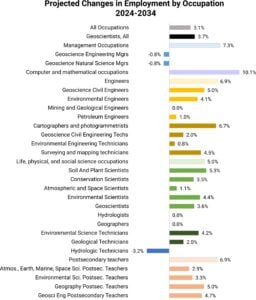
While Robinson agrees that today’s undergraduates are more informed about environmental choices, she said many graduate students value a geoscience degree, pursuing careers in environmental services. At UA, 36 percent of master’s graduates pursue careers in energy services while 22 percent pursue environmental services. Twenty-two percent pursue doctorate degrees in the geosciences.
Employment for geoscience majors bodes well for all graduate levels. Robinson said 80 percent of graduates with bachelor’s degrees from UA work in the geosciences as well as 88 percent of those with master’s degrees, and 94 percent of doctoral graduates.
Yong Zhang, chair of UA’s Geological Sciences Department, who directly interacts with students, believes a declining interest in the field is an issue for multiple reasons. There is limited K-12 exposure to earth sciences, as geoscience is not a required class in most states. Compounding this problem is competition from better-marketed STEM fields and a “narrow” public perception that geoscience only encapsulates the oil and gas industry, he said in an email.
As UA works to increase its undergraduate geoscience population, Zhang said the most beneficial contributions are high schools that offer dual-enrollment or AP environmental science courses with local field components; middle schools that offer hands-on activities and guest speakers from local geoscience employers, fieldtrips to nearby geological sites or university labs, and summer camps focused on earth science and water resources.
Universities also need to focus more on adults and returning learners when recruiting geoscience majors, said Dolores van der Kolk, a geologist and science communications coordinator at the Bureau of Economic Geology at the University of Texas at Austin and co-chair of the sessions at IMAGE.
She believes the ripple effect from the 2008 financial crisis, the 2014 industry downturn, the pandemic, and an overall decline in birthrates and immigrant populations are affecting enrollment numbers across all disciplines – creating the perfect storm.
Fields such as geology, which rely significantly on hands-on lab and field experience and interaction with instructors, lose their impact when instruction is moved online. When she taught geology courses at Texas State University, “I had to convert laboratory exercises with one set of rock samples into an online format in 2020,” van der Kolk said. “And, during COVID, I rarely had students come to my online office hours.”
She added that when in-person interactions are cut from the picture, students miss opportunities to have conversations that can be influential in deciding to pursue a geoscience degree.
Building a Better Pipeline
The difference between universities that are thriving in terms of enrollment and those that are struggling could be whether or not they are directing students toward the jobs, said Christopher Keane, director of geoscience profession and higher education at the American Geoscience Institute.
“The service sector is exploding,” he said. Schools that align their curricula with state licensure requirements and that help funnel students into a diverse and booming workforce are “winning” in terms of undergraduate enrollment. His opinion is based on the preliminary results of an audit AGI is currently conducting.
However, Keane admits the problem is regional in nature.
“Students don’t travel far for school, and they don’t go far for a job,” he added. “Schools that have made adjustments based on the workforce are succeeding.”
To address a declining undergraduate enrollment head on, the Jackson School of Geosciences at UT holistically reenvisioned its undergraduate education, embracing a skill-focused and flexible curriculum to adapt to a changing academic and career landscape.
Daniel Stockli, dean and former chair of the school’s Department of Earth and Planetary Sciences, said he has seen undergraduate enrollment increase from approximately 160 to 420 students in the last six years.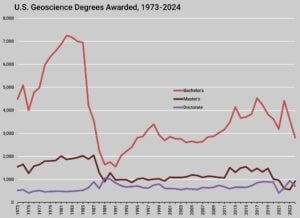
Curriculum revision played a major role in this endeavor, with faculty, academic leadership and student affairs professionals all playing a role, said Stockli, who also will present at IMAGE.
No longer are students required to funnel through classic “introduction to geology” courses. Now, they can enter the program through a greater variety of introductory courses, including geohazards, climate sciences, or oceanography, Stockli said.
“We liberated how students come into our degree. Freshmen have varying or no high school geoscience exposure levels and very different interests. It’s important to give them multiple avenues into geosciences,” he said. “This ‘broadening of the tent’ also allows more faculty to contribute to student success.”
UT also added a climate systems science major while uncapping its environmental science degree program, which has since grown from 40 to 120 majors. The program is now tied with geophysics as the second most popular area of study apart from geology, which also has seen solid growth.
“We need specializations that reflect where students go for jobs. One-third end up in the environmental sector,” Stockli said. “We still emphasize a solid geoscience foundation, including field courses, but they also need to prepare students with the skills to succeed in future careers that tackle tomorrow’s challenges.”
Furthermore, UT has revamped its six-week field geology courses by breaking them into two, three-week sessions, all ending before June 1. This frees up the summer for internships and more fully integrates these courses into the curriculum.
Lastly, when students come into the geoscience program, they are better supported by student advisers, freshman interest groups, and ongoing tutorial sessions in math, chemistry and physics, for example, so that one difficult class won’t become an impetus for a changed major.
“Geoscience is of critical importance for humanity, the economy and our planet,” Stockli said. “Our undergraduate program growth has shown that modernization of the curriculum, a holistically supportive academic support network, and education that focuses on students’ skills and employment are a powerful recipe for success.”
In the eyes of Keane, successful programs are those focused on the exit of their graduates rather than the entrance of new students. “In the end,” he said, “the students will come if they think the program will get them a career.”