
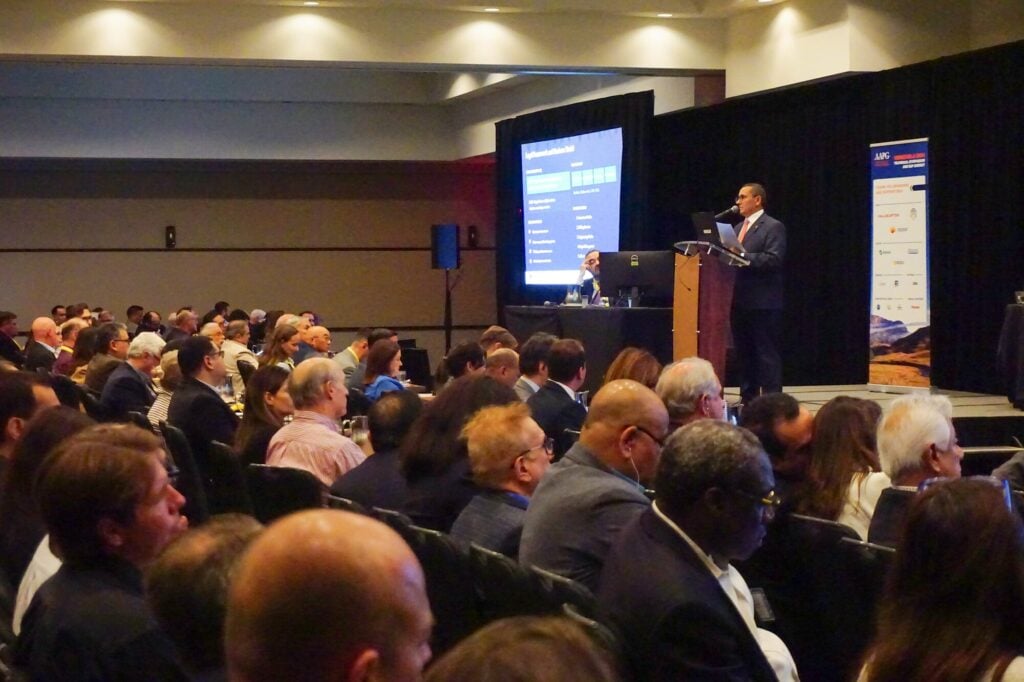
Political changes in Venezuela in January 2026 brought the world’s attention to the country and created a range of expectations for international companies interested in operating there. Those changes also brought opportunities for AAPG and for Venezuelan members around the world.
In response, many of those members began meeting in February to put together an event focused on the country’s geology and exploration and production opportunities.
Their creation, the “AAPG Venezuela Technical Symposium and E&P Summit: Unlocking Opportunities from Exploration to Implementation,” took place in The Woodlands, just north of Houston on May 18-19.
The integrated event had one day dedicated to geology and hydrocarbon potential and a second day focused on contracts, regulation, infrastructure and other considerations needed for doing business in Venezuela.
‘Early Stage of a Renaissance’
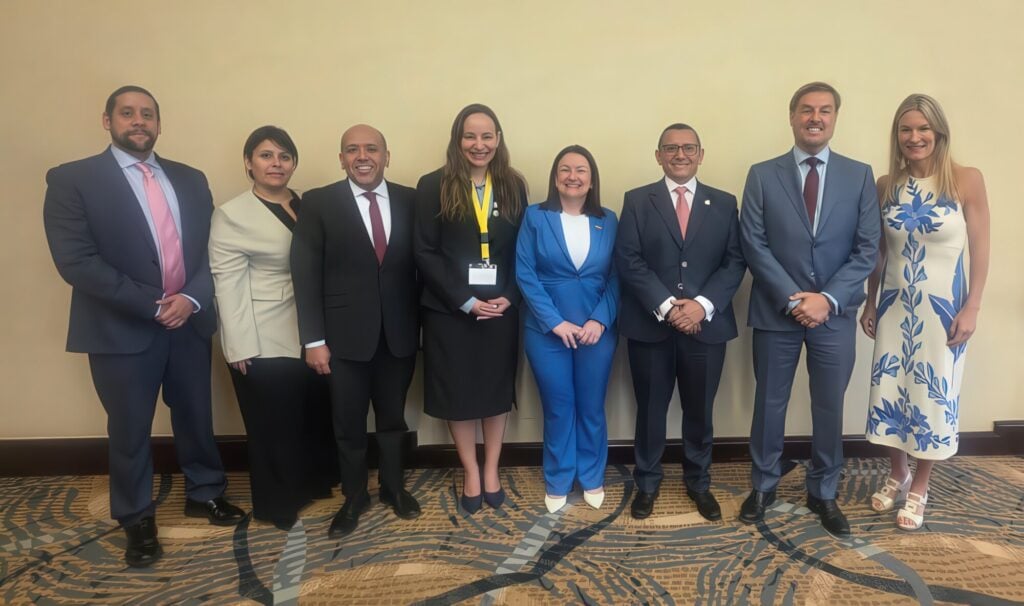
The content attracted a wide range decisionmakers, from technical experts to business development officials, from across the Americas and Europe, and brought in noteworthy speakers and attendees, including representatives from the U.S. Department of Energy, the Venezuelan Hydrocarbon Ministry, national oil company PDVSA and the Venezuelan Embassy in the United States.
Kyle Haustveit, assistant secretary from the U.S. DOE, recognized the event’s significance with his remarks at the opening ceremony.
“This is what the early stage of a renaissance looks like. It looks like a room in Houston full of geologists and engineers and lawyers and operators and policy people who decided to show up in person to do the unglamorous work of figuring out how to do this together,” he said.
The event held a personal significance for Ana Maria Goncalves, event chair and president-elect of AAPG’s Latin America and Caribbean Region and a Venezuelan geologist born in Ciudad Guyana in the Bolívar state.
“This event is truly historic,” she said. “This is the first major AAPG event focused exclusively on Venezuela: its geology, its energy potential, its history, and its future. And honestly, I believe this was a conversation we had been needing for a long time. How could we not talk within AAPG about the country with the largest oil reserves in the world and one of the greatest energy potentials on the planet?”
She stressed that Venezuela is not just an important name in the petroleum industry; it is part of the industry’s history.
“Our country has more than 150 years of petroleum history, a journey that began with natural oil seeps and the story of Hacienda La Alquitrana, evolving into the enormous energy potential we know today,” she said.
Hydrocarbon Potential
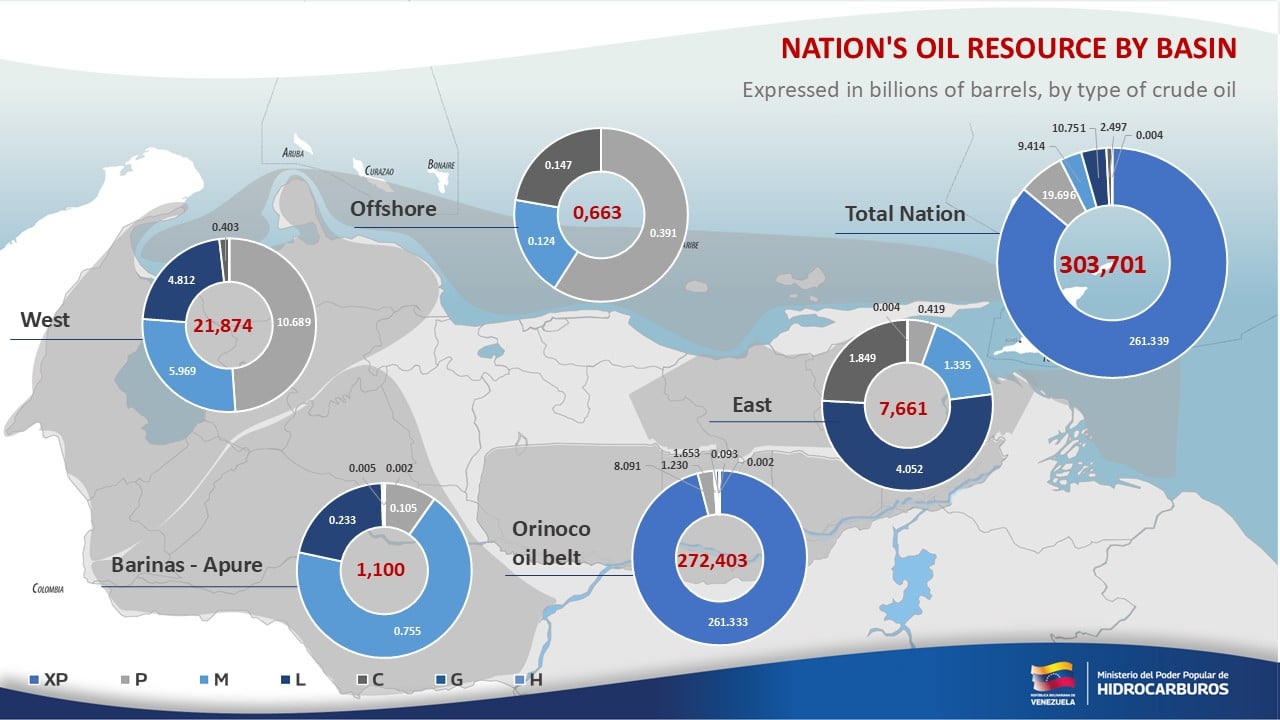
That potential, she said, is bound up in more than 400 oil fields, an extraordinary diversity of petroleum systems, and one of the most important hydrocarbon accumulations ever developed.
“But beyond the numbers, there is something that makes Venezuela truly special: the depth of its energy culture,” she said. “In Venezuela, the petroleum industry did not only generate production. It generated universities, research, and talent. It created entire generations of geologists, geophysicists, engineers, and technicians who helped build the energy industry both inside and outside the country.”
“And that is still reflected today in the quality of its professionals, in the respect Venezuelan geoscientists have earned around the world, and in the enormous amount of geological and geophysical information accumulated over decades,” Goncalves added.
Some of those professionals shared their expertise at the Technical Symposium held on May 18.
The Symposium highlighted Venezuelan’s diverse hydrocarbons: non-associated gas, condensates, light crude, heavy crude, and extra-heavy oil. Sessions also covered offshore opportunities, conventional and unconventional reservoirs, and resources still waiting to be reinterpreted with new technologies.
A Pivotal Moment
Perhaps the most remarkable part of the event was the timing, just four months after the most significant shakeup in Venezuela’s government, economy and policy, the removal of Nicolas Maduro from power.
“On January 3 of this year, a long chapter ended. A new one began,” said Haustveit.
He described how the United State government has worked with acting President Delcy Rodríguez to restore diplomatic relations, to reopen pathways for commerce, and to lay the legal groundwork for serious investment.
“The Organic Hydrocarbons Law passed in January. The Mining Law followed in April. The (Office of Foreign Assets Control) general license architecture, evolving from GL 46 through GL 57, now provides the most workable pathway for U.S. engagement in Venezuela that we have seen in more than a decade,” he said.
He added that the biggest story is not the legal architecture but the commercial activity that has followed.
“Venezuela is producing well above one million barrels per day, at levels this country has not seen since 2018,” he said. “The geology has not changed. Venezuela holds roughly 17 percent of the world’s proven oil reserves. The talent has not changed. What is changing is the framework, the relationships, and the willingness on both sides to do hard work together,”
The willingness to work together is paying off, he said, signaling memoranda of understanding signed in recent months, and a new Chevron contract executed under Venezuela’s new legal framework that expanded the company’s presence in the Orinoco Belt.
“These are not press releases. These are real barrels, real capital, and real commitments,” he said.
Business and Investment Opportunities
New contracts and commitments took center stage during the Exploration and Production Summit on May 19.
Sessions covered legal considerations, geopolitics, infrastructure, gas opportunities and experiences from operators.
The day also included guest speakers Paula Henao, Venezuela’s hydrocarbon minister, and Jovanny Martinez, executive vice president at PDVSA.
They lead a delegation comprised of 14 government officials, including the vice minister of hydrocarbons, the Venezuelan ambassador to the United States, the vice minister of gas and president of the PDVSA’s Venezuelan Petroleum Technology Institute.
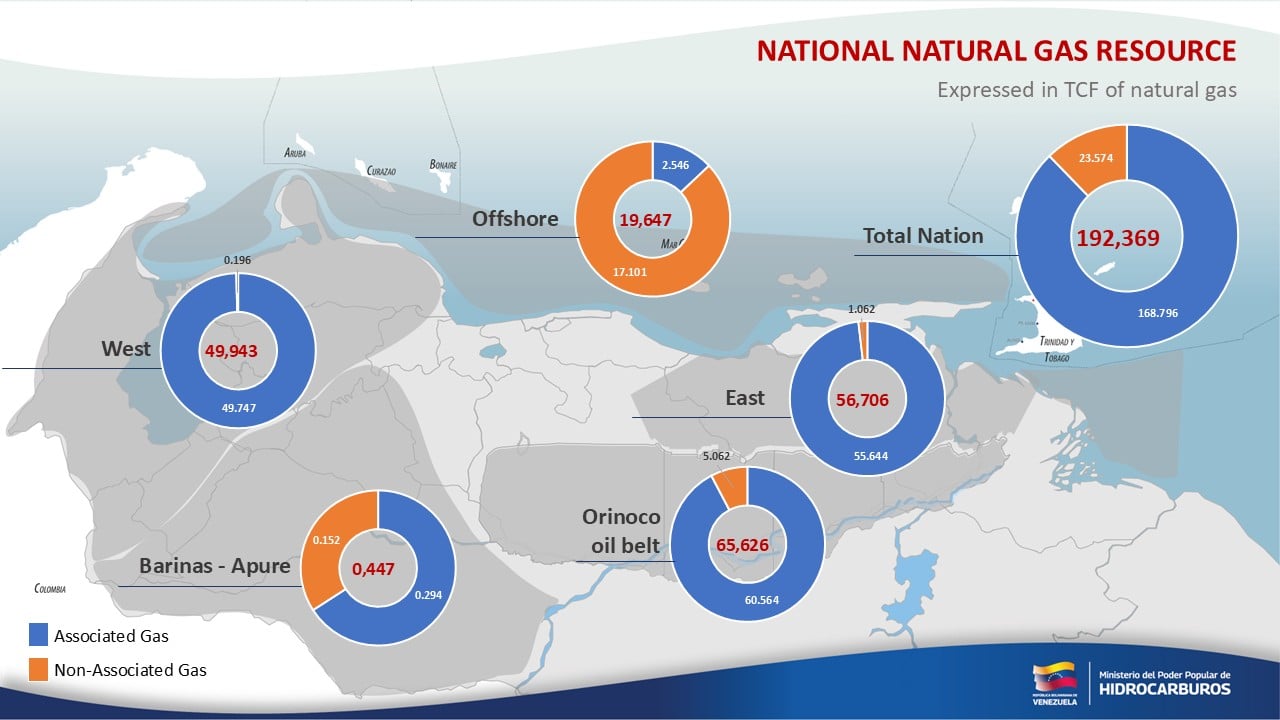
Martinez encouraged foreign companies to invest in Venezuela’s natural gas sector, noting that the country holds 192 trillion cubic feet of gas reserves – 70 percent of Latin America’s total gas reserves – and ranks ninth globally in natural gas.
Venezuela leads the world in oil reserves, with an estimated 303.7 million net barrels.
He said the recently passed legislation designed to promote provides opportunities for companies and encouraged them to sign contracts.
“Every agreement we sign, we will honor,” Martinez said.
Henao said the Venezuelan government is working to provide assurance to investors and soon will release regulations providing additional clarity on points included in the hydrocarbons law passed earlier this year.
“This symposium is exactly the kind of forum where we want to meet our future partners: the legal framework is in place, the resource is proven, and Venezuela is open for business,” she said.
Henao was the first Venezuelan cabinet member to visit the United States since Maduro’s capture in January, and her attendance at the meeting sent shock waves through the regional energy sector.
Registrations climbed from 150 to 350 in just four days. Attendees gathered outside the delegation’s meeting room, hoping to get a moment with the ministry and PDVSA.
The delegation only had time for a handful of meetings, but they expressed willingness to continue conversations at similar events in Caracas. They also met with representatives from AAPG’s Latin America and Caribbean Region leadership.
During the meeting, Henao expressed interest in supporting AAPG student chapters and sending technical staff to association events.
Goncalves described interactions with the ministry as very positive.
“The minister is a petroleum engineer, and I could see when meeting with her that values professional development and education. She also cares about students and building the next generation of professionals who will lead Venezuela’s energy sector,” she said.
“AAPG has been very active in Venezuela over the past few years, and I hope that working with the ministry and PDVSA will help us make the community even stronger,” she added.
Diverging Opinions
The event reflected the diversity of perspectives within the Venezuelan and international energy community. Some attendees expressed concerns about including Venezuelan government officials in the agenda, while other others emphasized the importance of technical and professional dialogue in this new phase for the country’s energy sector.
Goncalves signaled how the event provided the opportunity for professionals from all sides of the political spectrum to work together to achieve a greater good.
“Beyond the technical discussions, the event stood out for bringing together voices with diverse experiences and visions, reflecting the complexity and relevance of the moment the region is experiencing,” she said.
Haustveit acknowledged the challenges ahead and encouraged attendees to work together with humility.
“None of us, on either side, has all the answers about what the next phase looks like. We are in the early innings of something significant. The right posture for an early inning is curiosity, not certainty,” he said.
Hope and Perseverance
“And bring hope. Real hope. Not naive hope. Hope grounded in what you can see with your own eyes if you look honestly at this moment. Venezuelan production is climbing. Venezuelan institutions are being rebuilt. Venezuelan engineers are stepping back into rooms with their counterparts from around the world. American operators are deploying capital. Diplomats from both countries are doing work that would have been unimaginable 18 months ago,” he continued.
He encouraged attendees to persevere during difficult times.
“The work ahead is not going to be easy. There will be setbacks. There will be deals that fall through. There will be technical surprises and market surprises. None of that changes the basic picture. The geology is real. The relationships are real. The opportunity is real. And the people in this room will determine whether this hemisphere becomes what it has the capacity to be,” he said.
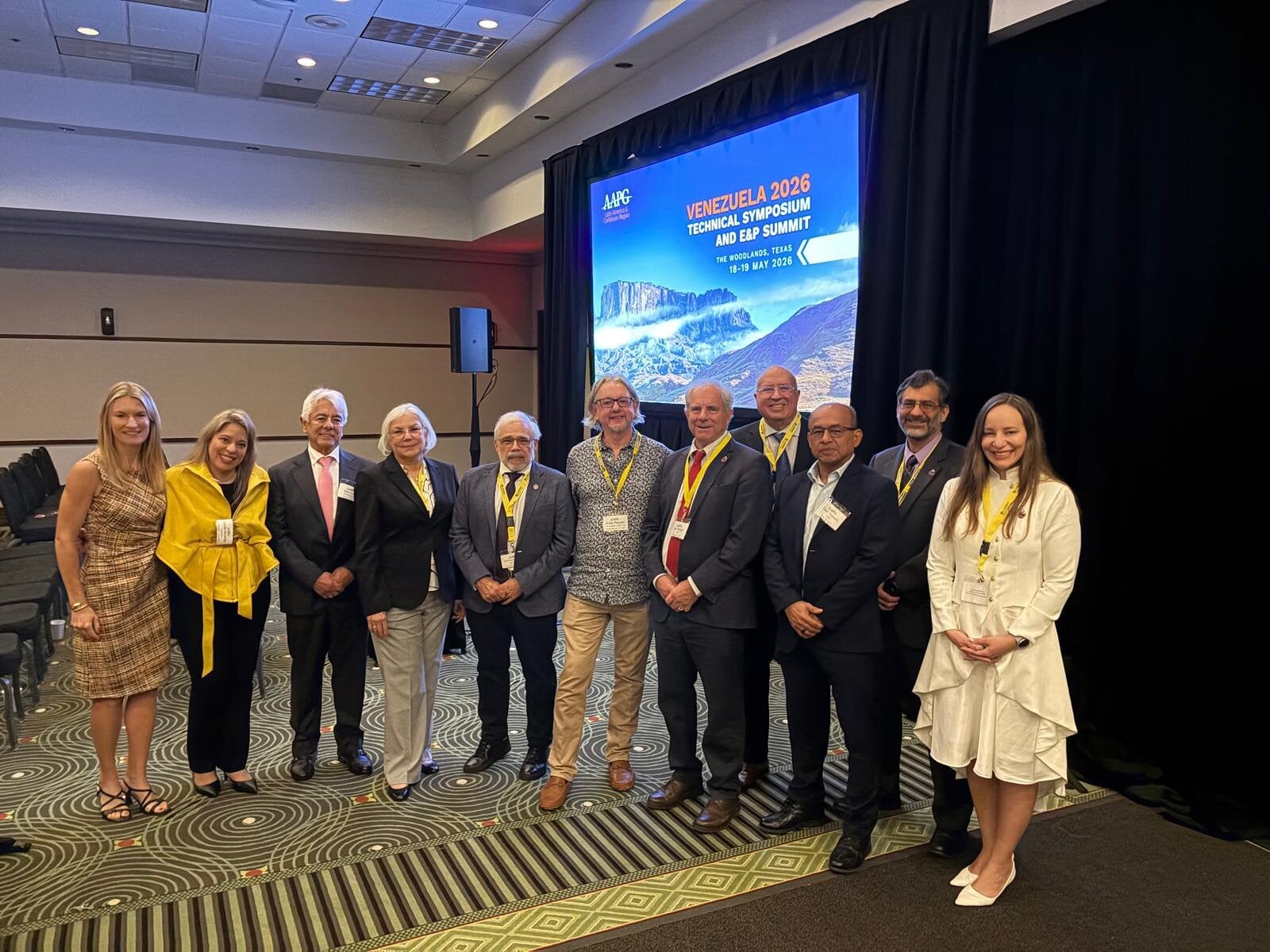
Goncalves also stressed the importance of moving forward.
“Venezuela should not be viewed only through its past, nor only through the difficult period it has experienced in recent years. It should also be viewed through its future opportunities,” she said.
“Venezuela still has so much to contribute technically and energetically to the world,” she said.
“Being here means looking once again at Venezuela through geology, technical insight, and future opportunities. It means reconnecting professionals from different generations around a country that profoundly shaped the history of the energy industry.”