
It’s a question that’s been asked for years within the U.S. energy industry: When will international development of shale oil and gas and other unconventional resources take off in a major way?
Greg Leveille, CEO of consulting firm Tidal Wave Technologies and a former chief technology officer for ConocoPhillips, thinks he has the answer:
Right about now.
Leveille will discuss his outlook at the upcoming Unconventional Resources Technology Conference in Houston, during the June 22 topical luncheon “Discovering and Commercializing Unconventional Reservoir Plays Larger and More Prolific than the Permian Basin and Marcellus Shale – The Promise of International Unconventionals.”
He said the URTeC presentation “is really meant to tee up some discussion” about the potential for unconventionals development outside the United States, plus a significant shift that’s just about to take place.
“When you look at the world today, in the United States this obviously has been a big, big focus of oil and gas investment over the past 25 years,” Leveille observed.
“Now you’re beginning to see the (shale) basins in the U.S. starting to reach maturity,” he said.
From Model T to Modern Shale
At the same time, technologies and techniques related to unconventionals development have constantly improved. Horizontal well laterals once started at 500 feet, but now extend up to 5 miles in some places. Multi-stage fracturing in shale plays is much better understood and more sophisticated today.
“The technology element really ties back to the fact that there’s been tremendous development in capabilities,” Leveille noted.
He said using unconventionals technology from 25 years ago compared to using today’s capabilities is like driving a vintage Model T compared to driving a modern sports car.
Leveille cited three considerations affecting the development of unconventional resources: First, geology. Second, technology. And third, the above-ground challenges that must be overcome.
“At the foundational level, geology is obviously the controlling factor,” he said.
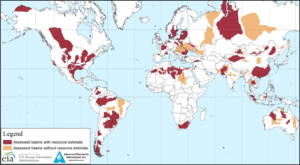
The U.S. Energy Information Administration published a map of international shale oil and gas resources in 2013, in association with Adanced Resources International. It showed an abundance of resource opportunities around the world, with heavy concentrations in Europe, North Africa, South America, Russia, China, and Australia.
Follow-up studies by other organizations confirmed the extent of international unconventionals. But in more than a decade, only a few of those plays have been developed, including the Montney shale in Canada, the Vaca Muerta play in Argentina and the Ordos and Sichuan basins in China.
Doug Valleau, president of Strategia Innovation and Technology Advisors, will be co-presenter with Leveille at the URTeC luncheon. Valleau said some countries have prioritized conventional oil and gas opportunities over unconventionals development. He listed several other factors that have slowed large-scale international development of resource plays:
- Regulatory and permitting frameworks that are not structured to support the industrial scale and pace characteristic of shale operations
- Limited tolerance for early-stage technical and economic setbacks and the iterative learning curve required to optimize performance
- Opposition from environmental groups and non-government organizations influencing government, public policy, and operator decisions
- Insufficient supporting infrastructure, supply-chain capacity and technical workforce development
But now, advanced technology for resource-play development looks to be a game-changer, according to Leveille.
“You can take modern technologies, couple them with rocks that are even better than the best rocks in the U.S., and you come up with a formula for overcoming the above-ground challenges,” he said.
“You can deploy the knowledge you’ve built up and use it in these other countries,” he added.
International Momentum
There’s a world of possibilities when it comes to international unconventionals. We’re already “seeing a number of deals being done, joint ventures. Several of them are in the Middle East,” Leveille noted.
“You’re seeing opportunities in Australia. North Africa is an area, I know, where there’s been interest,” he said.
Valleau named a dozen countries where unconventionals development is picking up speed or where increased future activity has already been announced.
“Current activity in unconventional resource development is already underway in countries such as Canada, Mexico, Argentina, Saudi Arabia and China,” he said.
‘Over the near term, I expect increased engagement from nations including the (United Arab Emirates), Bahrain, Egypt, Turkey, Australia, Algeria and Libya, as they aim to diversify their energy portfolios and apply lessons from early adopters,” Valleau added.
In mid-April, energy information and analytics firm Wood Mackenzie issued new research on international shale exploration. It reported that six countries “are advancing unconventional resource development to help address energy security objectives”: Algeria, the UAE, Mexico, Australia, Turkey, and Indonesia.
Recent events in the Middle East have made countries more aware of the importance of their own domestic production in the light of supply disruption, Woodmac noted.
“Where there is alignment with national interest and the will to make these projects succeed, incentives for investment will follow,” said Josh Dixon, Wood Mackenzie senior research analyst.
Deepwater exploration and development began in the U.S. Gulf and then spread worldwide. Leveille sees a similar pattern building for resource development, including coalbed methane and oil shale, as unconventionals go global.
“I would add geothermal as a third part of that – international unconventionals, deepwater and then geothermal opportunities.” Leveille said. “We’re seeing rapid advancements in industry’s ability to capture heat from the Earth’s crust and economically convert it to power.”
The United States has dominated unconventional resources development and production over the past two decades. That’s already shifting as international unconventionals expand, Leveille said. The pace of resource-play growth in the United States is slowing as international development speeds up.
“At some point, the exploration part passes and then the rapid development part passes. Our ability (in the United States) to grow production as rapidly as occurred over the past 25 years is no longer there,” he said.
The spread of unconventionals-related technology should look familiar to the energy industry, Leveille said, since it reflects a “familiar pattern of development, having nucleated in America and then after a couple of decades taking off around our planet.
“It’s not unusual at all.”