
“If you had to summarize what makes the best explorers, what would it be in two words?”
This person seemed exasperated. I had given a lengthy talk to the Denver Explorers Club. Heck, in all honesty, I was still on cloud nine since I had chatted with one of my all-time cycling heroes on the flight to Denver, Christian Vande Velde, one of the chief lieutenants during the U.S. Postal reign.
At that point, it hit me that for some, it’s frustrating to hold multiple thoughts simultaneously. How could I respond to the question? I’d prepared more than five years of interviews and countless hours studying the traits of great explorers. I had a successful company newsletter focusing on the topic of exploration leadership. How was I going to summarize all that work in two words? I finally realized an answer, and it sunk in. All because of Richard A. Sears’ poignant comment on peak oil, accompanying this article. Rich had been closely following data, living the data, looking at the data to reach his conclusion. Rich had been truly listening to the data.
“They … listen,” I replied.
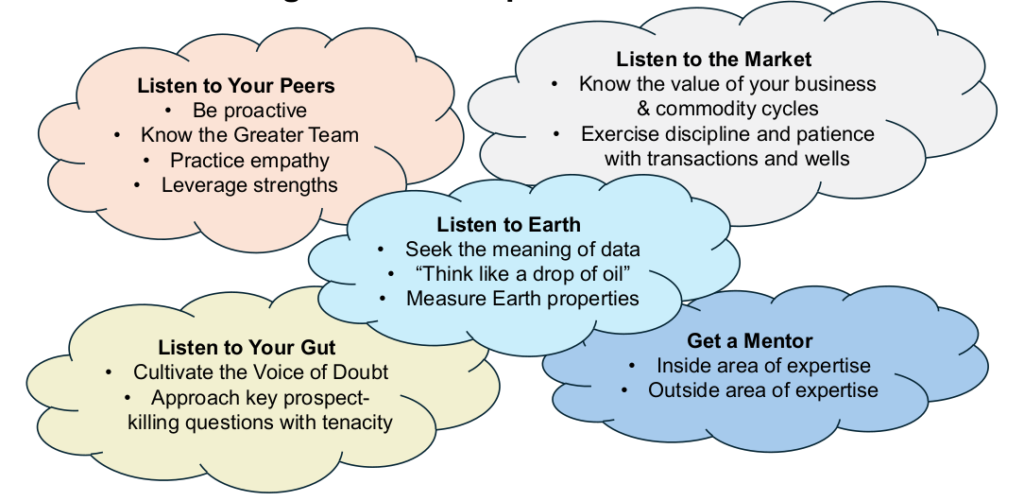
Now, expand, I thought: “The best explorers listen to the data, they listen to their colleagues and their partners who are showing them what is wrong with their prospect. They listen to their gut as a way of cultivating that human sensitivity to risk when making difficult, high-value decisions. And they listen to Earth.”
Explorers listen to the small voice in the back of their minds that is pulsing a message of doubt, “This prospect won’t work for this reason you’ve been too scared to approach because you think it will kill the prospect.”
The best oil finders embrace this fear, and they approach the key question with tenacity, ultimately seeking the truth about Earth. After all, in upstream, the Earth itself is the main competition for us explorers – not so much other exploration companies. Once you get to midstream and downstream, however, you are mainly competing with other companies.
Fast-forward to today: the Denver Explorers Club is thriving under the inspiring leadership of Jacinda Brown, Aaron Fisher, Ningning Li and Darren Kirkwood. Explorers gather monthly to listen to the latest studies that will give them an edge in exploration. Register soon for their next luncheon before it sells out – again.
Steps for Success
The best explorers are proactive listeners. Derek Adams, who has carried his expertise in exploration from ExxonMobil into the geothermal space, described how he engages with others to gather diverse ideas in addition to the conversations happening just within his own immediate business unit:
“Take the opportunity to learn and talk to other functions and groups. Talk to the land teams, dig into the commercial side, the development planning. Try to really understand the whole picture and why decisions were made.”
The best explorers seek mentors outside their comfort zones. Elijah White, Jr., retired executive from ExxonMobil, explained this topic in mentorship: “While in Libya … during a discussion on the topic of mentoring, the most senior person there, an engineer, commented, ‘I don’t have any mentors.’ So, I asked him, ‘How much do you know about geology? See these five people here – all geologists. I guarantee you can learn from all these people.’”
The best explorers seek community – not isolation – and corporate listening in teams. At the nexus of academia, industry and government, The Drifters, a research group with Instituto Andaluz de Ciencias de la Tierra (IACT/CSIC), excel at listening to each other, and as a result, produce game-changing research.
Wouter de Weger explained the collegiality of The Drifters: “The most fun part of the graduate program is my research group … I really love my colleagues and we share some amazing experiences together, like exploring together in the Moroccan desert after our JIP meeting.”
Listening for Meaning, Growing Your Empathy
The best explorers seek meaning behind the words. That applies to the business, to make sure they’re delivering on their objectives. Equally – or, perhaps, more importantly – they are empathetic with their colleagues. Of the broader aspects of communication in the oil business, Lori Fremin, retired general manager of deepwater for Shell, discussed listening as one of the most important aspects of leading with purpose: “You need to know all about where the person is coming from and what are their strengths. Listening to understand is needed to ensure each person can leverage their strengths to deliver value consistently within the organization.”
Another key example was offered by Amalia OIivera-Riley, while she was head of exploration at Tullow Oil during the pandemic. As history would unfold during that challenging time, expenses had to be reduced dramatically. Olivera-Riley discussed what it was like to keep the company solvent: “The crisis forced Tullow to exit blocks, cancel or defer activities, and engage in intense negotiations – all conducted virtually with people I had never met in person. This demanded a deep focus on empathy and kindness, and the relationships built during that time remain among the strongest of my career.”
Listening Ethos for Exploration Geoscientists
As Olivera-Riley offered in a recent presentation with Subsurface Consultants & Associates, empathy is one of the number-one ways to keep open communication
and flow of valuable ideas into the new ventures and exploration hopper: “Explorers deliver their best ideas when they know their peers and management care about them.”
No Book? No Problem
If you want to learn calculus, you can buy a book and learn calculus. Several, actually. Turns out there’s not really a book on how to do exploration, per se (this is a topic for a future post), so how is exploration know-how passed on? Over the campfire is one way. And by this, I mean elders telling inquisitive newbies how it’s done – and how it’s failed.
Diane Woodruff explained this in working with experts at Anadarko (now Oxy): “One of the main things I’ve learned is that you must rely on the greater team. As you evaluate all aspects of prospects, leverage experts in the company – other colleagues within different business units to get different perspectives. You’ll learn from those conversations the ways a prospect could work or fail. One of the most important things is to leverage expertise of (subject-matter experts) – experts like Van – early in the evaluation and then again in the post-drill analysis.”
Oh, and by the way, Diane referred to Van Mount. Did you know that Van’s face made the cover of one of Anadarko’s annual reports in the early 2000s? You know that one photo like a throwback Phil Collins looking-up-at-the-camera-from-down-below shot? The APC cover read “DEEPWATER” and was superimposed on ocean surface waves. An inspiring and formative memory for all of us younger geologists at that time.
Listen to the Market
No one can predict the price of crude oil or natural gas. Just look at the predictions versus outcome for some of the best market analysts. But you’d better have an idea of where the market is and its location in the commodity price cycle.
The late Peter J. Lellis, then CEO of Advance Energy Partners and chair of organizations like the Petroleum Investment Committee at Stanford, discussed this aspect of reacting with speed to what the market is providing, for example, the sale of his EnCap-backed company, AEP, to Matador for about $1.6 billion: “You need to react to what the market presents to you. If the market is receptive to IPOs, and there is a value arbitrage between IPO and a sale, then you’ll pursue an IPO. If the market is favorable to selling to a public company … adjust your strategy to go that direction. Now if the market isn’t favorable to either … it’s a bit more difficult. You need to be flexible, to react quickly and you need to pursue what the market is providing.”
William J. Quinn of Pearl Energy, formerly of NGP and Rainwater’s group, discussed this aspect of exercising discipline and patience to wait for the right, in his case, development opportunity for his portfolio: “Be patient and disciplined. There are two key points on this: you can’t rush it, and you can’t get too aggressive. If you can be patient and disciplined throughout the cycles, you’ll fare well.”
Think Like a Drop of Oil
I once met a tremendous oil finder who was generous enough to give a talk to our department at the University of Louisiana years ago. He gave a captivating presentation on giant discoveries from the United States to the Middle East. At the end, one of the students, perhaps it was the captain of the soon-to-be-globally-unprecedented third world championship team from UL in the AAPG Imperial Barrel Award competition, asked a question to this oil finder: “How do explorers really get inside the data to generate prospects?”
The oil finder replied, “Think like a drop of oil.”
Imagine how you’d find your way through the carrier beds and pore throats to end up trapped, and you’ll identify the prospects. I thought it was such a good quote, I used it during a presentation in London in 2019. In that audience was Matthew Lamont, Founder and CEO of DUG (formerly “DownUnder Geosolutions”).
On the flip side, if you’re one of the world’s most brilliant geophysicists, like Lamont, you reply: “It’s not so much about ‘thinking like a drop of oil,’ rather I propose: can we measure it?”
Two different ways of listening to the data: using your creativity to get inside the data versus a very left-brained, scientific approach of measuring Earth properties to make a discovery.
Let’s give K. W. Rudolph the last cautionary word on listening, as excerpted from The Explorer’s Mindset: “(Don’t) become overly wedded to your own ideas. Listen to others, their ideas might be valid.”
There is currently no book titled, “Listening for Exploration Geoscience” (sure, there are some generic frou frou examples on Amazon), but I think we’ve made a good start to this conversation here. I welcome and look forward to your comments and feedback.