
“I’m feeling dangerous – I’m excited to race,” I replied.
Kristian went on to compete in the North American Ironman Championship in The Woodlands, and I competed in the USA Triathlon Off-road Championship held near Austin. A superb day for racing across the great state of Texas where perseverance and tenacity paid off big for both road and off-road triathletes.
After seven hours, 21 minutes and some seconds, Blu – as he’s affectionately known throughout the sport – crossed the finish line in first, winning Ironman Texas in back-to-back years. Swimming 2.4 miles, biking 112 miles, and running 26.2 miles, Blu bested the entire field that Saturday, with his teammates finishing not far behind: Casper in third place and Gustav in eighth. It was a triumphant day for Norway’s female team, too, with a commanding win by Solveig Løvseth. Team Norway excelled in persistence and tenacity with their graceful victories, you could say, that day.
Oh and by the way, Blu’s marathon pace was 5 minutes and 45 seconds per mile.
If you recall the first installment of The Explorer’s Mindset in the AAPG Explorer in January, we described the five key elements laid out by Cindy A. Yeilding in her 2002 AAPG Distinguished Lecture that define successful explorers. I’d like to dive into one particular element this month, and that is the fifth element: persistence and tenacity, paired with grace.
A Pioneering Spirit
As I’m reminded in our Friends of Field Camp meetings with A-Lan Reynolds, Dick Bishop, Kevin Bohacs and many others (editor’s note: see related article by Barry Friedman in this issue), one of the first times university geoscience students’ persistence and tenacity is genuinely tested is in field camp their senior year. Weather can be unstable, terrain can be steep, days are long, mapping projects are complex. These conditions put a premium on a geology students’ desire for getting the work done.
In our South Dakota Mines field guide for Ranch A (Annenberg Ranch), written and edited by the late Alvis Lisenbee, current Director and Professor Nuri Uzunlar, and primary field station Professor Christopher Pellowski, one statement has always stood out to me in the early pages of the field guide: “Be willing to lug up one more hill on a hot afternoon to reach a critical outcrop. Another important characteristic of a geologist is physical endurance.”
Alvis certainly embodied this. It’s tough to keep pace with the energetic Nuri in the field. Chris is indefatigable. The quote applies to them easily and readily as they train hundreds of students every year for careers in geoscience.
The quote also reminds me of what Stephan A. Graham told our team of grad students one day in the field in California, about why he chose to become a geologist: “I was always curious about what was over the next hill.” A spirit of a pioneering explorer that is hard to suppress.
Take this ethos from some of the best field geologists, and check out what is over that next hill. This is an apt analogy for the folks in the Permian: How much oil is in that next Wolfcamp or Strawn bench? Or the U.S. Gulf working out of offices from Corpus Christi to New Orleans: How much oil is in that next Miocene turbidite reservoir?
Lucky No. 7
Persistence is so important for getting your prospect drilled. Cindy says it often takes seven tries – or more – to land a prospect in the portfolio for a year’s exploratory drilling program.
“Cindy, tell us about some of your tactics to persistence and perseverance … in trying to get a prospect understood and eventually endorsed,” I asked during our exploration retreat fireside chat at Margaritaville Lake Conroe. Some of the ways Cindy suggested getting that prospect across the finish line are humorous – and extremely effective:
- Have a colleague show the prospect, or multiple colleagues. Strength in numbers is persuasive and you get bonus insights from fresh eyes reviewing and explaining the opportunity.
- Post your most insightful data: maps, cross sections or seismic outside the restroom to foster intrigue. The fact is that everyone will pass by there at some point in the day. Please, please, please don’t bother people as they enter. But if you’re around when they exit, ask if they have any questions and offer to explain the opportunity.
- When your managers enter the room, feverishly roll up your data. If someone asks, “Were you showing a prospect? What was that?” You can give the reply, “Oh nothing, nothing at all,” or “It’s not quite ready to share yet.” This helps develop their curiosity and builds anticipation.
- Find out how your opportunity could be synergistic with the current drilling program, and frame it that way.
- Remember that “not now” is not “not ever.” Keep your data current and available: if it’s a good prospect, it’s time may come.
- Be persistent, consistent, and respectful. You’re often walking a fine line between explaining and overselling, which can overshadow and diminish the opportunity.
Finding Strength in Others’ Tenacity
Back at Stanford University, occasionally we’d look in our mailboxes at Geology Corner (Braun Hall) and find a gift, usually in the form of a book. I remember one day, perhaps in 2011 or so, all of the student mailboxes had received a book titled, “A Small Difference,” by Raymond Plank, the late founder and longtime president and CEO of Apache (now APA), World War II bomber pilot and accomplished student at Yale. Most of the book details what it took to build Apache. At every step, it took Plank’s tenacity and grit.
It is inspiring to learn about others who have persevered to create their own thriving organization that contributes to the global energy ecosystem, which consists of energy companies, research groups, consultancies, financial institutions and not-for-profits. Some of those most familiar to you who have read The Explorer’s Mindset include Susan Morrice with BNE, Mark Shann with Sierra and Westlawn Americas Offshore, Derek Adams with Earthbridge, Scott Tinker with Switch Energy Alliance, Javier with The Drifters, Paul Mann with the CBTH, Per Avseth with DIG Science, Cheryl Collarini with Collarini & Associates, Billy Quinn with Pearl Energy, Peter Lellis with Advance Energy Partners, Alex Cranberg with Aspect Energy … and the list goes on. What a tremendous cadre of explorers.
Why Write This Book?
Many people ask, “Why did you write this book?”
I interpret that question in several ways, one of which is: “Why persist in collecting interviews, analyzing the results and eventually writing a book about it?”
Or: “Why spend so much time, effort, money and passion on something like The Explorer’s Mindset, which may not yield returns exceeding your cost of capital?”
Dick Bishop, past president of AAPG and a known guy because he has such a wonderful wife, Edie, introduces this topic further in the first pages of The Explorer’s Mindset.
“It took the perseverance over years to collect a meaningful dialogue on exploration. And I stuck to it, as Lori Fremin, retired general manager of deepwater for Shell, would say. The oil business requires a certain element of ‘sticktoitness.’”
What?
Say it slowly with me: “Stick-to-it-ness.”
“Lori, what is that?”
Another way of expressing, “persistence and tenacity paired with grace.”
The grace part came into play when completing this book, when I asked all of the more than 30 interviewees, “Can your interview be published in full?” To my surprise, nearly 100 percent said, “Yes” to publishing the entire interview. Which is somewhat of a surprise, considering many of the interviews were with employees from large corporations, which are guarded carefully by legal teams accustomed to replying, “No, thanks.”
Don’t Bang Your Head on the Wall; Change Locations
Some people confuse persistence with a somewhat tragic repetition of actions that will lead nowhere.
When you hit “prospect block” (like writers’ block, but worse – you ain’t gonna find any oil and gas if you get prospect block) don’t think you have to muster the strength to power through an unfruitful or untenable prospect generation. We all have our ways of getting inspired. For me, sometimes it’s just as simple as changing locations – or changing desks at the office.
I get inspiration from doing just that – changing desks. As I sit here at the late Professor Siemon W. Muller’s desk, pondering the next installment of my column for the AAPG Explorer, I think about the geologists who have also put in time at this desk. This approximately 140-year-old desk has an interesting history. After James Perrin “J.P.” Smith retired from Stanford, the desk was inherited by Muller, who used this desk until the late 1960s. And it’s still going strong, inspiring geologists, here in Texas, a short way from the start line of last Saturday’s Ironman North American championship where Team Norway persevered for the win.
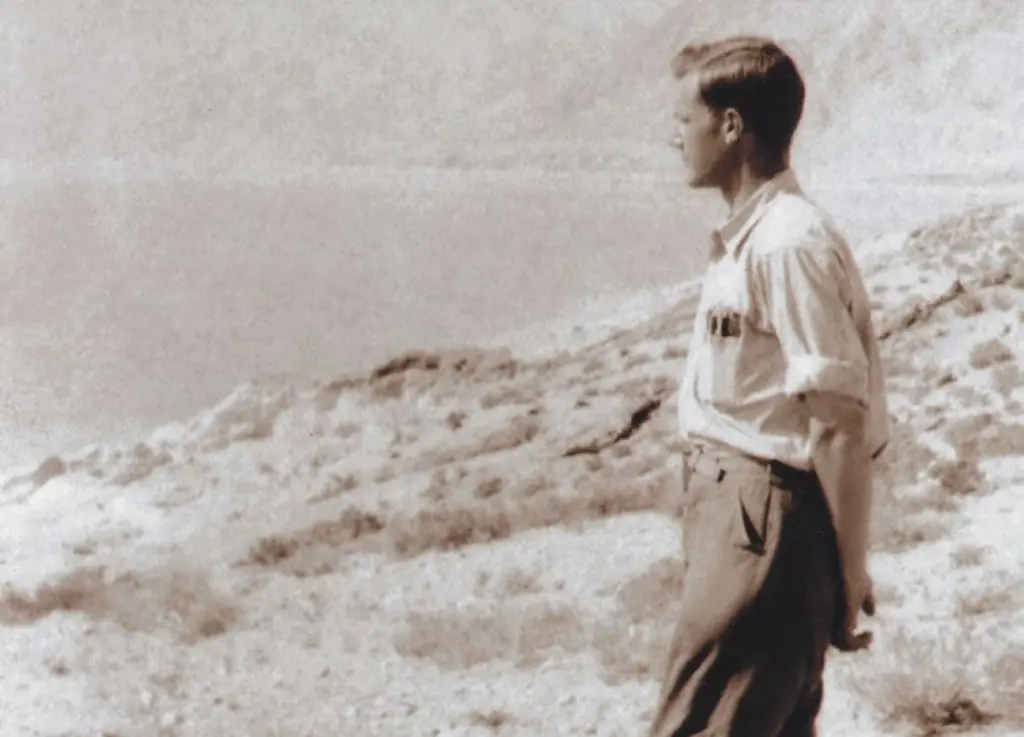
I hope you’re inspired by the photo of young Si Muller, looking out beyond Walker Lake, Nevada, fearlessly, circa 1928, wondering what would be found in the stratigraphy over the next hill. In one of those hills, he found the first Ichthyosaur in Nevada, one of his many game changing discoveries in his long and decorated career.
So keep exploring over that next hill, AAPG community, with persistence, tenacity – and don’t forget grace.
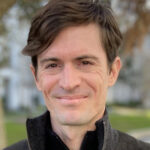
Jonathan R. Rotzien is President of Basin Dynamics. He has worked in most of the world’s petroleum producing regions and specializes in leading corporate projects, research programs and professional training courses pertaining to oil and gas exploration and production. In addition to his business, he serves in faculty and research roles at University of Houston, University of Texas at Austin, South Dakota Mines and The Drifters Research Group with the Andalusian Earth Sciences Institute. He currently holds consulting appointments with Hot Energy Group, based in Leoben, Austria, and Subsurface Consultants & Associates in Houston. With more than 100 publications including short courses, his most recent works include Deepwater Sedimentary Systems: Science, Discovery and Application (Elsevier, 2022), written by 62 authors from 20 countries, and the second edition of The Explorer’s Mindset: Lessons in Leadership in Applied Geoscience and the Energy Industry. He holds a bachelor’s from Colorado College and a doctorate from Stanford University.
This article is the sixth of the monthly articles on The Explorer’s Mindset prepared for AAPG Explorer. This column is based on the second edition of the book The Explorer’s Mindset: Lessons in Leadership in Applied Geoscience and the Energy Industry. Over the ensuing installments, we’ll be looking at the traits of the successful explorer, their leadership qualities and what has enabled them to make game changing discoveries.