
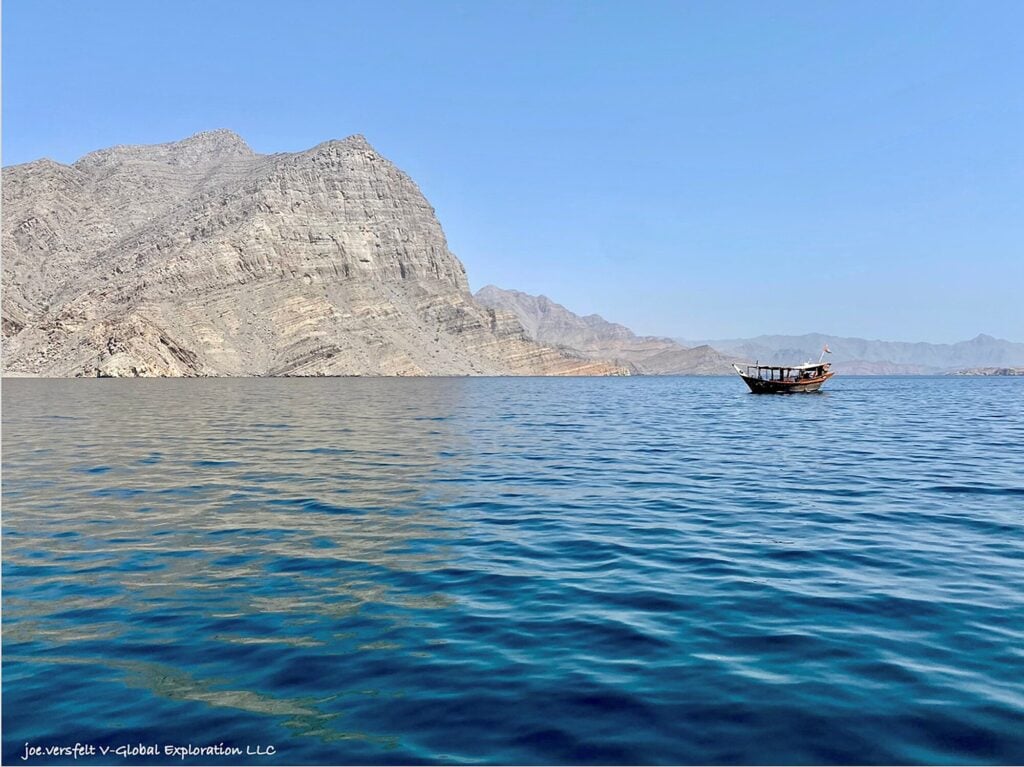
Contrary to what you might see or read on social media, the Strait of Hormuz has not “opened” by continental rifting between Iran and Oman. This waterway is the locus of converging plate tectonic interactions between the Arabian and Asian plates and offers a natural laboratory to study plate tectonic subduction and collision.
Since February, when the United States and Israel launched attacks on Iran, the Strait of Hormuz has been in the news daily. This narrow waterway, only 60- to 24-miles wide, is the passage for one-fifth of the world’s oil transportation, or about 20 million barrels per day. According to the International Energy Agency, 80 percent of this oil goes to Asian markets; however, any major disruption in oil flow impacts the global economy because of the international connectedness of the oil industry.
How did the Strait of Hormuz form?
At first glance, it might seem that tectonic forces shaping the region did not open this waterway wide enough to leave more room for sailing. However, over tens of millions of years, the Middle East has been under compressional and “closing” plate tectonics.

Strategic Geography
The Strait of Hormuz is bordered by Iran and Oman. Recent disruptions aside, the waterway has historically been open to international sailing. Water-depth increases from the Iranian coast toward Oman range from 160 to 330 feet.
Situated between the Persian Gulf and the Gulf of Oman, the Strait of Hormuz has always been a critical east-west connection for commerce and seafaring. For instance, The Periplus of the Erythraean Sea, written by a Greek sailor in the 1st century AD, mentions that in “this mouth of the Persian Gulf, there is much diving for pearl-mussel.”
What’s in a Name?
The word “Hormuz” is a shortened Persian form for the Zoroastrian god Ahura Mazda (Lord of Wisdom). The name has been given to several ancient Persian kings and princes, the 11th-century Hormuz Kingdom centered on the Hormuz Island, and to the Hormuz Salt, which is a Infracambrian (635 to 539 million years ago) evaporite formation at the base of the Strait of Hormuz and its islands.
Structural Framework
The Strait of Hormuz is a promontory between the Arabian and Asia plates and separates two tectonic styles in the region: the Zagros fold-and-thrust belt to the west and the Makran subduction zone to the east. The Zagros Capital Mountains formed via subduction of the Neo-Tethys Ocean during the Cretaceous-Paleogene times and the collision of Arabian and Asian continental plates in the Late Oligocene or about 27 million years ago. The Makran subduction zone and accretionary wedge date to the Late Cretaceous and are basically a remnant of the Neo-Tethys subduction.
The Hormuz promontory, or what is sometimes called the “Hormuz Syntaxis” or “Oman Line,” is structurally characterized by the westward over-thrusting of Musandam Peninsula in Oman and the Dibba strike-slip (transform) fault on the east.
Geological Evolution
The Middle East’s geology has been fashioned by the formation and fragmentation of the Gondwana supercontinent, the subduction and closure of Tethys Ocean offshore the northern margin of Gondwana, and the ultimate collision of the Arabian plate with Asia. The formation of the Strait of Hormuz can thus be summarized within the geological history and tectonic framework of the Middle East region in stages:
- Ediacaran Period (635 to 539 Ma): Extensional basin filled with evaporites and volcanics
- Paleozoic Era (540 to 251 Ma): Shallow marine sedimentation
- Late Permian (260 to 250 Ma): Opening of the Neo-Tethys Ocean
- Middle-Late Jurassic (175 to 143 Ma): Fragmentation of the Gondwana supercontinent and subsequent northward movement of the combined African Arabian plate
- Late Cretaceous (94 to 72 Ma): Obduction of the Samail Ophiolite in Oman
- Eocene (56 to 34 Ma): Overthrust of Musandam Peninsula along the Hagab thrust
- Late Oligocene (27 to 23 Ma): Closure of the Neo-Tethys and the continental collision of Arabian and Asian plates along the Main Zagros Thrust
- Miocene-Recent (23 to 0 Ma): Continental rifting along the Gulf of Aden and Red Sea, separation of Arabian plate from African plate, formation of the Zagros fold-and-thrust belt, uplift of Zagros Capital Mountains in Iran, and the superposition of the Zagros foreland basin atop the buried Neo-Tethyan platform.
Sea-Level Changes
During the glacial ages over the past 2.5 million years, sea levels were much lower and hence the Strait of Hormuz was even narrower. During the Holocene epoch, or in the past 12,000 years, as the ice melted, sea levels in the Strait of Hormuz also rose. For example, a study in Quaternary International indicates that the sea level rapidly rose in the Strait of Hormuz by 100 feet to its present level between 9,000 and 6,500 years ago.
Unique Tectonic Corridor
The Strait of Hormuz marks a complex tectonic corridor between the Arabian-Asian plate collision manifested in the Zagros Mountains to the west, the Neo-Tethyan Oman ophiolites and Neo-Tethyan platform sediments to the south, and the Makran subduction to the east. This tectonic zone is an active deformation zone and provides a unique situation to investigate plate tectonic processes. The region, as a recent paper by Majid Alipur in Results in Earth Sciences discusses, is home to the world’s most abundant oil and gas province.