
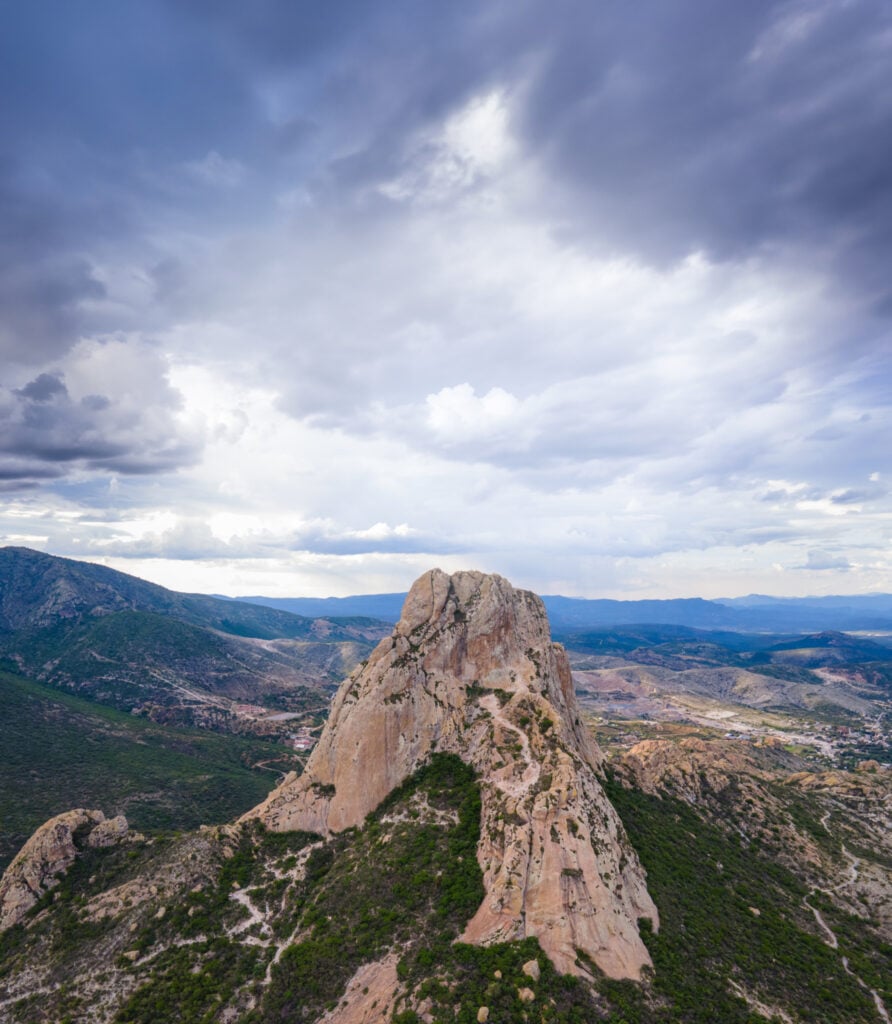
Though it doesn’t offer the coastal draw of Cancún, Tulum, or Puerto Vallarta, San Miguel de Allende in the central Mexican state of Guanajuato has become a renowned tourist destination in recent years (Note: The U.S. government has issued a travel advisory for Guanajuato. Make sure to investigate the area’s current safety status before traveling). Known for its rich history as a UNESCO World Heritage site, as well as its vibrantly colored churches, San Miguel de Allende is among the safest destinations in Mexico and is filled with a wealth of cultural attractions. A little more than two hours away in the neighboring state of Querétaro, hiking and geo-tourism await at Peña de Bernal.
About Peña de Bernal: With its highest point at 433 meters, Peña de Bernal is one of the tallest monoliths in the world and was declared an Intangible Cultural Heritage of Humanity Patrimony in 2009. It is also the entrance to the Sierra Gorda mountains, which were declared a UNESCO Biosphere Reserve in 2001.
Some studies indicate Peña de Bernal is a dacitic dome. One research paper published in Geosphere says of the geology, “Peña de Bernal is located at the intersection of three major geologic provinces: the Miocene–Quaternary Mexican Volcanic Belt, the mid-Tertiary Sierra Madre Occidental ignimbrite-dominated sequence, and the Mesozoic Sierra Madre Oriental fold-thrust belt, which in this area corresponds to the Sierra Gorda sector.
“Peña de Bernal is a highly crystalline and very resistant rock, gray to light gray when fresh and brown when weathered. It is composed of up to 80 percent volume in crystals and 20 percent volume of matrix glass; phenocrysts make up to 30 percent volume of the total. Mineralogy includes plagioclase, orthopyroxene, hornblende, biotite, sanidine, quartz, Fe-Ti oxides, apatite, and zircon. It has a porphyritic texture with phenocryst content varying within 15–30 percent volume.”
Trip Tips
Getting there: You’ll need to fly into Querétaro airport to visit San Miguel de Allende and Peña de Bernal. From there, you can drive or take a bus or BlaBla Car (basically a shared Uber for longer trips) to San Miguel de Allende.
Meals in Querétaro
If you have time to stop for lunch or dinner in Santiago de Querétaro after you land, I’d recommend eating at Tikua. If you’re feeling really adventurous, the escamoles (ant larvae) are a surprisingly tasty and creamy choice, or, if you’d like a more conventional dish, you can’t go wrong with the Chukwa, a battered and fried Mulato chile stuffed with Oaxacan string cheese, a chocolate sauce, and toasted almonds.
For breakfast, Mirthala is the perfect choice. Located near the town’s historic aqueduct built in the 18th century, this café offers many coffee options, whether you enjoy café solo (black coffee), café de olla (coffee steeped with spices), or a latte de cajeta (latte with a sweet honey and cinnamon flavor). Fresh regional fruit and any of the venue’s chilaquiles (a sort of breakfast nacho-type of meal) are among the many breakfast options.
Visiting Peña de Bernal
I’d recommend booking a day tour to Peña de Bernal from Querétaro or San Miguel de Allende. There are many options that include guides to safely drive you to the site and show you the highlights.
Hiking: Only guided mountain climbing tours make it to the top of the monolith. Self-guided hikes start about 20 minutes outside of the center of the town of Bernal. You can follow signs to the trailhead. At the entrance, you’ll need to pay an entrance fee of 60 pesos (about $3 USD). The hike to the highest viewing point, including time to take in the scene, is about two hours, and the last entrance is at 3 p.m. Note the hike does include stairs, scrambling over rocks at high heights, and a section that requires holding on to a rope for stability. Read: It’s an advanced hike. If you are afraid of heights or not the most sure of foot, you might want to take in the scenery from the base of the monolith.
Visiting the cathedral in San Miguel de Allende: Spend some time in San Miguel de Allende walking through its famous church and cobblestoned streets.
- Enjoy the cafés and boutiques on every corner. I’d recommend stopping at Café Umurán for breakfast. The café de olla here has a slight citrus twist worth experiencing, and the staff are extremely welcoming and accommodating.
- Another vibrant chapel inside the city is Lavaderos del Chorro. If you have time to make your way there, it is worth a quick look.
- The roads travel through steep hills, and the cobblestones are not stroller or stylish-shoe-friendly. Plan to trek in your sneakers and bring a baby carrier for any little adventurers.
- Temperatures range widely in some parts of the year. The mornings can start off at 45 degrees, and by 3 p.m. it could be in the low 80s. Layers and sunscreen are your best bet for those seasons.