
Venezuela is back in the spotlight of oil exploration and production growth. Since 2015, the country’s oil production has drastically dwindled. A 2016 U.S. Geological Survey assessment puts yet-to-discover and technically recoverable reserves in the Maracaibo Basin alone at 656 million barrels of oil and 5.7 trillion cubic feet of gas. Classic literature still forms the cornerstone of our geological knowledge of Venezuelan basins.
The February issue Explorer focused on oil in Venezuela, and this month, AAPG is organizing a Venezuela symposium in The Woodlands, Texas. AAPG Bulletin, which is celebrating its 110th volume this year, has published 152 papers on Venezuela from 1917 through 2025. One of these papers, “Geology of the Maracaibo Basin,” published in October 1946, is (according to my research) the longest paper ever published in the Bulletin. It has 120 pages of text and 45 pages of maps and illustrations, totaling 165 pages!
Meet the Author
Who was the man who published the longest paper in the history of the AAPG Bulletin?
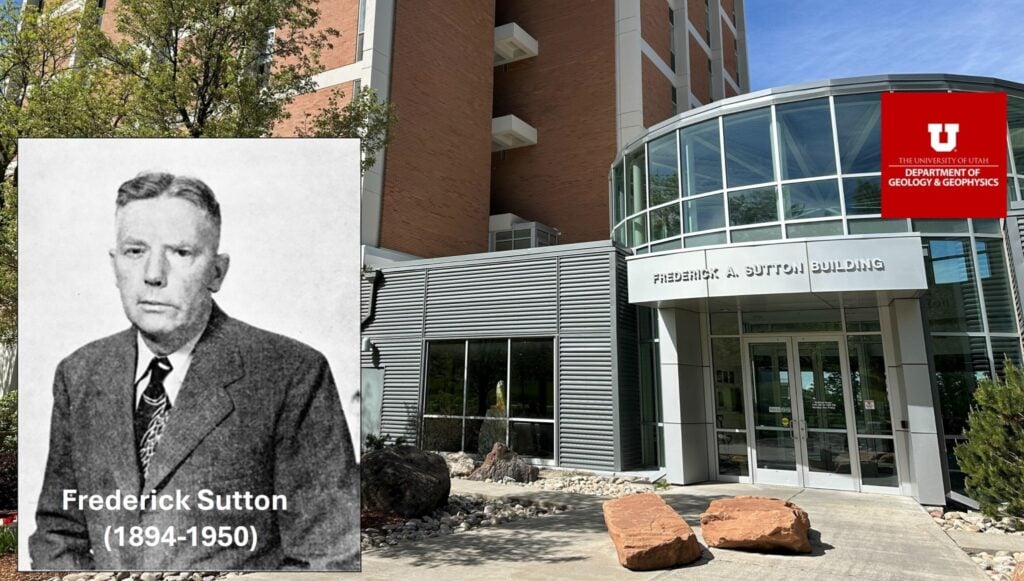
Frederick Albert Sutton was born in 1894 in Salt Lake City and graduated in mining engineering from The University of Utah in 1917. After fighting in World War I, Sutton worked from 1919 to 1921, successively, for Utah Railroad, Midwest Oil Company (Utah), and Utah Oil Refining.
He then joined Tropical Oil Company in Colombia, where he worked until 1924. This period opened a new chapter in his life, both professionally as he moved to Latin America and personally as he married Anne Loumina Newman, a teacher in Salt Lake City, in 1923. The couple had two daughters, Shirley and Marta, who were born in Argentina when Sutton worked for Standard Oil Company of New Jersey from 1925 to 1935, supporting his extended family in the United States through the Great Depression. From 1937 to 1938, Sutton worked for Standard Vacuum Oil Company of New York in China. Then, he joined Creole Petroleum Corporation in Venezuela, where he worked until 1949.
Sutton’s AAPG Bulletin paper on the Maracaibo Basin, which he first presented at the AAPG Annual Convention on April 3, 1946, was the synthesis of three decades of research work conducted by Creole Petroleum. “The writer undertook the assignment,” Sutton acknowledged in his paper, “at the suggestion of G. Zuloaga, manager of Creole’s exploration department.”
Sutton died in April 1950 in Salt Lake City at age 56 due to cerebral thrombosis. He had been planning to retire in August 1951.
In 2009, Sutton’s daughter Marta donated more than $12 million to construct the Frederick Albert Sutton Building, home to the Department of Geology and Geophysics at The University of Utah.
Maracaibo in the AAPG Bulletin
Sutton’s was not the first paper on the Maracaibo published in the Bulletin. Ralph Alexander Liddle (1896 –1963) had published “Tectonics of the Maracaibo Basin” in the February 1927 issue. Liddle situated Venezuela at the northern edge of Gondwana
Hollis Hedberg also published a paper in March 1931. Hedberg, then working for Venezuela Gulf Oil Company, characterized the Cretaceous age carbonaceous limestone of La Luna formation as “source rock” in which oil is “indigenous.” Hedberg (1903–1988) was an eminent petroleum geologist. AAPG Hedberg conferences were held in his honor from 2001 to 2020.
A benchmark AAPG publication on Maracaibo Basin is the April 2006 special issue of the Bulletin edited by Paul Mann and Alejandro Escalona. This volume in 10 papers details the structural and stratigraphic evolution as well as petroleum systems of Maracaibo. The contents originated from theses by graduate students at The University of Texas at Austin.
Why So Much Oil in the Maracaibo?
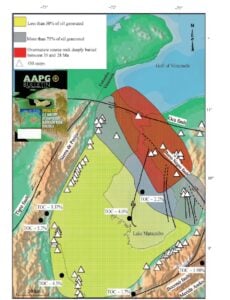
Even early geologists knew that Maracaibo was a highly petroliferous basin. Sutton estimated the “total remaining proved reserves of the basin” to be more than 5.5 billion barrels after producing 2.2 billion barrels by 1945. The 2006 Bulletin paper reports the cumulative oil production of more than 30 billion barrels and estimated ultimate oil reserves of more than 44 billion barrels.
Like the Zagros Basin in Iran, Maracaibo is characterized by superposition of a foreland basin atop continental passive margin. After a Jurassic rifting, continental shelf sediments, including the petroliferous La Luna Formation, were deposited during the Cretaceous. This was followed by compressional tectonics, deposition of massive clastic sediments, and creation of petroleum traps. In the Paleogene period, an oblique collision occurred between a Caribbean island arc and the northern margin of South America. In the Neogene, Andean uplift and strike-slip faulting complicated the structural framework of the Maracaibo.
While the Maracaibo will continue to be a prolific petroleum basin, its ecological sustainability must also be considered. A recent article by Matthew Smith on OilPrice.com discusses how decades of unregulated oil operations have heavily polluted the lake and its surroundings.