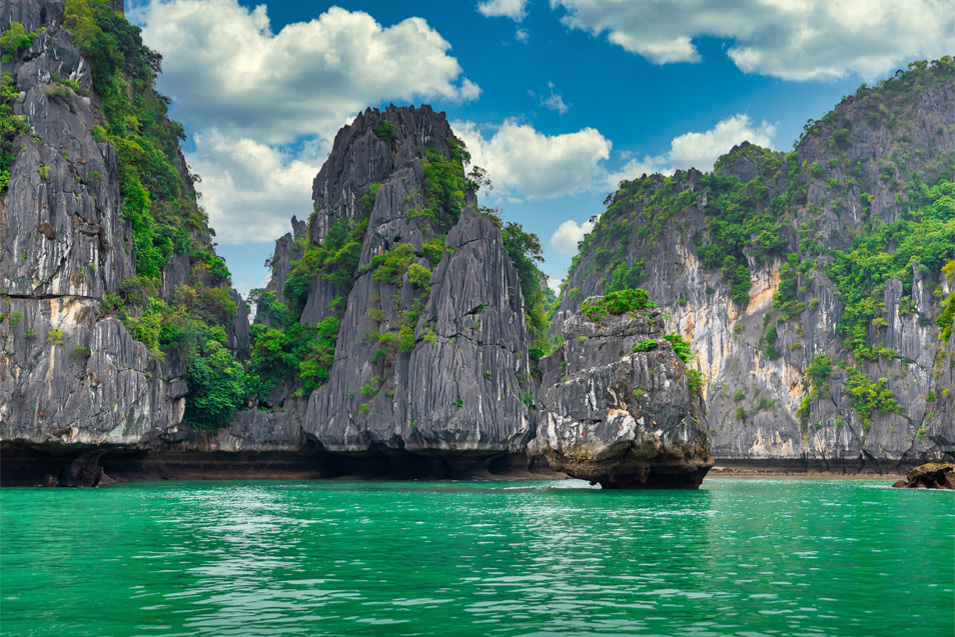
Roughly four hours east of the hustle and bustle of hundreds of motorcycles in Hanoi, Cát Bà Island provides the perfect quiet escape during any Vietnam visit – and it is home to some of the country’s most incredible geological scenery.
Getting there: From Hanoi’s Old Quarter, you can arrange a bus or van (the Vietnamese often call the vans limousines, but they are not what we in the United States would think of as limousines). These will take you to either a ferry station or a cable car, depending on weather and your ticket. The bus/van company will meet you on the other side of the bay and drop you off at your specified destination on Cát Bà.
Getting around: While Cát Bà Island is relatively small, you will not find Ubers, taxis or readily accessible public transit there. You’ll want to rent a motorcycle to buzz around the caves, beaches and small towns. You can find them for roughly $4 per day, plus gas. You can see most of what the island has to offer in a day or two.
Lan Ha Bay and Cai Beo Fishing Village: I would recommend starting your journey through Cát Bà by riding through the town with the same name. Enjoy the views of the ocean and the famous, and massive, limestone towers, called karst formations, all around. Near the dock on the southeastern side of the island, you can pay to take a boat around Lan Ha Bay. We paid around $12 to sail around the bay for an hour.
Lan Ha Bay is an extension of Ha Long Bay, a UNESCO World Heritage site where many tourists take weekend luxury or party cruises. Lan Ha Bay is far less trafficked, but equally as beautiful, made up of 300 karst islands and limestone sea rocks.
Five hundred million years ago, during the Paleozoic era, the area that is now Ha Long Bay was completely submerged in the sea. Since then, the area has undergone continual weathering from the country’s ample rainfall, chemical processes (the calcium carbonate in limestone interacts readily with weakly acidic water), wind, waves and tidal currents, creating the karst formations, grottos and caves seen today.
While sailing the bay, make sure to pass by Cai Beo Floating Village, where fisherman families have lived literally on the water, in boats and structures supported by buoys, for more than 7,000 years. It is one of the only remaining villages of its kind in Vietnam, and roughly 400 families still live there today. If you’re lucky, you’ll see one of the residents rowing a boat with their feet.
Historic caves: The northern part of the island is home to a couple of caves worth a visit. The first, often called the “Hospital Cave” in English or “Hang Quân Y” in Vietnamese, is located high up in one of the limestone formations. Pay the small entrance fee, climb the steep stairs and meet the attendant, who will give you a tour of the cave that was used as a secret hospital for North Vietnam’s army during the Vietnam war. Despite being a full three stories and equipped with drainage and ventilation, the cave was never found by the Americans during the war. The first floor is home to 14 functional rooms, including treatment rooms, a break room, waiting room and operating room. The second floor, with its stalactites and big open area, was used as a physical training area for soldiers. The third floor, currently off limits to visitors due to structural integrity issues, was a secret meeting room for military leaders during the war.
If you continue up the road to the north, there are a few more caves, including Trung Trang Cave. You’ll need to get there by at least 3 p.m., as it takes two hours to visit these caves, and the park closes at 5 p.m. Trung Trang is among the most impressive caves in Vietnam: it’s about 300 meters long and has thousands of stalagmites and stalactites in various shapes and colors. Fun fact: When it was first found in the early 1900s, it was filled with bats, and the locals called it the Bat Cave. It was later renamed the Navy Cave, (after Batman left, just kidding) as it became a secret base for the naval command from 1964–1968.
Finish your journey by riding to the end of the main road and back. You will pass through tons of beautiful karst formations and a couple of small villages before arriving at a dock on the northern side of the island. Keep an eye out for flocks of small white ducks that the villagers keep. They can be funny to watch for a couple minutes, as they tend to all move in unison and look quite different from any ducks I’ve ever seen in the United States.