

Most Americans would associate the Genesis project either with “Star Trek” or, somewhat more recently, with NASA as part of the space agency’s former satellite program. But the United States has an ongoing Genesis Mission today with billions of dollars committed to scientific research, including energy research.
So far, much of the energy funding is directed toward nuclear-power development and artificial intelligence applications.
Recently, the U.S. Department of Energy announced its selection of 278 projects for funding under the research initiative, backed by $5 billion in federal commitments. The response set a record for DOE, which received more than 5,000 funding applications.
“The remarkable number of high-quality proposals we received shows that America’s innovation pipeline is strong, and it points to even greater opportunities for future investment and continued expansion of the Genesis Mission portfolio,” said U.S. Energy Secretary Chris Wright.
A stated goal of Genesis is to double the productivity and impact of American science and engineering within a decade, by integrating AI into “transformative scientific discovery.”
The Genesis Mission Consortium now includes all 17 DOE national laboratories, five National Nuclear Security Administration sites and 41 industry, nonprofit and philanthropic organizations. Through the Consortium, Genesis also has secured more than $800 million in committed partner support, according to DOE. In addition to direct funding, those commitments include computing resources and credits, access to AI models, cloud infrastructure, scientific expertise and research partnerships.
AI Integration
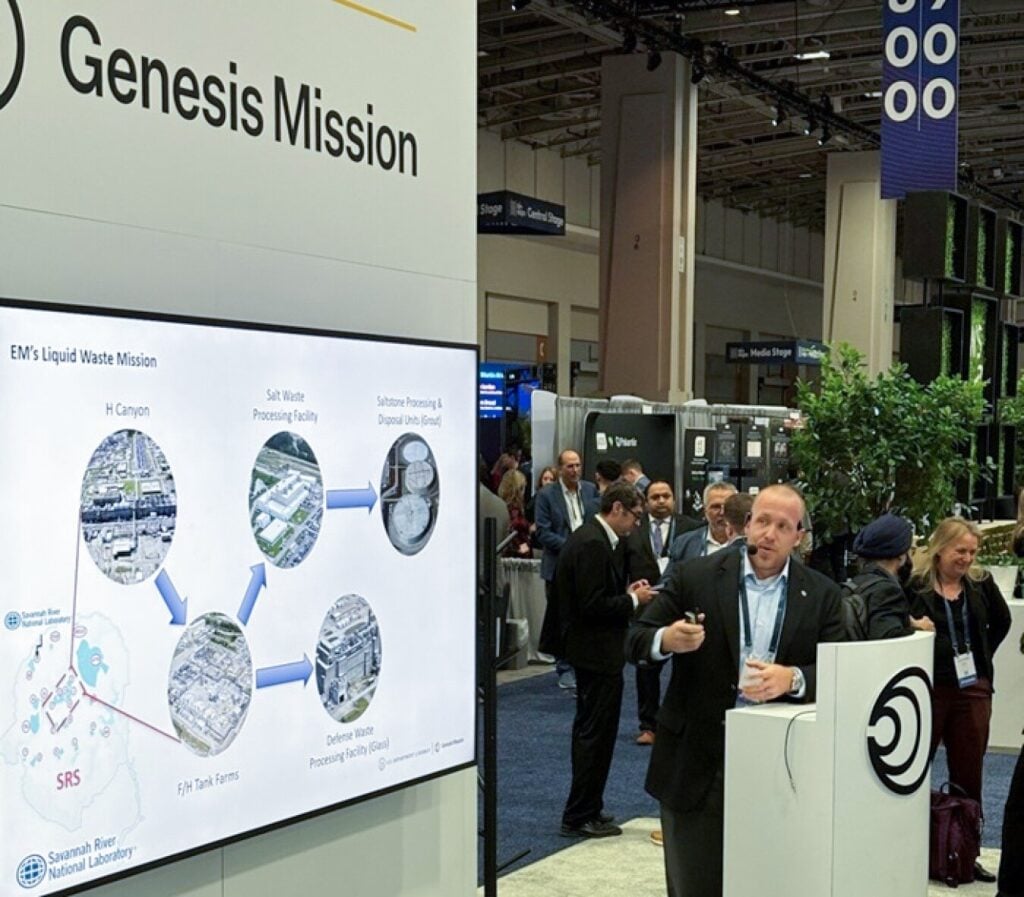
A key component of the research mission is to combine and leverage data held by federal agencies. In one example, the Department of the Interior plans to integrate its ongoing data collection efforts across subsurface energy, critical minerals, biological systems and water.
“Harnessing AI as a scientific tool will revolutionize the way scientific research is conducted. Doing so requires large amounts of organized, high-quality data and significant computing power, resources that already exist within DOE’s national laboratories and across the federal government,” DOE representatives noted.
The research program has established a Genesis Data Team to build “a scalable data foundation that integrates scientific data across various environments, facilitating efficient data sharing while ensuring provenance and quality.”
Two primary goals of the effort are, first, interoperability and data standards, and second, data assurance and integrity. “Interoperability” addresses the challenge of combining government data that exists in many different formats – some of them obsolete – and data accessed through various interfaces.
One of the Genesis objectives seeks to use AI to analyze more than 150 petabytes of data collected by NASA from telescopes, orbiters, landers and satellites, to integrate observations and unlock new discoveries. (A petabyte is equal to one quadrillion bytes.)
Some scientists have criticized the Genesis Mission program for promoting a “Silicon Valley mindset” and emphasizing speed and timetables over ongoing research. Critics worry it will continue to shift research activity away from universities. And some researchers note, and oppose, the program’s heavy emphasis on AI.
Stealing Fire from the Gods
So far, Genesis Mission funding has been approved for 342 participating institutions, including 157 companies, 142 universities, 16 national laboratories, 13 nonprofit organizations and 14 other institutions.
In August, DOE announced plans for a Fusion Science and Technology Roadmap, a comprehensive national strategy to accelerate the development and commercialization of fusion energy by the mid-2030s, without committing to specific funding levels.
The Idaho National Laboratory in Idaho Falls received the largest single Genesis award – $60 million over three years, subject to appropriations, for the nuclear energy Prometheus project. Prometheus is a collaborative effort among five national laboratories, 20 industry partners and academia.
It will use AI in designing, constructing and operating nuclear reactors with human-in-the-loop workflows, integrate AI into nuclear fuel fabrication and use AI for nuclear-legacy document management. Prometheus also has raised commitments for more than $200 million in industry cost-sharing and $30 million in industry capital.
DOE also continues to fund research projects directly involving oil and natural gas production. In July, it announced additional grants up to $150 million in support of cost-shared projects aimed at three critical priorities in the industry:
- Improving recovery efficiency from unconventional oil and gas reservoirs: “Funding in this area will support the rapid field deployment of novel technologies and processes – including exploring the potential of carbon dioxide as an injectant – to improve oil and gas extraction, increase the recovery factor and lower the break-even cost,” DOE reported.
- Advancing hydraulic-fracture characterization technologies: The funding “will support advanced diagnostics and characterization technologies to improve operational effectiveness and enhance resource recovery” related to fracture propagation, proppant behavior and well diagnostics, DOE noted.
- Developing innovative solutions for produced water management: Research in this area will address “field testing of advanced produced-water treatment technologies and processes that can reduce subsurface disposal, facilitate beneficial reuse and mitigate associated environmental risks,” the Department specified.
The agency noted that Permian Basin operators generated an estimated 22 million barrels of produced water per day in 2025 alone. It set an application deadline of Sept. 8 for all three program areas.
DOE then added a $65.5-million funding package for research to increase the value of stranded and underutilized hydrocarbon resources and to enhance supply-chain durability and reliability. The grants also are aimed at accelerating adoption of digital technologies and advanced analytics.
Harnessing AI for Science
Some Genesis Mission funding proposals have combined different types of energy research, including nuclear and oil and gas. Los Alamos National Laboratory in New Mexico was selected for seven project awards.
On the nuclear side, the proposals include developing an autonomous AI framework for closed-loop nuclear fuel qualification and AI-guided life prediction for fusion structural materials. In hydrocarbons, Los Alamos proposed building an AI-enabled decision-support platform for stimulation design, fracture characterization and production optimization, with a goal of doubling recovery.
Application of AI is a primary objective of the research efforts. First announced in November 2025, the Genesis Mission was described by the White House as a DOE effort to harness AI for science. The research program then expanded to include more than 15 federal agencies using the DOE-built American Science and Security Platform.
When DOE issued the initial Genesis $293-million request-for-application program in March, it emphasized proposals aimed at developing breakthrough technology, novel collaborations, interdisciplinary teams and leveraged AI models.
“America’s greatest scientific achievements have been born of national mobilizations paired with the construction of new institutions,” said Michael Kratsios, director of the White House Office of Science and Technology Policy. “The Genesis Mission is the next chapter in that tradition, as we work together to harness AI for scientific discovery at a scale no one else on the planet can match.”