
It’s easy to sum up the outlook for world crude oil prices: At this point, nobody has much of a clue.
Is the outlook for natural gas any clearer?
Based on recent reports and projections, the answer is, “Yes.” Sort of. Analysts don’t agree on all the details, but there’s a solid consensus about the current and near-term picture for gas.
It starts with a mild surprise. Demand for both LNG supply and power generation related to data centers was supposed to make 2026 a strong year for natural gas in the United States. That hasn’t happened so far, at least in the first half of the year.
Demand Decline
Energy analytics company Enverus reported that U.S. gas consumption declined 2.5 billion cubic feet a day in the first quarter of the year compared with the same period in 2025, led by residential, commercial and industrial weakness. Gas-fired power generation increased about 0.8 Bcf/d, lower than expected.
“Global gas demand is expected to fall by around 0.5 percent in 2026, marking its third annual decline this decade,” according to the International Energy Agency’s Gas Market Report for the third quarter of 2026.
Conflict in the Middle East disrupted LNG supply and accounted for part of the demand decline. Some Asian countries partly switched from gas-fired power generation to coal, and natural gas also saw competition from renewables, especially solar.
“The closure of the Strait of Hormuz has led to cutting off Qatar LNG from the global gas market,” noted Josephine Mills, senior analyst at Enverus Intelligence Research.
“Qatar accounted for 10 Bcf/d of exports or 20 percent of the LNG market. About 80 percent of the exports went to Asia, therefore we have seen Asian countries paying up for volumes on the spot market – outbidding Europe – resulting in higher international gas prices, demand rationing and gas-to-coal switching,” she observed.
Middle East natural gas consumption will contract by around 4 percent in 2026, the IEA predicted, its first annual decline since 1993. Asian gas demand will shrink by 0.5 percent, partly because of “reduced operating rates across gas- and energy-intensive industries.”
“In Europe, strong growth in renewables power output, together with higher gas prices, is expected to reduce gas demand by more than 2 percent for the year as a whole,” the IEA reported.
“In the U.S. we’ve observed behind-the-meter (BTM) solar offsetting gas-fired power generation. In Asia, the predominant market impacted by shut-in Qatari LNG, we saw demand rationing or gas-to-alternative supply switching for power generation,” i.e., gas-to-coal fired generation, Mills noted.
So, there’s no boom time for U.S. natural gas right now. In addition to other factors, data center buildout has been slower than expected, with opposition to data center construction surprisingly fierce in some areas. Mills said Enverus had forecast demand from BTM data-center growth in the United States to reach about 0.4 Bcf/d by exit-2026.
“Compared to what some forecasts have suggested, we are more conservative on the growth expected from data centers, particularly when compared to the magnitude of LNG export capacity coming online annually,” Mills noted.
U.S. Demand
In the United States, LNG demand has been something of a lifeline for natural gas. Enverus estimated LNG flows increased 3.6 Bcf/d in the first quarter of this year compared to a year earlier, absorbing almost 80 percent of the 4.6 Bcf/d domestic gas production increase over the same period.
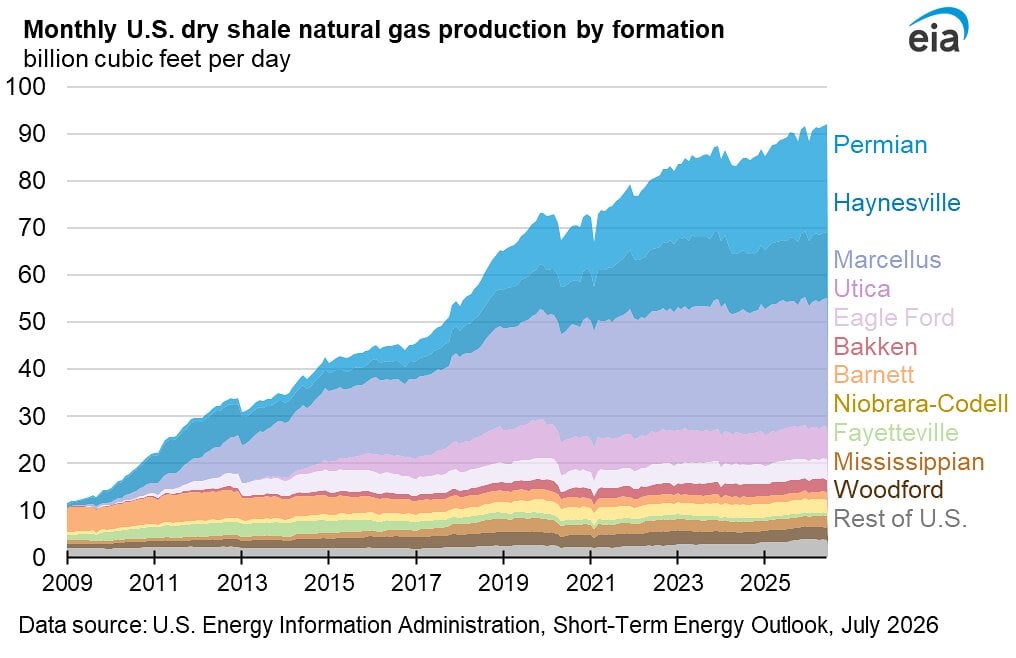
In its latest Short Term Energy Outlook, the U.S. Energy Information Administration forecast that natural gas demand across the U.S. economy will rise only slightly this year before increasing 3 percent in 2027.
“We expect U.S. natural gas consumption in the electric power sector will set a record next year, driven largely by rising overall electricity demand, the expansion of the natural gas generating fleet and relatively low natural gas prices,” it predicted.
The EIA foresees record U.S. production helping meet increased demand and putting moderate downward pressure on natural gas prices. The average Henry Hub spot price likely will decline below $3.50/million Btu next year, down slightly from 2025, it forecast.
New gas pipelines and increased pipeline capacity, especially out of the western Permian Basin, have helped boost U.S. gas supply. And the EIA has identified another reason for higher associated gas production from the basin.
It reported from 2021 to 2025, the Permian’s marketed natural gas production grew from 17.2 Bcf/d to 27.6 Bcf/d, a 60-percent increase. In the same period, Permian crude oil production grew by 39 percent.
“The higher growth in natural gas production is the result of increasing gas-oil ratios (GOR). As more oil and natural gas are produced, pressure within the reservoir declines; natural gas is easier to produce at lower pressures and the GOR increases,” the EIA noted.
U.S. natural gas producers will probably need to look beyond the next 12 months for a better price outlook. Mills expects relief to materialize at some point, mainly because LNG and other Gulf Coast demand will require higher gas production out of the Haynesville Shale play.
“As LNG export capacity expands, we see a call on the Haynesville to grow, given the limited egress or running room from other plays. The Haynesville is your marginal molecule, so (it) requires a higher price to incentivize production growth longer term,” she noted.
End of the Cheap Gas Era
Beyond that horizon, U.S. producers could be getting an ever bigger long-term price lift. In July, energy research consultancy Wood Mackenzie issued a new report, “Defying gravity: why U.S. Henry Hub natural gas prices are set to rise.”
“The decade of cheap Henry Hub gas is coming to an end,” Woodmac proclaimed. It forecast Henry Hub natural gas prices will approach $5/MMBtu by 2035.
“Rapid play development, near-zero-cost associated gas and year-on-year productivity gains drove (the) era of cheap, stable prices. Those tail winds have largely run their course,” said Kristy Kramer, Wood Mackenzie’s head of LNG strategy and market development.
“Power sector demand alone is calling for an additional 17 Bcfd (billion cubic feet/day of supply) by the mid-2030s, and the highest-quality acreage is already in production. Prices will need to rise to grow supply from here,” she added.
The Global Picture
Right now, war in the Persian Gulf region has damaged LNG production and curtailed Middle East energy shipments, leading to fuel-switching, suppressed LNG use and higher LNG prices. Lower than expected power-generation demand, competition from renewables and record gas production has put a lid on U.S. natural gas prices.
Enverus advised keeping an eye on U.S. gas storage levels. If power-sector demand remains weak, incremental storage could increase by about 200 billion cubic feet, reducing the price outlook by roughly $1/MMBtu.
Meanwhile, according to Mills, “weaker than expected domestic demand is offsetting high LNG exports, which, along with strong gas production, will keep prices suppressed and disconnected from the strong global gas prices that we forecast to persist through the summer.”