
For anyone who enjoys irony, there’s a wonderful story unfolding in Maine. It’s part of the larger picture of lithium supply in the United States. And that’s a darned good story all by itself.
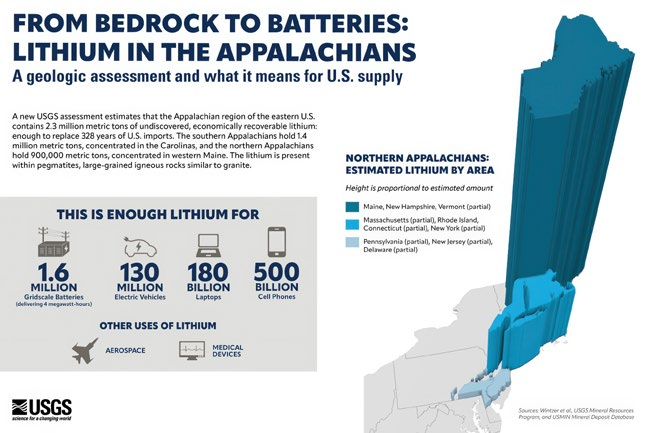
The U.S. Geological Survey recently released an estimate of 1.43 million metric tons of economically extractable lithium oxide deposits in the southern Appalachian region and 900,000 metric tons in the northern Appalachians. The lithium is found in coarse-grained pegmatites, USGS reported, with highest ore concentrations in the Carolinas, New Hampshire and Maine.
Background came from a 2025 USGS scientific research paper, “Quantitative Mineral Resource Assessment of Lithium Pegmatite Deposits in the Northern Appalachian Orogen,” published in the journal Natural Resources Research.
“This research shows that the Appalachians contain enough lithium to help meet the nation’s growing needs – a major contribution to U.S. mineral security, at a time when global lithium demand is rising rapidly,” said USGS Director Ned Mamula.
“The United States was the dominant world producer of lithium three decades ago, and this research highlights the abundant potential to reclaim our mineral independence,” he added.
Stories began appearing in the local Maine media five years ago about a substantial lithium deposit in the state. A couple hunting for gems in western Maine had found a large quantity of lithium-bearing spodumene crystal and wanted to extract it commercially.
A critical element in today’s world, lithium in rechargeable batteries helps power everything from cell phones and toothbrushes to electric vehicles. Lithium alloys are used to create lightweight, high-strength materials. Lithium compounds are important in medicine, especially for treatment of bipolar disorder.
“This (lithium production) is an industry that’s growing at a 15-percent growth rate, and it’s ubiquitous,” said Jonathan Evans, president and CEO of Lithium Americas Corp., in an online interview.
“Every universal power supply for a data center has a lithium battery in it. Missles on ships, drones on war fields .. it’s everywhere. And it continues to grow,” he said.
An initial estimate put the value of mining the Maine spodumene at $1.5 billion – if it could be mined.
This story continues on the other side of the country, in northern Nevada, where Lithium Americas is currently developing its Thacker Pass lithium open-pit mine and processing project. The Thacker Pass site sits at the southern end of the McDermitt Caldera, about 60 miles northwest of Winnemucca, Nev.
For fiscal 2026, Lithium Americas has targeted a capital expenditure outlay of $1.3 billion to $1.6 billion for the project’s Phase 1, designed for nominal production capacity of 40,000 metric tons per year of battery-quality lithium carbonate. That capacity is projected to rise to 160,000 metric tons per year over five build-out phases.
“Construction at Thacker Pass is accelerating toward mechanical completion in late 2027,” Evans stated in a recent report.
The Global Lithium Picture
Australia has been far and away the world’s biggest producer of lithium, followed by Chile, China, and Argentina. The United States, which gets most of its raw (unprocessed) lithium from Chile and Argentina, relied on imports for more than half of its lithium use last year, USGS noted.
The amount of raw lithium supply necessary for the United States to import is probably zero. According to the recent USGS release, the Appalachian region and New England – with more than 2.3 million metric tons of economically recoverable lithium – hold enough of the material to replace 328 years of U.S. imports at last year’s rate.
But there’s an even larger potential U.S. supply source. Lithium also can be extracted from brine, and in 2024 USGS researchers found that a total of 5 million to 19 million metric tons of lithium are present in brines in the Smackover Formation of southwest Arkansas, although USGS didn’t assess how much is economically recoverable.
In May, Standard Lithium Ltd. reported it had received final environmental clearance from the U.S. Department of Energy for its South West Arkansas lithium production project, operated by joint venture Smackover Lithium. The joint venture is a 55 to 45-percent partnership between Standard and Norwegian hydrocarbon producer Equinor.
Smackover Lithium plans initial annual production of 22,500 metric tons per year of battery-quality lithium. The first SWA project phase is backed by a $225 million grant from the DOE’s Office of Critical Minerals and Energy Innovation, issued in January.
And the McDermitt Caldera, site of the Thacker Pass operation, could contain 20 million metric tons of lithium carbonate equivalent embedded in clay beds, which would make it one of the world’s largest accumulations.
Currently, the United States has only one significant producing lithium source, the Albemarle Corp. Silver Peak mine in Nevada, according to the U.S. Bureau of Land Management. The mine has produced 5,000 to 6,000 metric tons of lithium annually.
Two years ago, DOE granted a $2.26 billion loan to Lithium Americas (through subsidiary Lithium Nevada Corp.) to help finance the Thacker Pass facilities. DOE later announced the loan was restructured to give the government a 5-percent equity ownership in the form of company warrants.
The United States also got a 5-percent ownership interest in a LAC/General Motors joint venture. GM holds a 38-percent interest in Thacker Pass and has a 20-year offtake agreement for Phase 1 production.
At the same time, the U.S. Department of Defense agreed to buy $400 million of a convertible preferred stock in rare-earth producer MP Materials. The U.S. government became the company’s largest shareholder, with a stake equaling 15 percent of the company’s shares.
Those moves signaled the government’s willingness to back U.S. production and processing of critical materials and rare earth elements, not only with favorable regulations, but also with direct investment.
The Maine Paradox
Meanwhile, back in Maine:
The state has adopted an aggressive plan to accelerate transition to light-duty electric and plug-in hybrid electric vehicles, a move strongly supported by local environmental groups. Maine lithium mining could provide an important resource for EV development.
Maine has extremely strict regulations pertaining to mining, and some members of the Maine legislature have tried to ease restrictions on lithium pegmatite mining in the state. That effort has been opposed by several environmental and conservation groups and some public officials.
The outlook for lithium mining and production in Maine remains uncertain.