
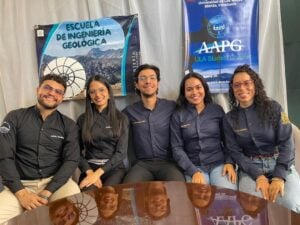
Mario Parra, geological engineering student at the University of the Andes, Mérida, Venezuela, was sitting on a public bus when he got the most exciting news of his academic career.
He had just joined team members competing in the virtual semifinal round of AAPG’s Latin America and Caribbean Region Imperial Barrel Award Competition and decided to head to work while the judges chose the winners.
“I was incredibly nervous and didn’t know what to expect,” he said. Before long, his team captain sent him a text message announcing that his university placed first among 17 teams participating in the region competition.
“I wanted to jump up and scream, but I had to contain myself because of where I was,” he said. “I immediately started texting my closest circle – my family, my partner, my friends, and my colleagues from both the university and work. The excitement was overwhelming. Before finally going into work, I took a detour home just to give a massive hug to my mom and my nephew, who were absolutely overflowing with joy and emotion.”
Interrupting Class
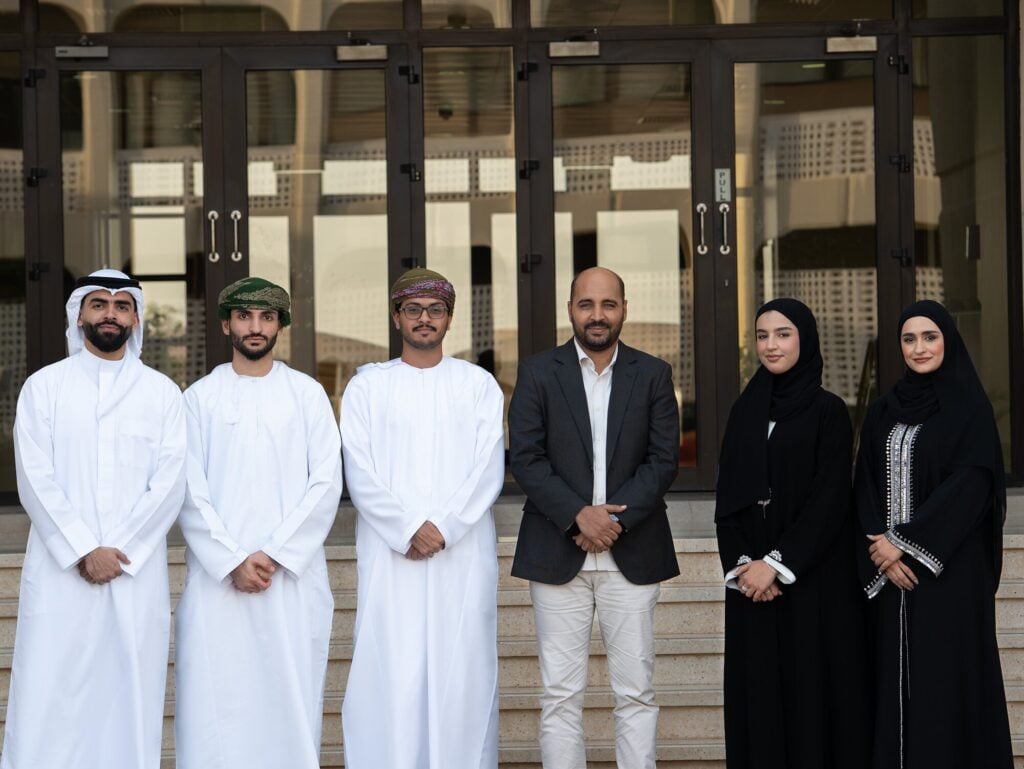
Middle East Region winners from Sultan Qaboos University in Oman got the news while gathered in the lab where they spent 10 weeks analyzing datasets
“The room meant a lot to us because almost every corner reminded us of a discussion, a long working session or a moment we had shared,” said petroleum engineering student and team member Jasim Al Aradi.
“We were excited, but also very nervous because we were waiting to find out whether we had won first place,” he said. “When the results were announced, we all jumped up and hugged each other. It was one of those moments where everyone was celebrating at the same time and no one really knew what to say.”
Team members ran to the classroom where their faculty adviser Mohammed Farfour was teaching.
“We interrupted his class just to tell him that we had won, which made the moment even more memorable,” Al Aradi said.
The Competition
The University of the Andes and Sultan Qaboos University are two of 82 universities who participated in the 2026 edition of the IBA, a basin evaluation program designed to give university geoscience students a realistic, industry-style exploration experience.
Teams work with real subsurface datasets, progressing from regional geological synthesis through prospect generation and ultimately to risk evaluation. Along the way, participants develop not only technical skills but also teamwork, communication, and perseverance essential to a career in the geosciences.
Teams have 10 weeks to work with datasets before presenting them to a panel of industry judges who evaluate both technical aspects of the presentation – regional context, integrated energy systems analysis, wellbore and analog analysis, prospect evaluation and risk assessment, project sustainability – as well as other skills, including teamwork, creativity and innovation.
The competition has two phases: regional semifinals held in six geographical areas – Africa, Asia Pacific, Europe, Latin America and Caribbean, Middle East and U.S. and Canada; and a global final gathering the winner from each group.
Catie Donohue, the Global IBA Committee Chair, described how the IBA competition, now approaching its 20th year, has evolved alongside the industry it represents.
“While the IBA was originally focused exclusively on petroleum exploration, recent competitions have expanded to include geothermal energy and carbon sequestration projects, reflecting the broadening scope of subsurface expertise required in today’s energy landscape,” she said.
The global semifinals feature a range of energy resources. The Africa, Asia Pacific, Middle East and U.S. and Canada Regions teams will present prospects from petroleum datasets. The European Region team will present a geothermal energy project, while the Latin America and Caribbean Region project focuses on carbon capture, use and storage.
Julie Bloxson, associate professor in the Department of Earth Sciences at Stephen F. Austin State University and IBA faculty adviser since 2019 (and newly-elected AAPG vice president of sections), compared IBA to a field camp.
“It’s a culmination experience where multiple classes, which have been siloed for a student’s academic career, come together to create a cohesive geologic story,” she said.
“The difference between IBA and field camp – besides the obvious ‘field’ part – is that IBA is an applied project with direct ties to societal issues that we are and will continue to face with energy security. It is taking field camp for many, placing it in the subsurface with different types of data sets, and telling the students ‘find me an energy resource that will help our future,’ whether it’s petroleum, geothermal or carbon storage,” she elaborated.
Intense Learning Curve
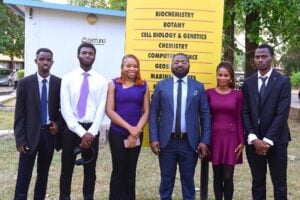
Anthonia Elijah-ifot, geology student at the Africa Region winner, the University of Lagos in Nigeria, said she joined IBA for the opportunity to gain professional experience before graduation.
“I really wanted to see what the job actually feels like outside of a classroom and get a hands-on chance to work with real data,” she said. “Because IBA is a prestigious international competition, I knew it would be a powerful way to boost my CV, put myself out there, and open major professional opportunities in the energy sector.”
Elijah-ifot said building an exploration prospect completely from scratch was an “incredible challenge” for the team.
“The steep learning curve with industry-standard software was a massive hurdle, especially since we had to master programs we had never really worked with before to carry out our evaluation,” she said. “Combining that technical learning curve with intense time pressure working very late into the night just to get the job done and meet our deadlines definitely pushed us to our limits.”
The hard work and late nights eventually paid off. The University of Lagos team beat out 12 other teams to take the Africa Region semifinals and qualify for a place in the Global Competition.
For Elijah-ifot, the most rewarding part of the competition was the sense of fulfillment felt upon finishing the project.
“It was so beautiful and peaceful to look at our final prospect and realize that all our grueling hours, late nights, and intense efforts were not in vain. Seeing it all come together successfully was absolutely rewarding,” she said.
Efficiency and Time Management
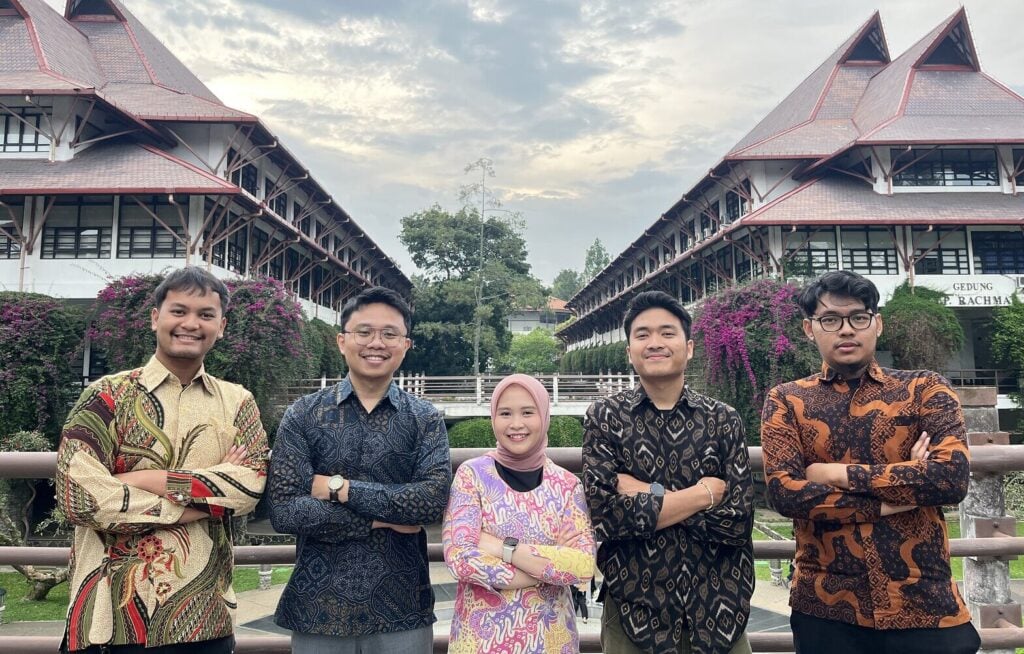
Dinda Putri Khamisa, geological engineering student from Asia Pacific Region winner Institut Teknologi Bandung from Indonesia, shared similar stories of challenges and rewards.
“The most challenging part was dealing with limited data while being expected to deliver sharp, high-impact regional analysis under a tight 10-week deadline. This constraint forced us to step up our efficiency and master the art of time management. We had to trust each other’s expertise and collaborate seamlessly to integrate diverse subsurface datasets into a solid and clear final presentation,” she said.
“The most rewarding part was the moment of breakthrough, seeing months of late-night data interpretation finally come together into a high-confidence exploration prospect. Watching our team learn to work so well together, where everyone’s technical insights complemented one another, was incredibly fulfilling. Furthermore, successfully defending our concepts helped us grow a lot professionally. It proved that we are capable of conducting industry-standard basin analysis on a global stage.”
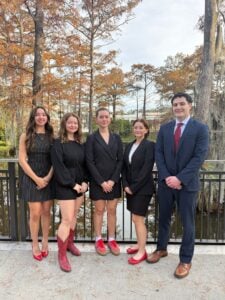
Breakthrough moments were a highlight for Amadeo Suazo, member of the University of Louisiana at Lafayette team, which placed first in the United States and Canada Region competition.
“The most rewarding part for me was having those ‘a-ha’ moments,” he said. “Everyone learned a lot, but when our ideas snowballed and everything started to make sense, those were truly special moments.”
Suazo decided to participate in IBA after finishing his undergraduate degree in geology at the University of Kansas.
“I started out as a mudlogger, so I always wanted to learn all the steps in the exploration process before a well is drilled. I saw the end result, but I wanted to understand all the thoughts and processes that led up to that point,” he said.
Maintaining a Tradition
Gergõ Glavanov, member of the European Region winning team, Eötvös Loránd University in Hungary, said participating in the IBA has been one of the best decisions of his university studies so far.
“I would strongly encourage every geoscience student to take part, regardless of where they study in the world,” he said. “The competition provides invaluable professional experience, develops both technical and teamwork skills, and offers unique networking opportunities.”
Glavanov found inspiration in Eötvös Loránd University teams who qualified for IBA Finals in 2017 and 2024.
“As a first-year university student, I found these achievements highly inspiring. They motivated me to challenge myself and participate in the competition this year as a master’s student,” he said.
Reaching the global finals was a dream come true for Glavanov and a significant accomplishment for the university who competed with a geothermal dataset.
“We received positive feedback and congratulations from our mentors, university professors, former IBA teams, participants, and professionals from the Hungarian geothermal and O&G sector,” he said. “This recognition made all the hard work and dedication throughout the competition feel truly worthwhile.”
The Post-COVID Comeback
Donohue shared how the in-person finals in Houston represents a victory not only for teams, but also for AAPG’s IBA program, which has faced a series of challenges over the past few years.
“Like much of the geoscience sector, the IBA program experienced a significant inflection point during the COVID-19 pandemic,” Donohue said.
“Competitions shifted online, and industry consolidation reduced financial sponsorship. At the same time, student participation declined as hiring slowed and research funding for university programs tightened. Despite these challenges, the program endured – largely due to the commitment of volunteers who recognized its lasting impact on generations of geoscientists now working across the industry.”
The Committee receives support from volunteers like Michael Lis, data scientist at SLB, who competed in the IBA competition during graduate school when he represented the University of South Carolina.
“Our team placed third in our division, and it was an exciting experience that allowed me to connect with students from around the region and universities,” he said. “More recently, I had the opportunity to support the IBA competition from the industry side as a judge and as part of SLB’s involvement as a technology sponsor.”
Jonathan Membreno, geophysicist at Oxy and former participant, credits IBA with shaping his career.
“From both my own experience and now as someone involved in recruiting, I can say it’s often one of the first things I look for on a resume. For me personally, it played a key role in helping me land my first professional opportunity.”
Now Membreno serves as the IBA Committee’s petroleum dataset coordinator and is responsible for preparing and distributing the datasets used by university teams.
“The IBA is important because it serves as a bridge for students who may not yet have industry experience. It gives them a chance to work with real petroleum systems and develop practical skills that mirror what geoscientists do day-to-day. It helps turn theoretical knowledge into applied experience,” he said.
Return to In-Person
Donohue recognized volunteers for working to revitalize the program by updating technical content, rebuilding sponsorship, and increasing student engagement, all with the goal of returning to in-person competitions.
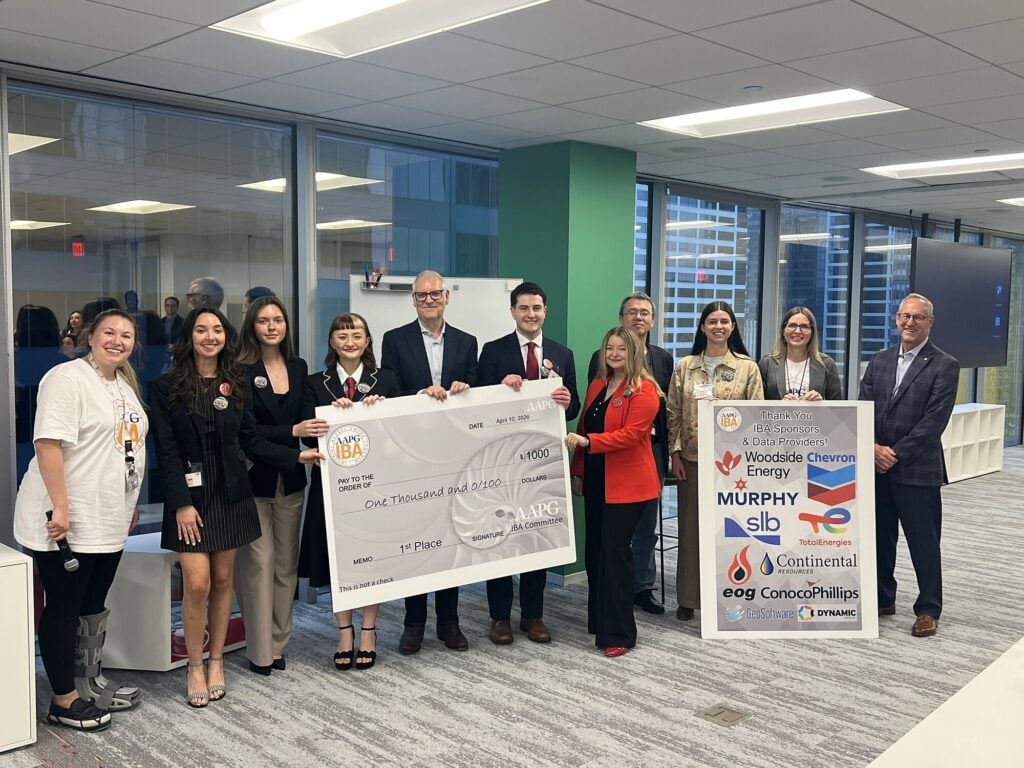
“A major milestone was reached on April 10, when the North America region hosted its first in-person competition since 2019. Participation doubled, with the number of teams increasing from seven to fourteen – an encouraging sign of renewed momentum,” she said.
The Africa, Asia Pacific, Europe and Latin America and Caribbean semifinals took place online. The Middle East Region, which traditionally has sufficient funding for in-person competition, was forced to move the competition online as well due to regional conflict.
Donahue admired the Middle East Region’s resilience.
“Even so, seven universities competed, maintaining the high technical standards for which the region is known. Their continued engagement underscores the global commitment to the IBA program, even under challenging circumstances.”
Donohue said IBA’s progress is the direct result of sustained volunteer effort and strong support from AAPG leadership.
Presidential Priority
Brian Horn, AAPG president from 2025-26, made support for IBA a key focus during his term in office.
“Given the membership decline over the past 10 years and the loss of many geoscientists from the industry, I felt it was important to get back to encouraging college students to be part of the industry,” he said. “Not all of us majored in geology thinking we would become petroleum geologists, but I have had many recruiters tell me they wanted to hire the best geoscientists.”
During his presidency, Horn visited college campuses and talked about AAPG and careers in geoscience focused on energy.
“Given all the new challenges for energy, critical minerals and the increasing demand for energy, I wanted to attract students into a program that will give them an example of what this profession is like,” he said. “The IBA is AAPG’s capstone program and provides a real-life exercise in what working in the energy business is like.”
Donohue said support from elected and staff leadership is critical to the program’s success.
“While many AAPG initiatives operate independently, the success of the IBA depends on alignment with and support from the organization’s Executive Committee. With this backing, total team registration has grown from 70 to 82 in the current season,” she said.
Global Finals in Houston
For Donohue, the high-point moment for the 2026 competition is the first in-person Global Final since the pandemic.
The competition will be held at Murphy Oil Corporation on Aug. 17, the first day of the International Meeting for Applied Geoscience and Energy.
The global competition is funded by global sponsorships from Murphy Oil Corporation, Chevron Corporation, Total Energies, and Woodside Energy and in part by regional sponsorships from Aramco, Petroleum Development Oman, Kuwait Oil Company, ConocoPhillips, Continental Resources and EOG.
Donahoe thanked corporate sponsors for making the competition possible.
“We are deeply grateful to our sponsors for the financial support of the 2026 competition,” she said. “This sponsorship represents a direct investment in the future of our global energy sector.”
Corporate sponsorship covers scholarship awards, student airfare, lodging, visa fees for the final taking place Aug. 17-20, as well as other networking opportunities offered by the IBA.
If teams are unable to get visa approvals to travel to the United States they will be able to compete virtually.
Winning teams also receive monetary prizes to support programs at their universities, with the highest monetary award of $10,000 going to the winner of the Global Final.
Horn thanked sponsors for supporting the 2026 competition and encouraged them to continue investing in IBA.
“I believe the participants in this competition are representative of the future workforce of our industry,” he said. “We hope companies will embrace IBA competition and give their staff time to be mentors and engage with the teams as well as financial or technical support. It is a great recruiting tool, and current staff can engage work with potential new hires and observe how they work in a team environment and solve problems. This is a skill that everyone needs in our industry.”
To learn more about IBA or to support the competition with sponsorship, a dataset donation or mentorship, visit IBA.AAPG.org.