

Fall is in the air, leaves are piling up on the patio and gardening season is waning. With the changing of the season’s, it’s natural to think of cycles. Thinking of the beauty of layered strata – like that of Arches National Park, for example, my thoughts go to the cycles all around us, and then, to Milutin Milankovitch.
Milankovitch was a Serbian mathematician and a prominent civil engineer who built dams, bridges and viaducts and specialized in reinforced concrete. From 1904 to 1908, Milankovitch published his doctoral thesis and other papers about concrete construction. In 1909 he went on to the University of Belgrade’s Department of Applied Mathematics and began his research into classical and celestial mechanics and theoretical physics.
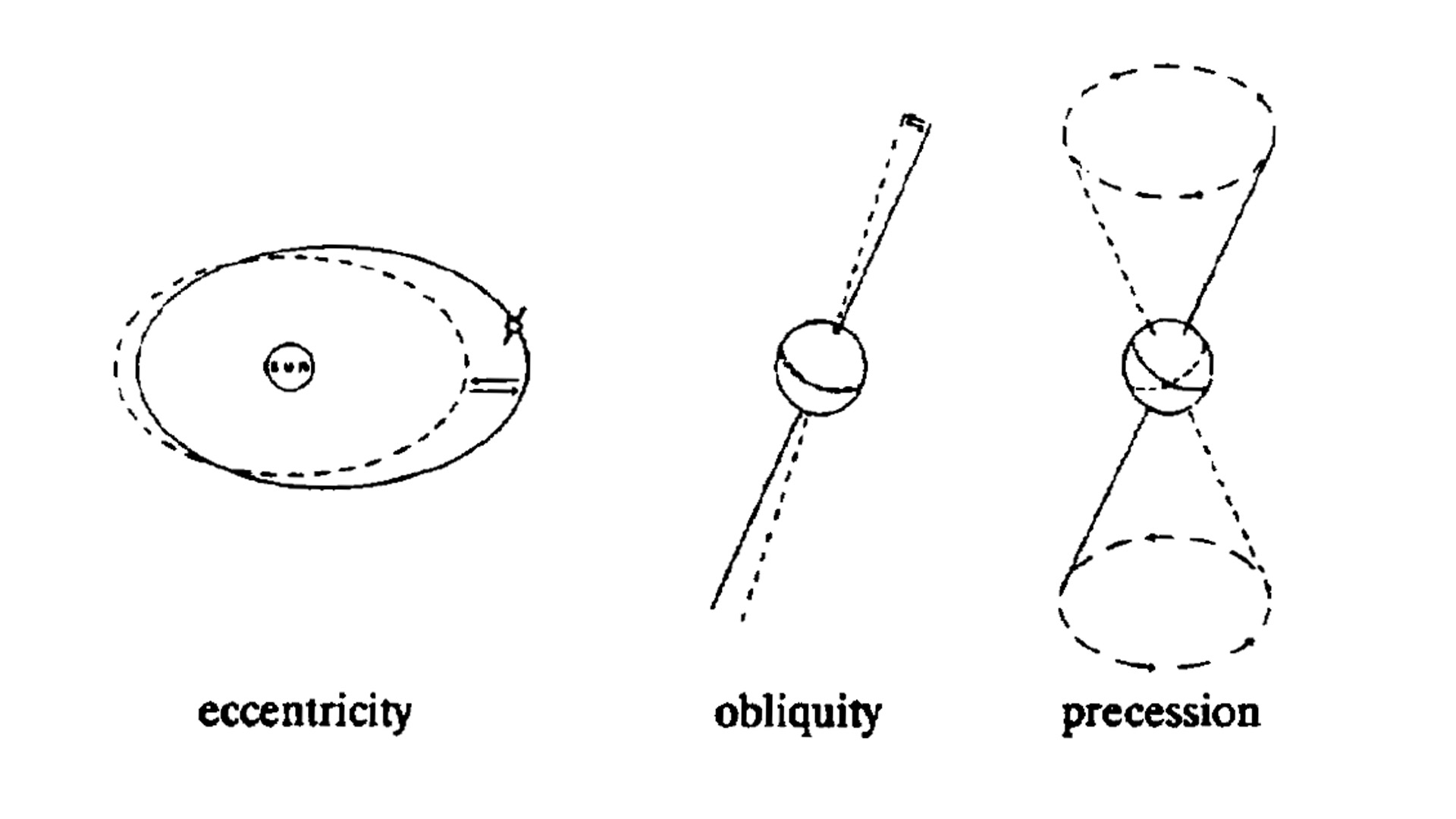
Even while imprisoned during World War I, he continued to add to and fine-tune his work using a slide rule and hand-written calculations. He determined the Earth’s precession index, obliquity and eccentricity, all with the intention of understanding the insolation of the sun’s energy on Earth and the atmosphere. His astronomical theory of glaciation is the fundamental framework utilized by scientists today.
A full text search of the Datapages Archives yields 1,210 documents that mention “Milankovitch,” 242 documents that mention “climatic forcing,” 959 documents that mention “paleoclimatology,” and much more.
Milankovitch’s Theory
Milankovitch wanted to chart the Pleistocene glaciations and understand the advance and retreat of the ice sheets over time. Milankovitch’s 1941 calculations incorporate the following:
- Eccentricity: The cycle governed by the shape of the Earth’s orbit, measuring how much it deviates from a perfect circle, with periods that range from 0.1, 0.4, 1.3, 2.0 and 3.5 million years. The Earth receives more solar radiation at perihelion than at aphelion. Today the northern hemisphere has aphelial summers and perihelial winters causing little seasonality, while it is the opposite for the southern hemisphere, with the maximum seasonality.
- Obliquity: The cycle related to the tilt of the Earth’s axis with respect to the orbital plane, which varies between 22.1 and 24.5 degrees. The average period for the change in the tilt of the Earth’s axis is 41 thousand years, but this has slowed with the decreasing spin-rate of the Earth. A greater axial tilt yields more extreme seasons.
- Precession: The cycle associated with the wobble of the Earth’s axis, due to gravitational forces of the sun and moon on the Earth’s equatorial bulge. The range of precession periodicities is 19,000 to 26,000 years, which varies due to the ellipse of the orbit.
Current Work
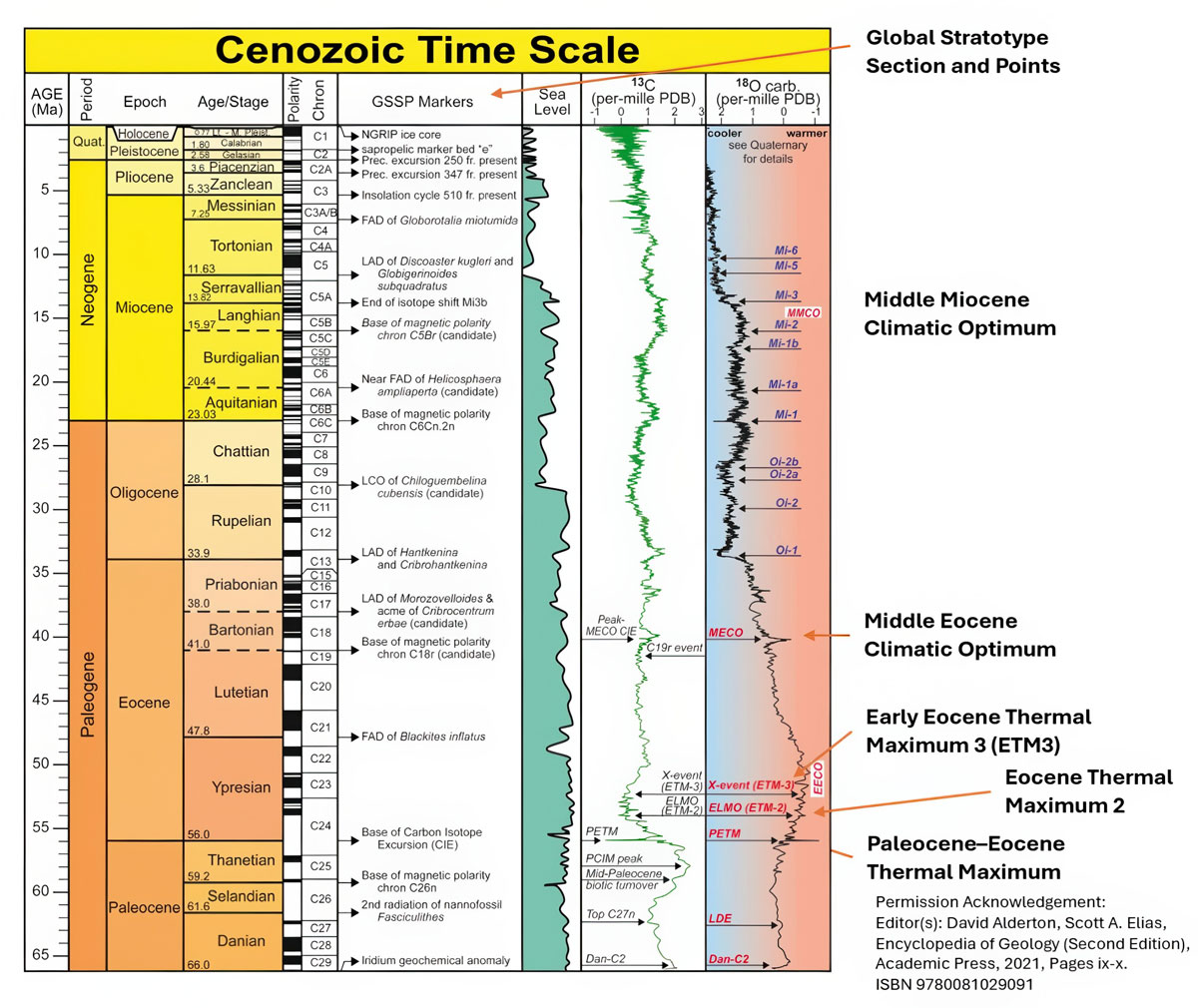
It wasn’t until after his death that his theory was accepted. In the 1960s and ‘70s, deep-sea sediment cores and ice cores solidified his theory. With combined work from scientists from various fields, almost all the Cenozoic Era (remember, Milankovitch focused on the Pleistocene Epoch) has a continuous astronomical time scale (see Cenozoic Time Scale Chart) that includes integrated magnetic, stratigraphic, biostratigraphic and geochronologic data correlated with a precise model of Earth’s astronomical parameters. The geoscience community is hard at work filling in the gaps, finding new anomalies and discovering new correlations with Milankovitch’s Theory.
I would like to send out my appreciation to all the geoscientists, stratigraphers, mathematicians, paleontologists and others who have worked lifetimes to explain the seemingly unexplainable, whose love of the discipline and rigor of the research bring the wonder to humanity’s collective knowledge. Thank you.