
Decades ago, a well-known sedimentary geologist received a large tan envelope in the mail. He opened it. Inside were several core photos and a note. The note asked, “Have you ever seen these before?”
Another equally well-known sedimentary geologist received an identical large tan envelope in the mail. He opened it. Inside he saw the same core photographs and a note that read, “Have you ever seen these before?”
The first geologist responded, “I have seen these before, and I know exactly what they are and what they represent.”
The other geologist responded, “I have not seen a lot of sedimentation units (a.k.a. “beds”) like these before, but I have some ideas on how they could be characterized.”
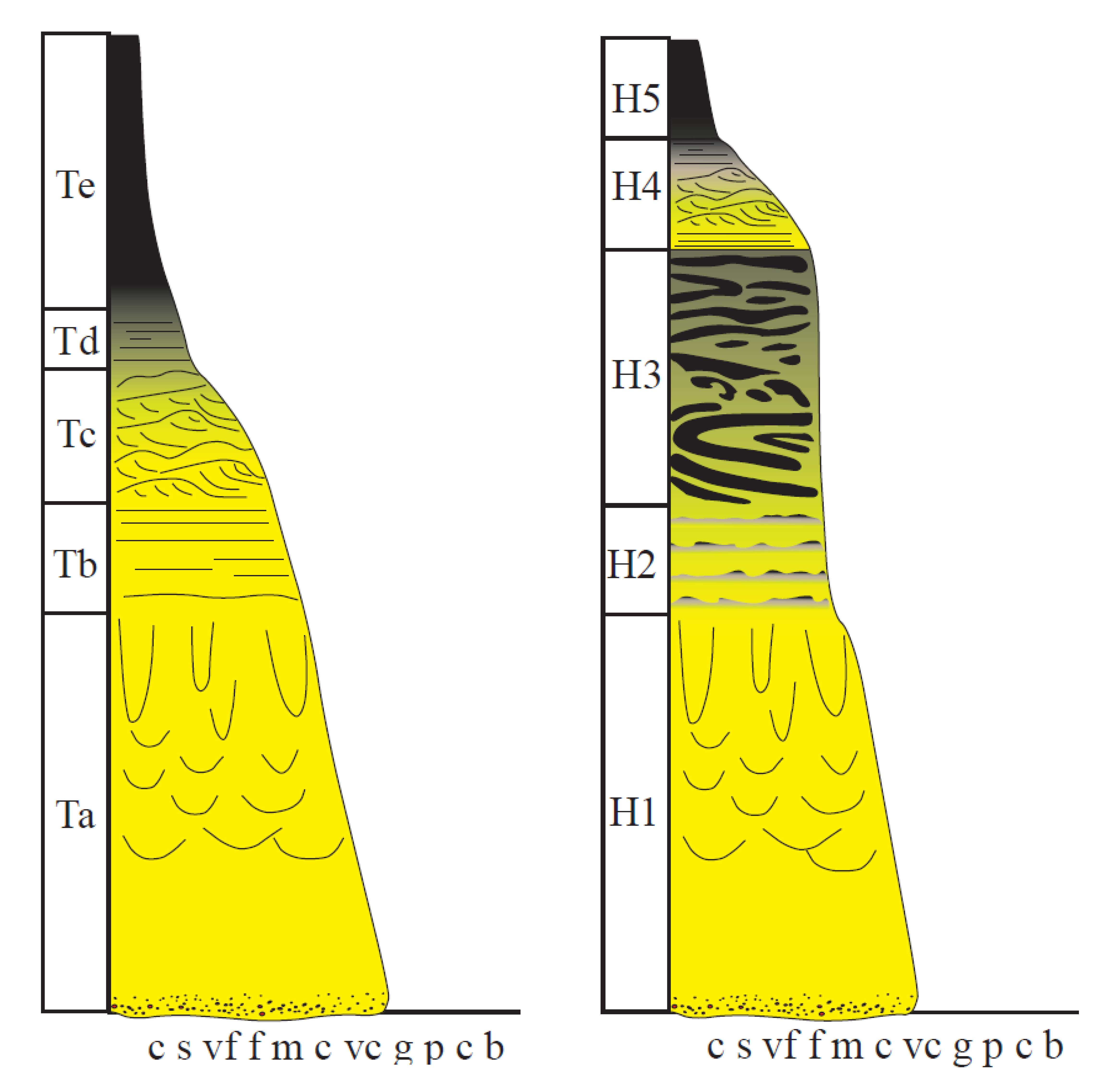
The second geologist got the gig. They resisted the urge to think dogmatically, constrained by the existing deepwater depositional models available at the time. While the core photos seemed to show beds that appeared to be somewhat like turbidites, they didn’t fit the model of Bouma or Lowe or any of the other existing depositional models. Upon further inspection by the second geologist using first principles of geoscience, the beds were something different. They had a higher clay content than most turbidites, underrecognized sedimentary structures, different internal stacking patterns, and were eventually introduced to the oil and gas industry as “slurry-flow deposits.” A complicated term. For the layman, “slurry-flow deposits” are muddy sandstone deposits. Muddy sandstone deposits represent some of the best producing reservoirs in the world if the conditions are right.
Fast-forward nearly three decades, and there are several principal depositional models for muddy sandstone deposited by both fluid turbulence and matrix strength. We’ve opened our eyes to their range and variability, again, to not be constrained by the existing models. Production histories show reservoirs consisting of certain types of muddy sandstone are better and more valuable than others. Whereas some of these reservoirs have near-darcy permeability in the UK North Sea and flow with ease, in the Wilcox Trend in the deepwater Gulf of America, they’re an order or two of magnitude lower permeability. And they can be OK in the Ventura Basin, California, to the Ormen Lange Field, offshore Norway. These are just a few examples.
Using the Bigger Brain to Combat Dogma
Nowadays, people aren’t sending around pictures of muddy sandstone reservoirs (so much), but clogging email inboxes with attribute images of odd bedforms extracted using PaleoScan. No location given. No depth. Just an image. Good luck with that. But it does allow us to focus our attention to the relevant seismic geomorphological details, which is nice.
“What is this?” asks the emailer regarding the apparent large bedforms in the image.
It is critical to understand the nature of these large bedforms in question because they can mean the difference between a high-quality reservoir and one that is as permeable as the Eagle Ford, Barnett, Marcellus, Duvernay, Vaca Muerta, Beetaloo … name your favorite ultra-low- perm unconventional play.
Except for the most discerning, deepwater bedforms were thought to be nearly identical in formation and geometry to those proposed in the bedform stability diagram for fluvial sedimentary systems. After all, that’s how many currently see the Bouma Sequence. That dogma has been broken. It turns out the bedform stability diagram for fluvial systems is vastly different than the stability diagram for sediment gravity flows. This was discovered by Juan Fedele’s team at the ExxonMobil lab about a decade ago and advanced by Octavio Sequeiros a few months ago. Today, bedform stability is relevant for deep- and ultra-deepwater prospecting because it allows explorers to estimate the sand fraction, for example, in various types of large bedforms based on their geometry as measured in attribute images.
Dogma is Useful, But Slow Down
Dogma is useful. It helps us make quick decisions fast based on data and experience. But as Kurt W. Rudolph explains in “The Explorer’s Mindset: Lessons in Leadership in Geoscience and the Energy Industry,” humans need to think slow:
“Kahneman wrote a popular book about ten years ago that made their work accessible. In it, he describes these two modes of thinking – fast thinking and slow thinking …
“When humans evolved … they had fast choices to make. Quick decisions. That’s what fast thinking is about. It’s efficient, fast, easy, and really takes no mental effort on your part…
“When faced with choices, we’ll often default to this real easy way of thinking. Which can be a huge pitfall in complicated situations.”
Practicing dogmatic thinking can reveal to us quickly what we think the answer is; but if we are curious enough to admit we might not know the answer right away, that is where the new ideas pop up. It is important to prioritize this space into your workflows.
Per Avseth, chief technology officer of DIG Science, describes this important step in his business:
“I really think science is a lot about being creative, and exploring the unknown. Gantt charts are needed to some degree in many projects, but Gantt charts can kill creativity. You need to be able to make detours and new directions during research projects; this is what I refer to as ‘creative space’ – which can last quite some time. Before you get to that, you need to load data, assess quality, have a feel for the data. This is the exploratory analysis. Then one should think outside the box, and be allowed to become a bit wild. And a team should brainstorm. I try to convey that to others – this mindset of the creative process. You can’t always plan to get new bright ideas, but having that space opens up the possibility for new ways of thinking about the solution.”
‘We Just Don’t Know What We Don’t Know’
Last month’s article discussed AAPG Memoir 125 “Giant Fields of the Decade: 2010-2020” by Sternbach, Merrill and Dolson. Sternbach and co-authors wrote that dogma in the exploration business was busted in five ways in the last decade: the rise in stratigraphic trap success; unconventional field development; ultra- deepwater drilling 5 to 9 kilometers below mudline; giant field discovery on oceanic crust or greatly thinned continental crust; and tilted oil-gas-water contacts.
We take these dogma-bustin’ successes as exploration gospel now, but certainly did not 10 years ago. These successes were proven though first principles of geoscience and exploration.
If you’re leading entire teams, disciplines or companies, you might say, “Yeah, it’s easy to argue against dogmatic thinking.” You’re at the top of the food chain. People listen to you, respect you, maybe even fear you. But if you’re a new graduate onboarding with a team you’ve never met, challenging dogma can be nearly impossible.
I remember one of my first deepwater assignments. Lots of classic plays like deepwater channel belts and lobe complexes, juxtaposed with some chaotic mass-transport fairways.
Where do these large deepwater channel belts terminate?
It appeared to me they kept going … way off the map and onto, probably, oceanic crust.
“Well, there must be a whopping pile of sand there,” I thought to myself, amused that this could lead to an interesting discussion on the merits and limitations of finding a new giant. As a young explorer, you can be cautious, insecure – you certainly don’t want people to make fun of your ideas. Sure enough, the manager said, “No further exploration downslope. No oil and gas to be found there.” Move on. I shrugged my shoulders and went back to my desk. I assumed the manager had more experience and knew “the rules” of exploration. I figured, “OK, consider this topic dropped. I’ll go back to mapping the plays ‘we know will work.’”
Which is not really exploration at all, when you think about it. What could have been an alternate outcome from this interaction with management?
Richard Chuchla’s quote from the beginning of this article concludes with this sage advice to exploration leadership:
“One of the most impactful roles a leader can have is to have the back of a subordinate standing up to dogma.”
Today, finding giant oil and gas fields on oceanic crust is not so radical. Consider Venus. Kudos to TotalEnergies and the greater team. It’s amazing what you can create/ideate when you “release the harness of dogma” – a battle cry in a recent exploration function meeting in Houston.
Per Avseth continued: “Think outside the box, because there is no box.”
This is a topic for a future post. But first, how do you embody an approach that favors open-minded thinking?
Put It into Practice
Dogmatic thinking is a problem I know too well from advising and teaching, whether it’s in a downtown Houston skyscraper or in the field at the base of Mount Cook. My fellow subject-matter experts and I are the few people in the front of the room. We’re the authority on the matter being discussed. So what’s one way to acknowledge dogma and not let it detract from the key material we are discussing that day?
As a student of geology for life, I enjoy hearing stories about how the exploration business has evolved, and how our thinking has changed about Earth. Some of those changes have happened right in front of my eyes, from the understanding of sediment gravity flow deposits, the nature of deepwater bedforms, to pushing the petroleum systems frontier onto oceanic crust in the South Atlantic. Some changes seem so obvious today, and so silly when we think about what was said years ago about the oil and gas exploration business. Here are some other quotes gathered over the last several decades (as early as the 1970s and as late as about five years ago). I like to introduce to teams, to show how we need to stay mentally awake about what we know, and if it is dogma:
“I’ll drink every drop of oil found off the Gulf of Mexico continental shelf.” ~1970
“We’ll find a North Sea-like chalk in the Paleogene Gulf of Mexico.” ~1995
“The North Slope of Alaska has no more large fields to find.” ~2010
“Dunes do not form in deepwater environments; currents aren’t capable of doing that in bathyal depths.” ~2010
“Sediment gravity flow deposits and contourites do not exist together in nature.” ~2020
And you and I could keep going on our favorite quotes that illustrate the concept of dogma in the exploration business. I hope this article encourages you to think carefully about the truths we hold so closely in exploration today.
This article is the third of the monthly articles on The Explorer’s Mindset prepared for AAPG Explorer. This column is based on the second edition of the book, “The Explorer’s Mindset: Lessons in Leadership in Applied Geoscience and the Energy Industry.” Over the next several months and 3 years, we’ll be looking at the traits of the successful explorer, their leadership qualities and what has enabled them to make game-changing discoveries.
For a complete list references for this article, contact the author at JonRotzien@ basindynamics.com.