
Petroleum and geopolitics have shaped the history of Venezuela for more than a century.
Time travel can help explain how.
Start by setting the dial back 125 years, to 1901. A group of U.S. companies is trying to control the supply of a key hydrocarbon resource:
asphalt for street and road paving. These companies, known as the Asphalt Trust, have acquired large reserves of asphalt in Trinidad, Venezuela and other countries.
Cipriano Castro, Venezuela’s president, threatens to seize his country’s major asphalt deposit. According to research published in the Journal of American History, the New York and Bermudez Co. spends $145,000 to fund a revolution against his government. But Castro ultimately prevails, a gunboat quashes the uprising and the Asphalt Trust soon collapses.
The Roosevelt Corrolary
Jump ahead to December 1904, as President Theodore Roosevelt prepares to deliver his annual message to the U.S. Congress. At this point, the situation in Venezuela has devolved into an international crisis. Great Britain, Germany and Italy impose a naval blockade. Castro agrees to set aside some of the country’s customs duties to settle European claims of debts and damages incurred in Venezuela’s recent civil wars.
Fearing these events will lead to greater European involvement in Latin America, Roosevelt proposes an expansion of U.S. influence under the Monroe Doctrine. He tells Congress:
“Chronic wrongdoing … may in America, as elsewhere, ultimately require intervention by some civilized nation, and in the Western Hemisphere the adherence of the United States to the Monroe Doctrine may force the United States, however reluctantly, in flagrant cases of such wrongdoing or impotence, to the exercise of an international police power.”
This becomes known as the Roosevelt Corollary to the Monroe Doctrine. It will not be the last time a U.S. President seeks to expand the doctrine because of Venezuela.
Birth of a Petroleum State
In 1914, Caribbean Petroleum Co. drills the Zumaque-1 well on the eastern side of Lake Maracaibo, and it makes a commercial oil discovery. Production is limited and the oil is very heavy – tarry – but the find draws increased attention to Venezuela as a potential exploration frontier, including from Royal Dutch Shell and Standard Oil.
Travel to December 1922, in the same oilfield area east of Maracaibo. A Shell subsidiary decides to deepen an abandoned shallow well, the Los Barrosos-2. The drilling crew encounters a productive oil sand below 1,450 feet, and the well soon flows at a rate around 2,000 barrels a day, a gratifying output.
It does not stop. The flow increases, then explodes, sending a plume of thick oil 200 feet into the air. A Shell geologist later estimates production from the blowout gusher at 100,000 barrels/day. And from that moment on, Venezuela becomes a petroleum state, its economy tied to exporting heavy crude.
“In the 1920s, when that started, it changed the whole area – not just Venezuela, but the whole region around Venezuela,” said Andres Tremante of Florida International University.
People in the region “saw Venezuela as a good opportunity. A lot of people came to Venezuela to work there,” he said.
Tremante, a native of Venezuela, is a teaching professor of mechanical and materials engineering at FIU. He serves as senior director of the school’s Center for Development, Support, and Success in Engineering and Computing, and of its Engineering Industry-Innovation Ecosystem program.
Glide past the Great Depression years, when the oil price drops below 25 cents per barrel. By the 1930s, Venezuela emerges as the world’s largest oil exporter and its third largest producer. But Shell, Standard Oil and Gulf control most of the country’s oil operations and production.
A School of Oil
Turn the time dial to 1943. Venezuela introduces a new Hydrocarbons Law that establishes a higher, uniform royalty rate and mandates 40-year concession reversions to the state, setting the stage for 50-50 profit sharing with the oil companies. As World War II increases global demand for petroleum, Venezuelan crude production nears 1 million barrels per day.
“Venezuela was a school about the oil business. Venezuela was where Europeans and Americans were both there working in the oil business,” observed Tremante, who began his career as a research scientist in oil and gas before entering academia.
The sides brought differing views: “For instance, the U.S. was more about volume, and the Europeans were more about price.
“Venezuela was always a good opportunity to merge those two philosophies,” he said.
Birth of a Cartel
It’s the year 1960, and Juan Pablo Perez Alfonso is about to realize a longtime dream. Perez Alfonso, a leading Venezuelan politician, serves as the country’s minister of mines and hydrocarbons. For years, he has been trying to broker an agreement among the world’s largest crude oil producers.
His efforts get a boost when the Soviet Union begins cutting its crude export prices to gain market share, and major oil companies respond with price cuts of their own. Also, U.S. President Dwight Eisenhower has just restricted American oil imports, with special exceptions for Mexican and Canadian crude.
Together with Saudi oil minister Abdullah Tariki, Perez Alfonso convinces Saudi Arabia, Iraq, Iran. and Kuwait to join Venezuela in an Organization of Petroleum Exporting Countries, to protect the interests of oil exporters. Known as OPEC, the organization will add more members and have a significant influence on world energy for more than 65 years.
Perez Alfonso becomes celebrated as the leading architect of OPEC’s creation, the “Father of OPEC.” In the future, people will think of the cartel as a Middle Eastern institution, forgetting its Venezuelan origins.
“The biggest wave” of oil expansion and people entering the industry “was between the 1960s and 1970s, when because of the oil price Venezuela was expanding its economy and growing,” Tremante said.
“It was a huge window for everyone to invest,” he noted.
The World’s Largest Oil Reserves
New Year’s Day, 1976. Venezuela nationalizes its oil industry under President Carlos Andrés Pérez and creates state- owned company Petróleos de Venezuela S.A. (PDVSA). The country prospers as oil prices spike, largely because of events in the Middle East, including the Yom Kippur War, the resulting Oil Crisis and the Iranian Revolution.
But the 1980s bring a global oil glut and a price collapse. Venezuela’s crude production, which had passed 3.4 million barrels/day in 1971, falls by half. Because of nationalization and the low oil price, investors are wary and some foreign oil companies abandon the country.
A quick visit to 1983. Oil discoveries just south of the Orinoco River began in the 1930s. Highly viscous and often laced with impurities, the Orinoco region’s oil is low grade and difficult to produce. But there’s a whole lot of it.
An official assessment effort this year will put the Orinoco Oil Belt’s oil in place at more than 1 trillion barrels. Later evaluations project total recoverable heavy crude at 500 billion to 650 billion barrels. The world begins to realize that Venezuela holds the planet’s largest oil reserves.
Devastating Decline
Next stop, December 2002. A general strike and work stoppage envelops Venezuela, aimed at toppling President Hugo Chavez, or at least forcing new elections. Business and labor coalitions support the strike; PDVSA’s leaders back the Chavez opposition. PDVSA management walks out, and so do thousands of oil workers.
Within two months, businesses begin to reopen under economic pressure. Chavez retains his power. He replaces PDVSA top management and ultimately fires 18,000- 20,000 PDVSA employees. Loyalists take control as the company is restructured. Chavez begins diverting large amounts of oil receipts from reinvestment to social programs.
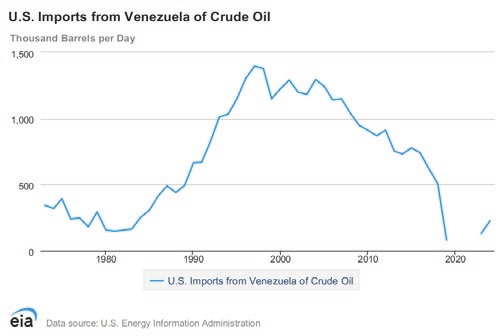
Venezuela’s oil production climbs back to surpass the 3 million barrels a day in the late 1990s. U.S. imports of Venezuela’s heavy crude reach 1.4 million bpd. Then in 2006-07, Chavez moves to take control of joint energy ventures and to seize the assets of non- complying foreign oil companies, including those of ExxonMobil and ConocoPhillips, which leave the country.
A devastating 13-year production decline sets in, under the last years of Chavez and the presidency of Nicolas Maduro. The reason is, really, “All of the above.” Economic sanctions, underinvestment, infrastructure and equipment failure, mismanagement, corrupt governance, a global oil-price collapse, a worldwide pandemic – all contribute to the decline.
By the low point in 2020, Venezuelan production dips below 500,000 barrels per day.
‘A Major Change Has Happened’
In January 2026, a U.S. military incursion removes Maduro from power. Tremante is astounded, “because I thought it would never happen. It would never, never, ever happen. Then, it happened.” He feels encouraged by recent talks between the U.S. and Venezuela, and the preliminary efforts to revitalize Venezuelan production.
“The challenge of that happening may be the new window that is opening. We have new boundaries on the situation now. No matter how you change the boundaries, you always have room to invest,” Tremante said.
“I think a major change has happened. And I understand from the new actors that the vector is pointing toward strictly business,” he observed.
When there is a great deal of money to be made, Tremante has noticed, countries and companies and individuals will figure out a way to make it.
“I apologize for being so practical,” he said.